


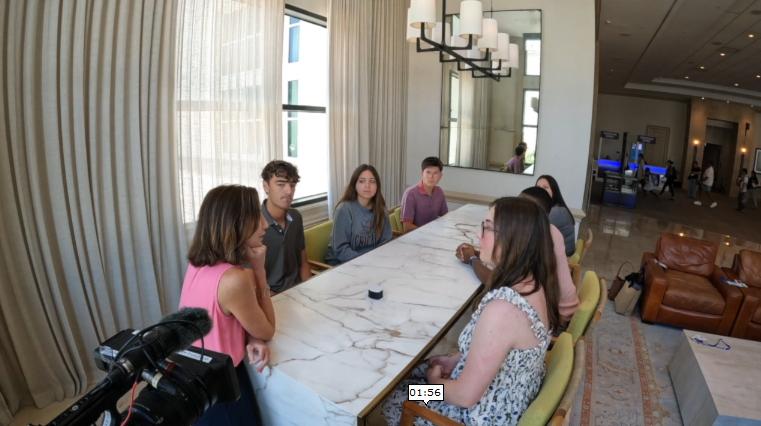


ORLANDO, Fla. — Teens from anti-drug coalitions across the country joined grieving parents and federal law enforcement at a Florida summit this week, united by a shared mission: stopping fentanyl before it kills more Americans.
The Fentanyl Free America Summit in Orlando drew an unexpected but powerful group of attendees — students who traveled from around the country to learn about the resurgence of fentanyl so they can return home with a message about one of the country's deadliest drug threats.
Watch report from Katie LaGrone
"Why the heck are you guys at a fentanyl summit in Florida?" Investigative Reporter Katie LaGrone asked a group of teen attendees.
Hannah Kahn, an 18-year-old attendee, explained what brought her there.
"I have a relative who is addicted to methamphetamine and just seeing how that has destroyed his life has like encouraged me to prevent that from anybody else," Kahn said.
The students are members of their community anti-drug coalitions. They came with questions — and answers — about how fentanyl spreads and why young people may not recognize the danger.
"I feel like it's not known because a lot of times it's just laced. People aren't seeking out fentanyl necessarily. It is just within other drugs," Khan said.
The teens also had pointed advice for adults on how to talk to young people about drugs.
Jasmine Figueroa, a 19-year-old attendee, said, "It is not a taboo topic. Tell them what cocaine is. Tell them what LSD is. Tell them what acid is. They're going to get educated one way or another. You might as well be the first one to educate them and tell them the truth about how things are."
This year's summit welcomed a powerful new partner: the U.S. Drug Enforcement Administration. DEA Administrator Terrance Cole spent time with victim families and sat down with LaGrone to talk about the ongoing threat.
"This poison is being manufactured and distributed out of Mexico by the Mexican cartels," Cole said.
When asked what is being done differently to combat the problem today, Cole pointed to new tools from the current administration.
"Well, the president has given us different tools. He's designated them [Mexican cartels] as foreign terrorists, which opens different avenues for us to target," Cole said.
For parents who have lost children, the summit is deeply personal. Mari Rodriguez’s daughter, Imam, died of fentanyl poisoning in 2023. Rodriguez described the moment that changed her life.
"She made the mistake of buying a Percocet pill that had fentanyl in it, and it took her life," Rodriguez said.
The grief, she explained, is relentless.
"Every day I have to live with what I didn't know. What did I miss? Why wasn't I stronger? Why did I give her some space?" Rodriguez said through tears.
Rodriguez said the fight against fentanyl in the U.S should have started long ago.
Rodriguez said, "They're killing our children, our youth, our future. We should have been working on this since 2009, when the first fentanyl was found on our streets, because these monsters are not stopping. They're not stopping."
As part of her ongoing investigation into the resurgence of fentanyl in Florida, LaGrone has spoken with families impacted by the drug and recently reported from inside the DEA's busiest drug lab, where agents described the potency of what they're finding.
"This turned out to be 16% fentanyl, that’s high," a DEA chemist told the I-Team investigator.
LaGrone has also reported on misleading claims about America’s ongoing fight against fentanyl. While deaths from the synthetic opioid are down, tracking how widespread fentanyl has become is nearly impossible — in part because of Narcan, an over-the-counter nasal spray that is increasing survival rates.
For the teens at the summit, prevention comes down to open conversation and making Narcan as common as any household product.
"I think a lot of people have that stereotype of like Narcan is only for responders and EMS. But we have to think about it as a household product, just like talking about Benadryl," Khan said.
Share Your Story with Katie
Katie LaGrone focuses on making sure Florida’s laws actually work and her investigations have gotten results. If you know of a policy or law that’s not working how it’s intended, send Katie a message below.
.

Pasco County mom of 5 takes in 3 children left without food or power whose mother faces neglect charges
Jasmine Young, a mother of 5, opened her home to three neglected girls as their mother faces child neglect charges for leaving them without food, power or water.