

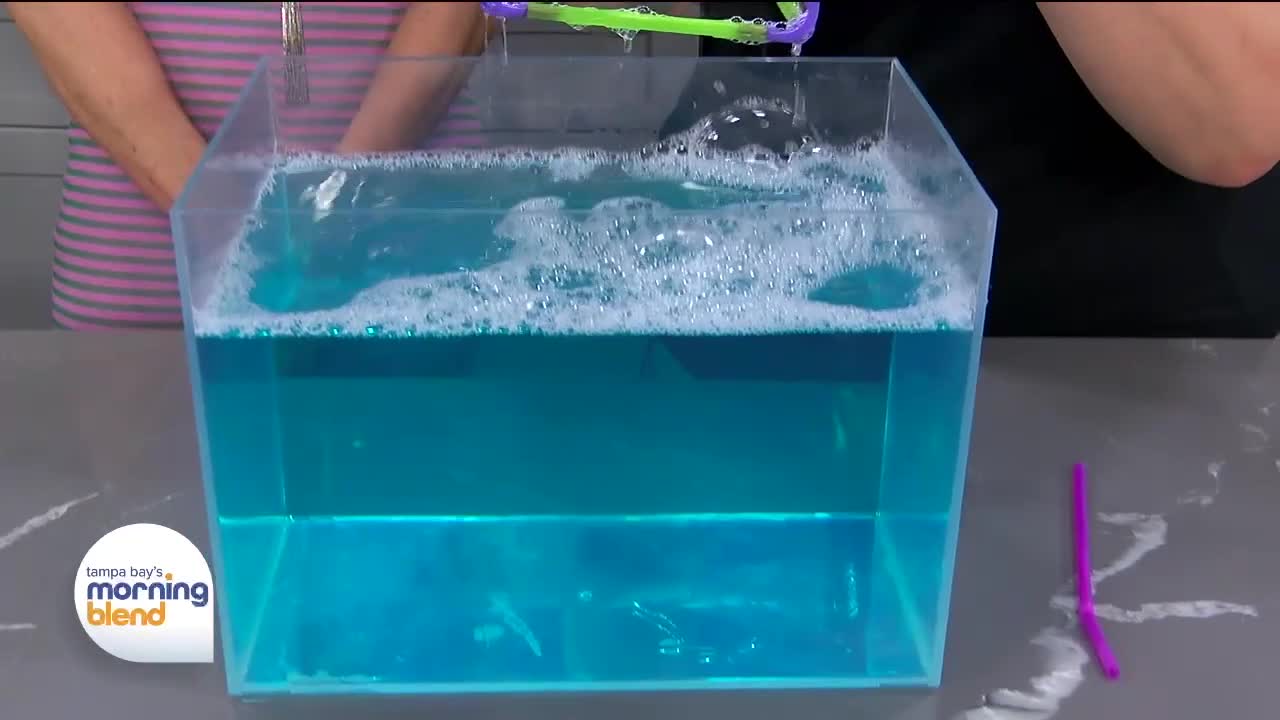

Water has a stretchy “skin:" Water molecules stick together. Each water molecule has a tiny positive end and a tiny negative end. Opposite charges attract, just like magnets. So the positive end of one water molecule is pulled toward the negative end of another, creating surface tension. That’s what lets a thin layer of water stretch into a bubble instead of popping right away.
Soap makes bubbles strong: Soap loosens that tight surface just enough to make the bubble flexible. It helps trap air inside so you can blow big, long-lasting bubbles.
Shaped bubbles: Bubbles want to be round. Surface tension always pulls evenly in all directions, which makes bubbles form spheres. The square frame guides the shape. When you dip a cube frame into the bubble mix, a thin film forms along the square edges. The frame holds the straight sides in place, while the bubble still gently curves because it naturally wants to be round.
For more information and to learn about summer camps, visit mosi.org
