

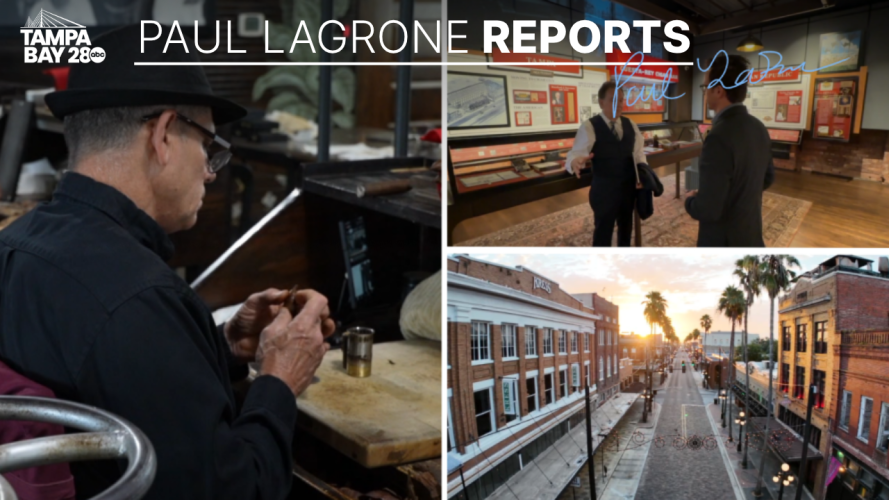


TAMPA, Fla. — As the nation marks 250 years of history, we’re looking back at the roots of our own.
Here in Tampa, so much of that story begins on the brick streets and the smoke-filled factories in Ybor City.
WATCH: America 250: Legacy, roots, culture that built Tampa’s Ybor City
In the late 1800s, a cigar maker named Vicente Martinez Ybor came to Tampa by way of Cuba and Key West, bringing with him a vision that quickly grew into an industry. Partnering with Ignacio Haya they didn’t just build cigar factories; they built a city. It became a place where immigrants from Cuba, Italy, Spain, Germany, and Jewish families from Europe came chasing the same idea, “Opportunity.”
“That’s part of the history of Tampa,” said Victor DiMaio.
DiMaio is the president of the Hillsborough Democratic Hispanic Caucus. He not only grew up here, but his grandparents were also part of the original families who worked in the cigar industry.
“None of us would be here today if it wasn't for those people back 100, 150 years ago, you know, they all came here as immigrants for a better life,” said DiMaio.
At its peak, Tampa wasn’t just making cigars, it was leading the world. Hundreds of factories, thousands of workers, entire families turning tobacco into survival. Some worked in factories, others at home.
“Including my grandmother, who they would get half a dozen people together at the kitchen table, buy tobacco from some guy who would sell it to them, and they would make, Um, and it was called a Buckeye. In English it's called a Buckeye, and my mother Mercedes had her own little label, and my grandmother would sell cigars. It was a super popular thing to do right from home,” said DiMaio.
“Right from home, like completely homemade cigar,” said LaGrone.
That history is still alive inside the J.C. Newman Cigar Factory. A place where stepping into the elevator feels like stepping into another century.
“Now they would store a lot of the tobacco in the basement because it was cooler,” explained DiMaio.
Upstairs, the place hasn’t changed much in 100 years. Hands still roll cigars, one at a time. In fact, the week we came was the 140th anniversary of the first cigar ever rolled in Tampa in 1886.
“The reason we're here is because of the cigar workers that you are sitting behind us today. It's the last largest cigar working cigar factory in the whole United States. It's still alive and it's still, you know, done worldwide, but we're still the king right now,” explained DiMaio.
Inside the factories, workers prepared the leaves and they had a name that still gets a laugh today.
“There were thousands of workers that used to strip the vine. I have a lot of friends I grew up with who say, 'Yes, my grandmother was a stripper, and we don't mean Mons Venus,' we mean they were an integral part of the cigar making industry that employed hundreds of thousands of Cubans back in the day,” said DiMaio.
Today, Ybor City is one of Tampa’s most visited destinations with nightlife, restaurants, unmistakable character. But beneath the music and neon is the foundation as solid as the bricks, immigrant families who took a chance on themselves and a risk on a city that didn’t exist yet.
“My grandparents came here from Cuba to make cigars. I mean that was, that was, they came here as immigrants. I know immigration is kind of a bad word nowadays, sadly, but the fact is, you know, Tampa was a little sleepy town of a few 100 people until Mr. Ybor from Ybor City brought his cigar factory and left Havana for Key West,” said DiMaio.
America’s story stretches back 250 years. Tampa’s story didn’t start that long ago, built by the hands of immigrants and still rising in the smoke today.
Share Your Story with Paul

Tampa Bay 28 Anchor Paul LaGrone grew up in Plant City, so he’s seen firsthand how that part of Hillsborough County has changed over the years. As Tampa Bay 28’s leading political anchor he knows state and local politics impact decisions we make at home. Paul wants to hear how state policies impact you. Just use the form below to send him a message.
.
Bradenton community responds after 20-year-old volleyball star dies from disease that affects 2 in a million
The 20-year-old IMG Academy volleyball star and Under Armour All-American died Sept. 16 after a three-month battle with the rare blood disorder — even though doctors had found her a 100% bone marrow match, her mother, Tanya Mack tells Tampa Bay 28 reporter Haley Zarcone.
