




FLORIDA —
“You don’t know what you’re taking out there”
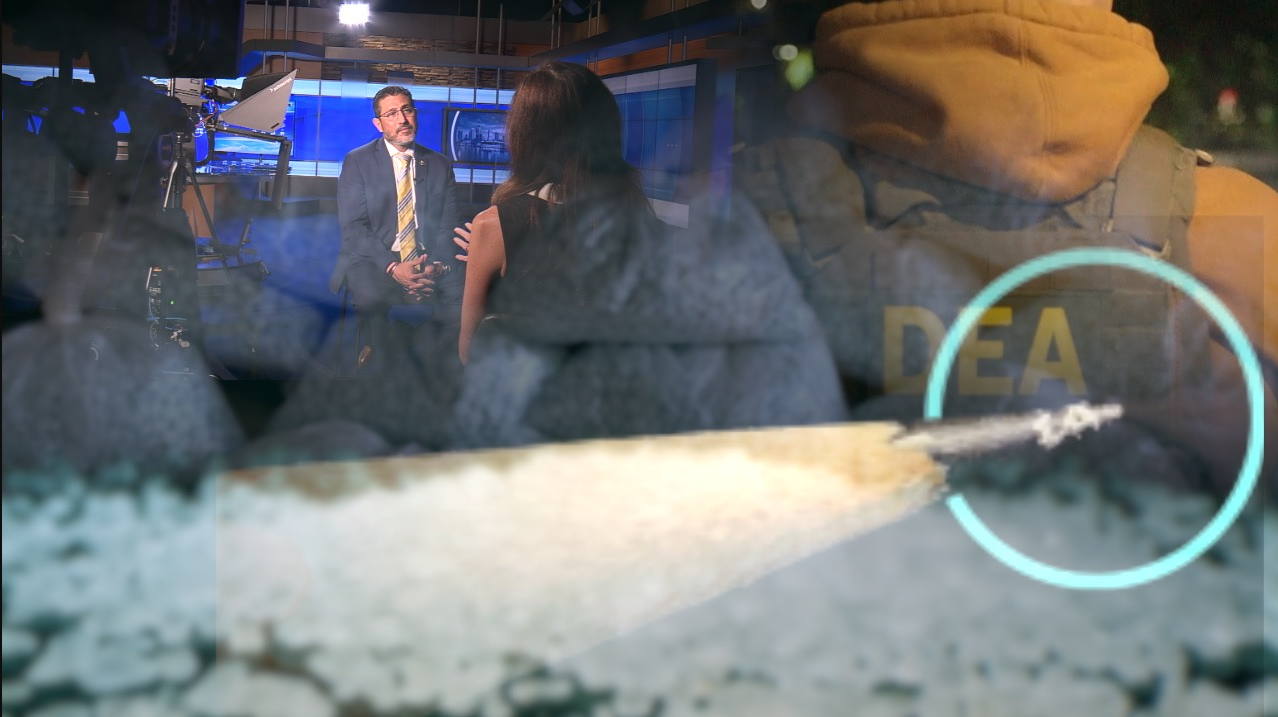
Carfentanil, a synthetic opioid so potent that a dose smaller than a grain of salt can kill a human, is surging back into Florida's drug supply — and federal drug enforcement officials say it is now their top priority.
Daniel Escobar, special agent in charge of the DEA's newly formed Tampa Field Division, sat down exclusively with Investigative Reporter Katie LaGrone to warn the public about the chemical's return and the growing threat it poses.
Watch full report from Katie LaGrone
"You don't know what you're taking out there. It's super dangerous," Escobar said.
Carfentanil is used as a tranquilizer for large animals like elephants. It is estimated to be 100 times stronger than fentanyl and 10,000 times more potent than morphine — and it has no approved human use.

"Not at all," Escobar said when asked whether there is any human use for carfentanil.
How carfentanil made a comeback
The DEA says Mexican drug cartels began using carfentanil to produce stronger, more potent versions of fentanyl and other opioids — including heroin, cocaine and meth — after the Chinese government banned the precursor chemicals used to make fentanyl. Escobar said interrupting the supply of carfentanil in the U.S. is now among the federal agency’s top priorities.
"It's the highest levels. Anything that has to do with like fentanyl or carfentanil, or any of these, because they're killing Americans," Escobar said.
The drug is not new. Carfentanil has been on the DEA's radar for more than a decade, with major outbreaks in 2016 and 2017 that killed more than 1,000 people in Florida alone. Its return began drawing the DEA's attention two years ago, when a number of seized drugs tested positive for the substance. A year later, that number tripled — and this year, Escobar said they are on track to find even more.
"These are just homemade labs in Mexico. There's no rhyme or reason to how much they put in or how much they don't put in. So that's the dangerous part about it," Escobar said.
The “one and you’re done” drug
Dr. Bruce Goldberger is a clinical professor at the University of Florida. He also tracks drug trends and drug-related deaths in Florida, and co-authored a report on carfentanil's return to the state. The report states that while "evidence of a new state-level outbreak is inconclusive…monthly deaths…have reached concerning new levels." It cites 93 carfentanil deaths between 2018 and 2023, and 56 deaths in 2024 alone.
"We have seen a reappearance of this substance and the decedent population," Goldberger said.
While drug trackers are reporting fewer fentanyl deaths, researchers have found that the decrease correlates to an increase in carfentanil deaths.
The danger extends beyond what users knowingly consume. Escobar says the drug can be one and done for a person.
"Absolutely. There's no more experimenting with drugs. In the 70s and 80s, you know, you tried marijuana, you tried something else — you got away with it, right? Nowadays, if you take the wrong drug that you don't know anything about, they're automatic, they're killers," Escobar said.
The DEA is now working to get federal legislation on the books banning compounds found in carfentanil. In the meantime, Escobar is urging parents to monitor their children's social media activity.
"Look to see what your kids are playing on the Snapchats, all the different social media apps, because you can get drugs delivered right to your house, and it could have a deadly dose of fentanyl or carfentanil," Escobar said.
When asked whether drugs are that accessible, Escobar said simply: "Absolutely."
Share Your Story with Katie
Katie LaGrone focuses on making sure Florida’s laws actually work and her investigations have gotten results. If you know of a policy or law that’s not working how it’s intended, send Katie a message below.
.
Bradenton community responds after 20-year-old volleyball star dies from disease that affects 2 in a million
The 20-year-old IMG Academy volleyball star and Under Armour All-American died Sept. 16 after a three-month battle with the rare blood disorder — even though doctors had found her a 100% bone marrow match, her mother, Tanya Mack tells Tampa Bay 28 reporter Haley Zarcone.