


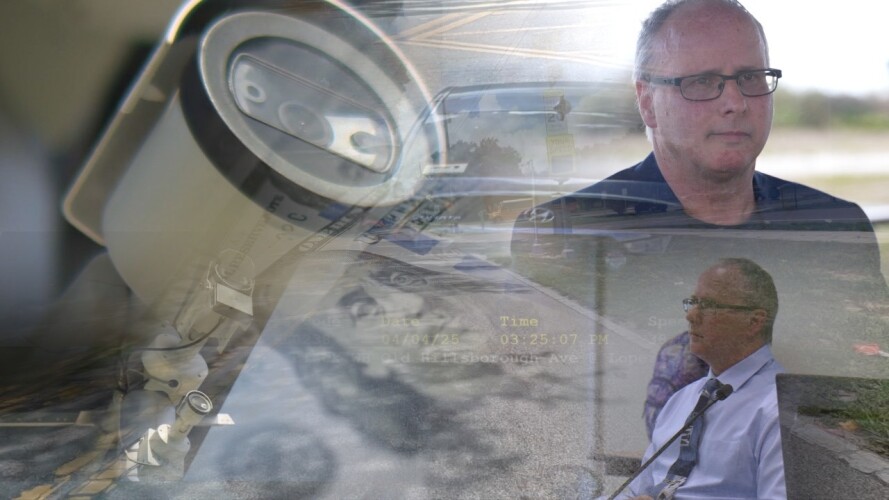


HILLSBOROUGH COUNTY, Fla. — A Hillsborough County magistrate who spent months ruling on school speed zone camera cases is now blowing the whistle on Florida's controversial new camera program. He says it is set up for drivers to fail and that county and law enforcement officials have ignored repeated warnings about its problems.
Dr. Tom Santarlas, appointed by the county as the sole impartial officer to hear driver appeals, ruled on hundreds of cases since July before being reassigned in what he believes was retaliation for dismissing nearly every violation that came before him in December.
Watch report from Katie LaGrone
"It's a broken system. There's no doubt about it," Santarlas recently told Investigative Reporter Katie LaGrone.
Santarlas sat down for his first on-camera interview to detail why he believes the video devices, intended to protect students and others near campus, are instead being used to unfairly take money from drivers.
"Do you feel like the school speed zone camera program is set up for drivers to fail?" LaGrone asked.
"Absolutely," Santarlas said.
WEB EXTRA: Full interview with Katie LaGrone
In Hillsborough County alone, more than 105,000 violations have been issued since the fall of 2024, resulting in more than $6 million in paid fines, according to RedSpeed, the private, for-profit camera vendor operating the program.
Budget data provided by the county also shows the program’s explosive growth with weekly averages in paid fines increasing from about $10,000 per week last year to $285,000 per week this year.
Statewide, the cameras have generated more than 827,000 driver citations and nearly $66 million in paid fines, also according to RedSpeed. About three dozen counties and cities are currently operating cameras in some school speed zones.
Santarlas says problems with the program were apparent from the start. Among his chief concerns: the law is too vague, giving counties the ability to ticket drivers all day, even during hours when school is not in session and when the flashing beacons meant to direct drivers to slow down in a school zone are not flashing.
He also takes issue with the evidence used to support violations. While cameras capture a vehicle with a date and time stamp of an alleged violation, no image or video is included showing the signs that a driver violated. Unlike red light camera violations, which show the entire intersection detailing how and when a driver breaks the law. Instead, Santarlas said he is often left having to take the word of the local sheriff’s office, which is tasked with reviewing each ticket as it’s mailed to drivers.
Santarlas said fixing this would be simple and fairer to everyone involved.
“They can pull that camera back 30 feet, 40 feet, and get everything in that frame of vision for the magistrate to see.”
Drivers who have appeared before Santarlas echoed his concerns. Last year, Joe Weaver of Hillsborough County told the magistrate the flashing beacon wasn’t flashing and the school day was over when he was captured going just under the 40 mph posted speed limit in the zone he was traveling through. Another driver also testified that there were no signs flashing when she was captured by the camera, supposedly speeding.
LaGrone and her photographer, Matthew Apthorp, have been reporting on concerns with the legislatively approved camera program since last year.
Over the course of their reporting, they’ve spoken to drivers who described being ticketed when school was not in session, when signs were not clearly posted, and when lights never flashed.
Some received multiple tickets within a matter of weeks. One driver who lives on a fixed income, described receiving three violations back-to-back to back.
Santarlas says he repeatedly raised his concerns publicly during hearings— but heard nothing from county leaders or the Hillsborough Sheriff’s office.
"The frustrating part is that the Hillsborough County Sheriff's Office and the Hillsborough County Attorney's Office, they know that there's a problem. We've all told them that — the legislatures know about it, and yet nobody is willing to do the right thing," Santarlas said.
In December, after months of raising concerns without response, Santarlas said he stopped upholding cases he believed lacked sufficient evidence.
"I said, enough is enough. We're not going to be upholding these cases any longer when you can't prove your allegation and you don't have the proper equipment in place to enforce this law," Santarlas said.
Less than two months later, he was reassigned. Santarlas believes the reassignment was retaliation for not rubber-stamping cases.
In a county letter he provided to LaGrone, the division director denied being told about Santarlas' concerns and said any claims the magistrate was expected to “rubber stamp cases” were “false.” The director justified Santarlas’ reassignment as being "based on the need of the organization."
Santarlas rejects that explanation.
"Right now, we have something that doesn't work, and yet they are obstinate about continuing this process month after month and taking money from our fellow citizens that work very hard for that money," Santarlas said.
When asked directly whether he thinks the program has become the “money grab,” frustrated drivers have descried it to be, Santarlas stopped short of using that term.
"I won't go that far, but I will say that the sheriff's office and the county attorney's office knew, or should have known, that there were problems in this program. They heard me speak about it. So why it went on deaf ears, I don't know. You can connect those dots if you want to," Santarlas said.
His decision to speak out publicly, he said, came down to principle.
"Right is right and wrong is wrong, and that's why I am coming forward," Santarlas said.
LaGrone previously brought concerns about the school speed zone cameras to FL Rep. Susan Valdes, who co-sponsored the law creating the camera program. She expressed concern about the cameras causing confusion and said she did not like “gotcha” enforcement.
However, despite pledging she’d investigate the issue and get back to us, she hasn’t responded to repeated inquiries.
Neither the county nor the sheriff's office acknowledged Santarlas' concerns about the camera program, stating that any issues with the camera program should be taken up with the legislature. However, both criticized Santarlas for speaking out publicly, saying doing so undermines public confidence in the hearing process.
FULL STATEMENT FROM HILLSBOROUGH COUNTY ATTORNEY’S OFFICE:
When presiding over school zone camera hearings, the magistrate is acting in a quasi-judicial capacity. A neutral, impartial decision maker who can listen to the evidence and apply the law without prejudgment is critical to these proceedings. Even the appearance of impartiality can undermine public confidence in the integrity of the hearings and violate the due process owed to all parties in compliance in the proceeding.
FULL STATEMENT FROM THE HILLSBOROUGH COUNTY SHERIFF’S OFFICE:
It is concerning to hear that a judicial officer has expressed such definitive and public opinions regarding a program governed by Florida law, in which he is required to serve as a neutral arbiter. As an attorney acting in a judicial capacity, he has taken an oath to remain fair and impartial. When strong positions are publicly articulated on matters that may come before the court, it raises significant questions about neutrality and the fairness of the proceedings over which he presides.
We are also concerned by reports of blanket dismissals, as he admitted in his press release, issued without individualized findings or stated legal cause. Florida law establishes specific procedures and standards for adjudicating these citations. Departing from those statutory requirements undermines the uniform application of the law and creates inconsistency in its enforcement.
The Hillsborough County Sheriff’s Office administers the school zone speed enforcement program in accordance with Florida law. The equipment, citation process, and evidentiary standards are prescribed by statute. We do not independently design the program or deviate from what the Legislature has authorized. Our responsibility, as law enforcement officers, is to implement and enforce the law as written.
If there are concerns about the statutory framework itself, the appropriate avenue for change is through the legislative process. Should the Legislature amend the law or establish new requirements, we will comply fully, as we always do.
Our focus remains on public safety and protecting children in school zones. The program was enacted statewide for that purpose, and we will continue to enforce it consistently with the law and our duty to this community.
This story was reported on-air by Katie LaGrone and has been converted to this platform with the assistance of AI. Our editorial team verifies all reporting on all platforms for fairness and accuracy.
Share Your Story with Katie
Katie LaGrone focuses on making sure Florida’s laws actually work and her investigations have gotten results. If you know of a policy or law that’s not working how it’s intended, send Katie a message below.
.

Pasco County mom of 5 takes in 3 children left without food or power whose mother faces neglect charges
Jasmine Young, a mother of 5, opened her home to three neglected girls as their mother faces child neglect charges for leaving them without food, power or water.