



DESOTO COUNTY, Fla. — As Florida lawmakers deliberate the state budget, conservationists are sounding the alarm about what they call a last chance to save the state's remaining wild lands before they're lost to development forever.
For more than a decade, Tampa Bay 28 reporter Michael Paluska has covered environmental issues across Florida. And advocates tell us the situation has reached a critical turning point.
WATCH: Sacred land: What will it take to save wild Florida? Money
RELATED: New wildlife crossing will connect ecosystems separated for 50 years
DEVELOPMENT OUTPACING CONSERVATION?
According to conservative estimates, the average acreage lost is around 160 per day— roughly 60,000 acres annually. One study published by 1000 Friends of Florida shows that even more land will be lost by 2070 due to urban sprawl and sea level rise. All while funding for some conservation programs has been dramatically slashed.
Last year, funding for the Florida Forever Program plummeted from a recurring $100 million annually to just $18 million, creating a shortfall of more than $200 million for active conservation projects, according to stats from Bellini Capital.
THE FLORIDA WILDLIFE CORRIDOR ACT
The Florida Wildlife Corridor Act was established in 2021, a landmark piece of legislation that protected nearly 10 million acres of land in the corridor, along with an additional 8 million acres in so-called opportunity zones. Those 8-million acres are up for grabs, many in rapidly developing areas, especially Polk County. The Florida legislature has budgeted over $2 billion for protecting land in the Florida Wildlife Corridor since 2021, according to the Florida Wildlife Corridor Foundation.
However, as more people move to the state and land becomes increasingly expensive, advocates say more money is needed to realize the vision of giving wildlife the freedom to travel East to West or North to South between heavily developed areas.
"It is absolutely a race against time," Julie Morris, Executive Director of the Florida Conservation Group, said. "We do not have the luxury of saying, 'You know what, let's look at funding this in a few years or a few years down the road.' These properties like this are not going to be here.”
SACRED LAND
The funding crisis comes as development pressure intensifies across the state. Ranchers and farmers who have held land for generations are being outbid and forced to sell.
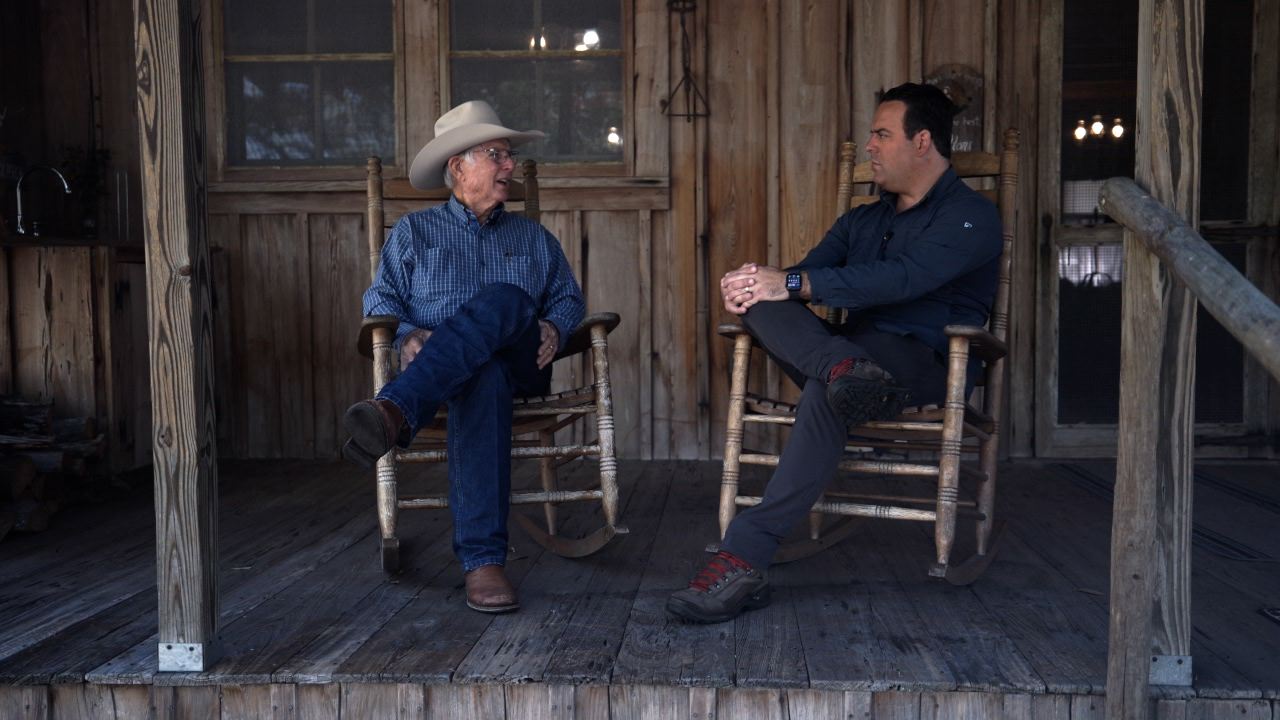
Doyle Carlton, a seventh-generation Floridian who owns the Roman III Ranch in DeSoto County, knows the pressure firsthand.
“Anyone ever come to you and say, ‘We want to buy that?’” Paluska asked.
“Oh, yeah,” Carlton said. “Yeah, we’d have no trouble selling the property.”
“When my dad got this property in 1960, it kind of fell in that sacred category,” Carlton said.
“What made it sacred?” Paluska asked.
"Just the beauty of it, we've got the Horse Creek run through this property, 12 miles of shoreline, beautiful, natural wood, wildlife, deer,” Carlton said. “And it would be a shame to do anything to take away from that beauty. I am the seventh-generation Floridian.
And then we've got a 10th generation that's growing now.”
Through the Florida Forever Program and a partnership with the Southwest Florida Water Management District, 16,000 acres were conserved. The land will remain wild in some areas while also doubling as a working cattle ranch.
“Any improvements we make are for the livestock of the wildlife,” Carlton said. "Just feel very blessed that we're able to do that. Because I think we could have fought it off for a long, long time, but I think there would have gotten to the point that it would have been possibly too valuable to sit on for cattle land, and that would have been hard for my children and grandchildren later on down the road."
THE LAST GREEN THREAD
For years, documentaries like "The Last Green Thread" (2020) have sounded the alarm on human impacts to nature. And, as advocates work tirelessly to secure the vision of wild Florida, the stakes can’t be higher.
Jason Lauritsen, Chief Conservation Officer at the Florida Wildlife Corridor Foundation, explains the urgency using a state map that resembles a giant jigsaw puzzle of critical wildlife crossings.
"The small pieces are really important, but they're the most difficult ones to secure," Lauritsen said. "There are places in the state where we just have these narrow gaps that are incredibly vulnerable to one project."
Lauritsen explained how connections between large landmasses that cut through urban sprawl, leading animals into more and more ecosystems, are closing fast, and that time is running out.
"There are over 450 projects within the rural and family lands protection program. And I think there are around 150 in Florida Forever," Lauritsen said. "There are people waiting in line to have their land acquired, which is phenomenal. The problem is we don't have the funding available to support those acquisitions, and so some of them wait in line for years, decades."
The consequences of losing these connections can be severe for wildlife.
Take a look at the map for yourself.
RELATED: Exotic Animal Invaders: Tracking the invasive Burmese python through the swamps of Florida
HOPE COMES WITH A BEAR
The story of M-34 Bear highlights the desperate need for connectivity.
Joe Guthrie, Director of the Predator-Prey Program at Archbold Biological Station, gave us the backstory on the bear. From the Fall of 2009 to the Summer of 2010, wildlife biologists with the University of Kentucky, working at Archbold Biological Station in Highlands County, captured and tracked the bear outside Sebring. Researchers monitored M-34’s movements until its tracking collar detached as designed and was recovered in 2010.
Guthrie wanted to stress to the public that “all research involving the bear, including its capture and collaring, was conducted with permits from the Florida Fish and Wildlife Conservation Commission.”
More than a decade later, that bear’s journey inspired a wildlife crossing under Interstate 4 in Polk County that opened in 2024. The crossing between Lakeland and Davenport near the Hilochee Wildlife Management Area connected two ecosystems, North and South, that had been severed for 50 years following the construction of I-4. A major win for bears, panthers, deer, and all the other wildlife that will be able to enter new territories.
"To maintain genetic health, you don't need to have a steady stream of 50 bears a year going across," Lauritsen said. "You just need one bear a year exchange for genetics, not even every year, just one bear every generation to go in there and exchange genes and genetics and keep those populations healthy.”
MONEY, MONEY, MONEY
Morris emphasizes that landowners are ready to participate in conservation efforts if funding is available.
"We have landowners who have lined up that have said, 'Hey, we want to protect our land. We're willing to protect our land in perpetuity. We're willing to keep it like this," Morris said. "What we really need is consistent, reliable funding for both programs.”
As legislators in Tallahassee hold the power to restore funding, conservationists warn that without immediate action, Florida's remaining wild lands and the wildlife corridors that connect them could be lost forever.
“There are over $200 million worth of projects that are in the Florida forever pipeline, and as the dollars are spent, you're going to end up having a point in time where we can't execute on a contract because there's not enough money in there,” Lauritsen told Paluska. “We need to have those dollars restored so that we can continue; the land's not going to get cheaper. So, if we can acquire them sooner, the better.”
RELATED: Wildlife filmmakers use the power of video to save the Florida panther
This story was reported on-air by Michael Paluska and converted to this platform with the assistance of AI. Paluska and our editorial team verify all reporting on all platforms for fairness and accuracy.
Share Your Story with Michael
A lot goes into the price of paradise and Michael Paluska focuses on every aspect. From the job market and housing to how Florida’s growth impacts our state’s wildlife. Send Michael tips to keep these important conversations going.
.
Bradenton community responds after 20-year-old volleyball star dies from disease that affects 2 in a million
The 20-year-old IMG Academy volleyball star and Under Armour All-American died Sept. 16 after a three-month battle with the rare blood disorder — even though doctors had found her a 100% bone marrow match, her mother, Tanya Mack tells Tampa Bay 28 reporter Haley Zarcone.
