

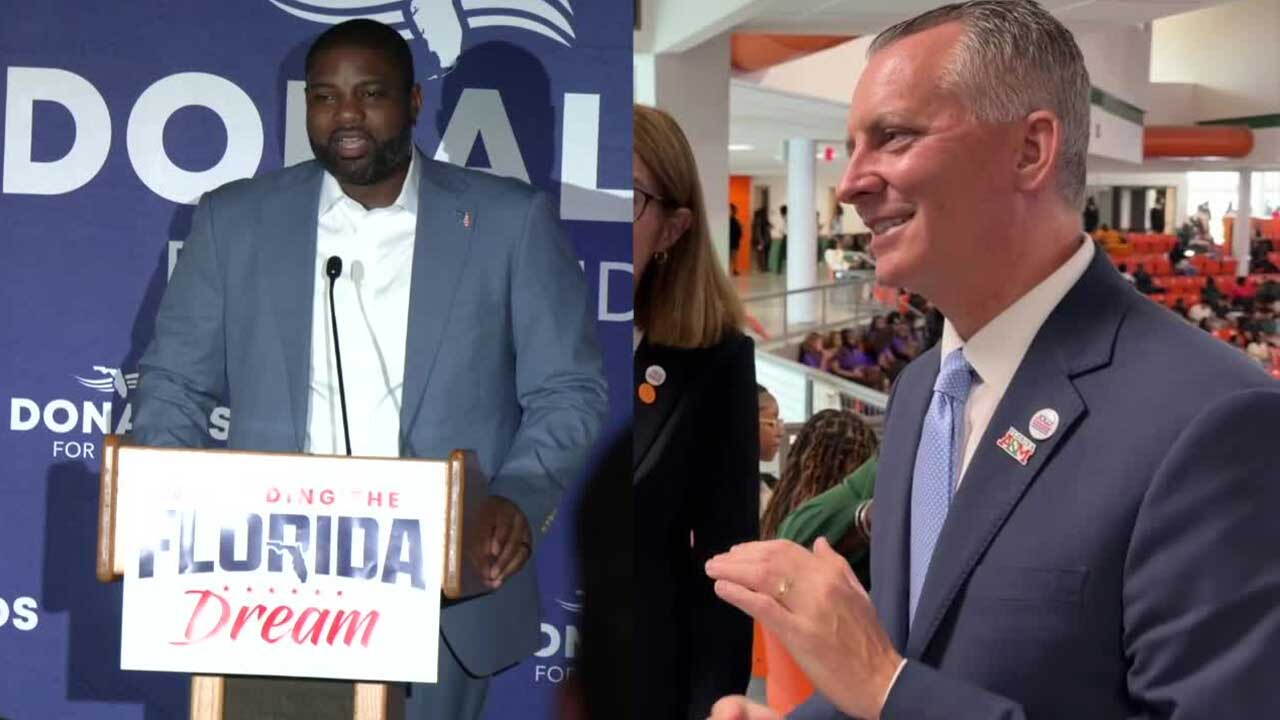


TALLAHASSEE, Fla. — The data cloud needs a place to land. Florida's candidates for governor disagree on the welcome mat.
Republican nominee Byron Donalds argues that data centers are infrastructure Florida needs to compete, with safeguards to protect water supplies, electric customers and nearby neighborhoods. Democratic nominee David Jolly wants a one-year pause on construction to examine the environmental, health and economic consequences.
WATCH BELOW: Data centers divide Florida governor's race
Their disagreement is turning the buildings behind artificial intelligence into a campaign battle over familiar concerns: what happens to Florida's land and water, who benefits from development and who gets the bill.
"Well, what happens when you threaten capital is capital leaves," Donalds said in an interview.
He argues that discouraging investment could undermine the economic opportunities Floridians need to keep up with the cost of living.
"People need to be able to afford the Florida dream and build for their lives. But you can't build for your life if you don't have a high-paying job. And you're not going to have a high-paying job if you don't have companies who invest in your state," Donalds said.
Donalds has outlined three priorities for regulating the facilities: protecting customers from higher utility bills, limiting water demands through cooling systems that recirculate water or use air, and keeping facilities away from homes.
His campaign also says local communities should be able to reject them.
"If communities don't want data centers, there will be no data centers in those communities, "the campaign said in a statement reported by Florida Politics.
Florida has already adopted new restrictions. SB 484, signed by Gov. Ron DeSantis in May, preserves local authority over development and requires utility rate protections designed to ensure large data centers cover their own cost of service. It also establishes water-permitting requirements.
The law calls for an independent study of data centers' economic, environmental, energy and public health effects.
Jolly wants Florida to stop new construction while questions about those impacts are examined. He says he would impose a one-year statewide moratorium beginning when he takes office if elected.
"They are rushing to build these things for reasons of profit for the industry, but not out of public interest, and I think we need to hit pause," Jolly said.
His campaign is making Donalds' support for the projects an advertising target, telling viewers to "Say no to Data Center Donalds.”
The White House, meanwhile, wants the accelerator.
President Donald Trump argued Monday that data centers bring jobs and lower taxes, warning that communities rejecting them could end up "backwards and poor." His administration has also promoted a ratepayer protection pledge calling on major technology companies to cover the energy and infrastructure costs of their projects.
But that sales pitch faces a skeptical audience.
A July University of North Florida poll found 68% of likely Florida voters opposed an AI data center in their local area, while 28% supported one. The survey of 848 likely midterm voters was conducted July 8–17 and had a margin of sampling error of plus or minus 3.8 percentage points.
A national Economist/YouGov poll conducted Aug. 28–31 found 63% of U.S. adults opposed a new data center in their community, compared with 19% who supported one. Opposition included 71% of Democrats, 66% of independents and 52% of Republicans.
That national survey also found 60% believed a new data center would increase their electricity costs.
The polls measured attitudes toward local construction, not support for a statewide moratorium. Still, they show the political challenge facing supporters of expansion.
The promise is an economic boom. Many voters remain unconvinced they want it moving in next door.
