

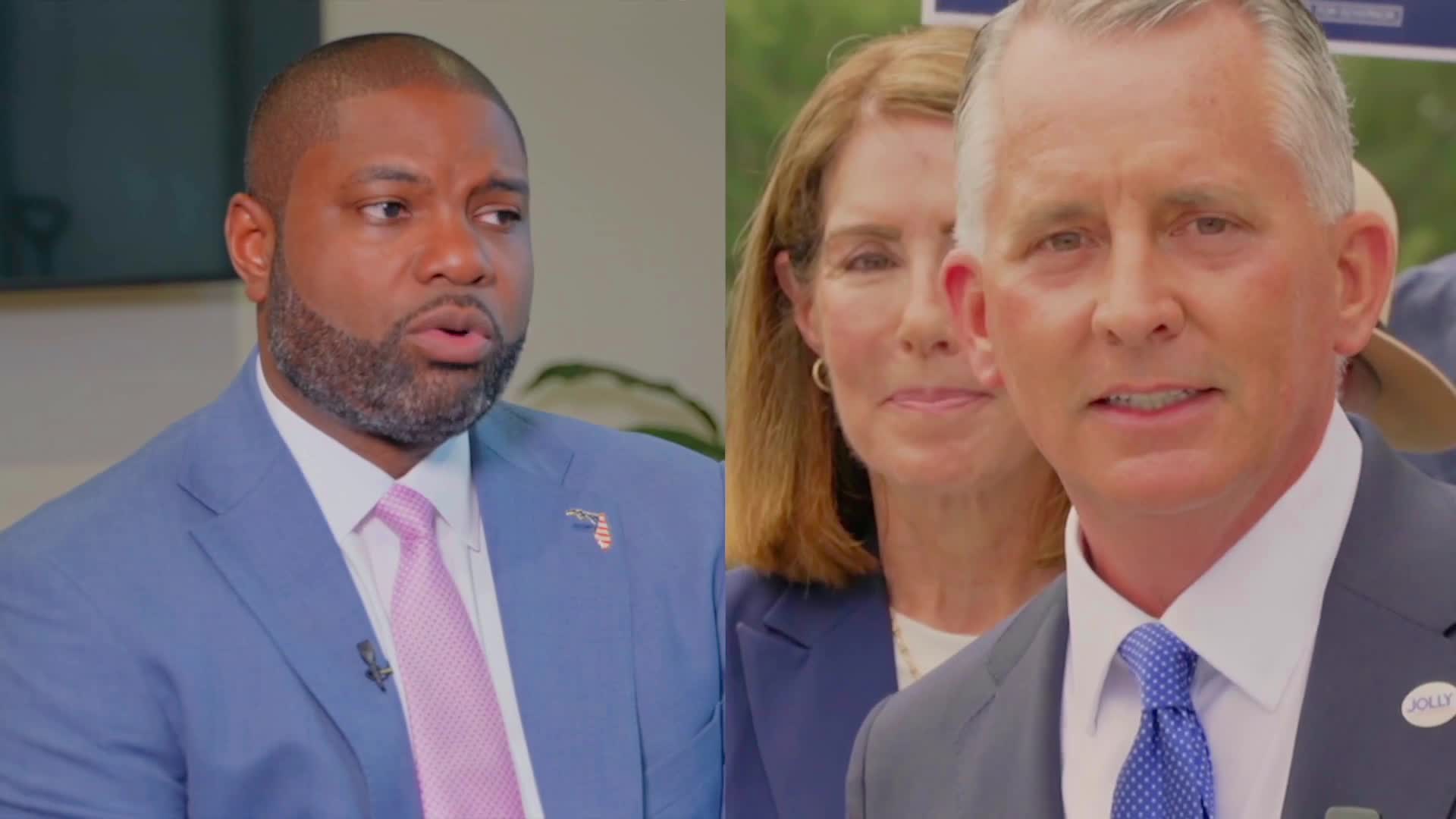


TALLAHASSEE, Fla. — Florida's candidates for governor are turning artificial intelligence into campaign ammunition, with Democrat David Jolly promising a pause on new data centers and Republican Byron Donalds warning that a statewide freeze could drive investment elsewhere.
Their disagreement puts water, electricity costs and local control at the center of a growing debate over the buildings powering the technology.
WATCH BELOW: Jolly, Donalds turn AI data centers into campaign battleground
"We don't need data centers in the state of Florida at all, at all, at all," Jolly told CBS Miami in a Sept. 13 interview.
Jolly has proposed a one-year moratorium if elected, arguing Florida needs more time to assess the effects on communities and natural resources. During a Tallahassee stop, he framed the proposal as a response to residents' concerns.
"And at some point, our job as leaders is to listen and to follow public opinion," Jolly said.
His campaign says he will visit Northern Virginia's "Data Center Alley" this week to meet residents who say nearby facilities have disrupted their lives. The campaign announced the trip Sept. 14, saying Jolly would hear concerns about persistent noise, air quality and other effects of development.
Back in Florida, Democrats launched their "Data Center Donalds" tour Tuesday in Pinellas County, accusing Donalds of putting industry donors ahead of communities. Agriculture commissioner nominee Joey Mendoza Atkins and state House candidate Bryan Beckman joined residents at the site of a previously proposed data center, according to the party.
Donalds argues Florida can protect communities while remaining open to the infrastructure businesses need.
"Capital goes where it's valued," he said in an August interview, warning that talk of bans and moratoriums could signal Florida is not the place to invest. “But you can't build for your life if you don't have a high-paying job. And you're not going to have a high-paying job if you don't have companies who invest in your state," Donalds said.
Last week, Donalds described AI as a “force multiplier,” comparing its potential to the internet and personal computers. He also said local governments should retain control over whether projects are built.
"On data centers, like I said, if a local government doesn't want to build it, then they won't build it," he said.
Donalds supports keeping facilities away from homes and using cooling technology that conserves water, including systems that recirculate water or use air cooling.
Polling shows voters distinguish between AI and the facilities supporting it.
A July survey from the University of North Florida’s Public Opinion Research Lab found 68% of likely Florida midterm voters opposed an AI data center in their local area, while 28% supported one. The same survey found voters evenly divided on the general increase in AI use, with 49% supporting it and 49% opposing it. The poll surveyed 848 likely voters July 8–17. UNF poll results and methodology.
Florida has already adopted new rules for large data centers. Gov. Ron DeSantis signed SB 484 in May.
The law requires electricity rate structures designed to ensure large customers pay their own service costs, preserves local planning and land-use authority, and establishes water-permitting requirements for large data centers. It also calls for an independent study of their economic, environmental and public-health effects. Florida Senate's summary of the law.
Jolly argues paying for utilities does not resolve the broader concerns.
"He's basically saying you can come plunder our natural resources as long as you pay your own way," Jolly said of Donalds' position.
Donalds, meanwhile, has argued that leadership requires more than following public opinion.
“And so, it's easy just to listen to what everybody's saying, to follow the polling, but that's not leadership,” he said in August.
Voters will choose Florida’s next governor Nov. 3.
