

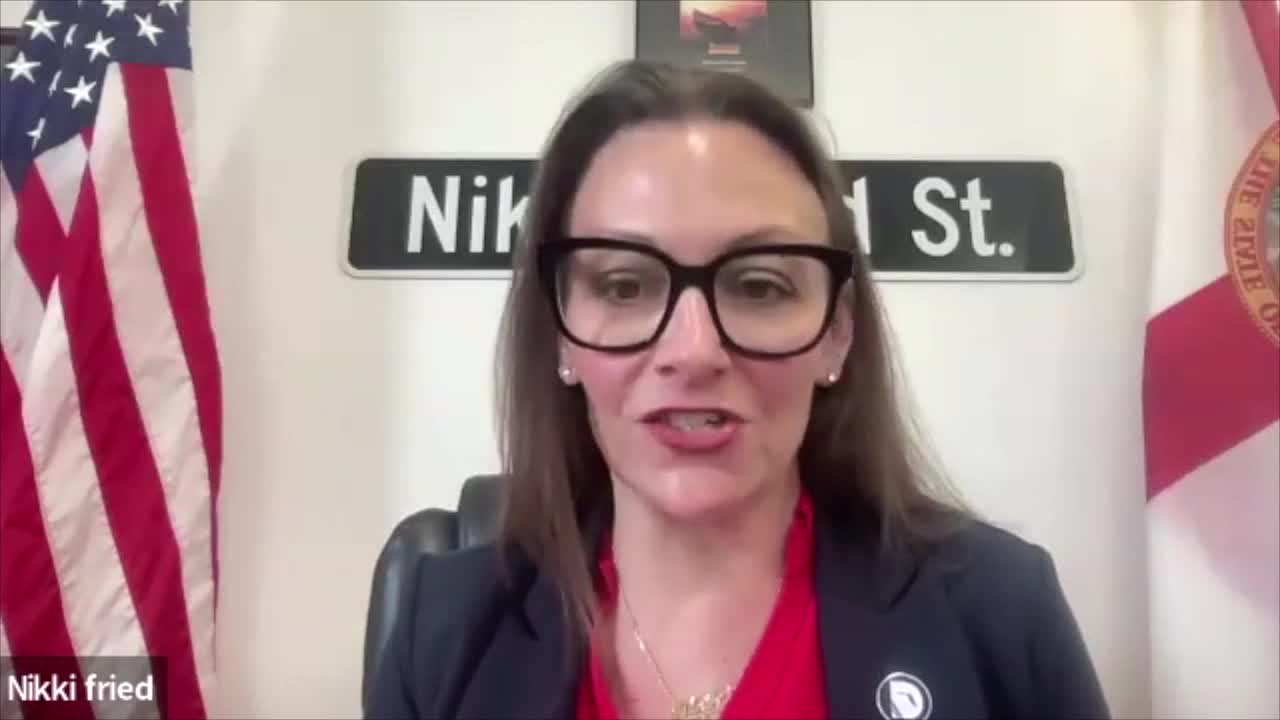


TALLAHASSEE, Fla. — Florida Democrats say they have proof a 2026 comeback is possible. Now, they have to prove that momentum can survive Election Day.
After decisive statewide losses in 2022 and 2024, Democratic leaders on Monday outlined a path they say could break Republican supermajorities in the Florida Legislature and begin moving the state’s politics back toward the middle.
"The Republican supermajority in this legislature is breakable, and we are going to break it this cycle," Florida Democratic Party Chair Nikki Fried said during a virtual briefing.
WATCH: Florida Democrats say 2026 momentum can break GOP supermajorities
The party pointed to more than 30 local and special-election flips since the 2024 election, more than 3,000 volunteers, increased candidate recruitment and an advantage in requests for vote-by-mail ballots. The party’s tally includes local offices as well as recent legislative special elections — not 30 seats in the Florida Legislature.
Fried said the difference this cycle is the party’s "Pendulum Project," a year-round organizing operation designed to maintain voter contact between major elections.
"This does feel different for multiple reasons," Fried said in a separate interview. "We have seen that work paying off by flipping almost 33 seats at this point, overperforming the national average."
Democrats are building their message around affordability, blaming nearly three decades of Republican control for rising housing, property-insurance, healthcare and everyday living costs.
Fried said the party’s candidates will also challenge a Republican-backed property-tax amendment headed to voters, arguing that cutting local-government revenue could threaten services or shift costs elsewhere.
"If they wanted to reduce the cost of living for everyday Floridians, they could have done that through the legislative process," Fried said. "Instead, what they’re doing is making our local governments the big boogeyman."
Republicans have promoted the measure as a way to provide relief to homeowners facing higher tax bills. Democrats argue the proposal does not address property-insurance premiums and could squeeze funding for police, fire departments, roads, parks and other local services.
Florida Democrats are also counting on a political pattern that has helped opposition parties in past midterm elections: voters often punish the party controlling the White House. Party leaders believe dissatisfaction with President Donald Trump and economic conditions could help Democrats reconnect with working-class voters, younger Floridians and voters with no party affiliation.
"This year is different, very different," Senate Democratic Leader-designate Tracie Davis said. "We have put in place the programs needed to capitalize and break these supermajorities once and for all."
The climb, however, remains steep.
Governor Ron DeSantis defeated Democrat Charlie Crist by roughly 19 percentage points in 2022. Two years later, Trump carried Florida over Kamala Harris by about 13 points, the largest Republican presidential margin in the state since 1988.
Republicans have also built a voter-registration advantage of more than 1.5 million. As of May 31, Florida had about 5.54 million active registered Republicans and 4.03 million Democrats, according to the state Division of Elections. Another 3.32 million voters were registered without a party affiliation.
Republicans remain at or above the two-thirds threshold needed for supermajority power in both legislative chambers. A two-thirds majority amounts to 80 of the 120 House seats and 27 of the 40 Senate seats when every member is present.
Political analyst Susan MacManus said Democrats are betting that affordability concerns will help them reclaim working-class voters and attract independents. But she said their registration deficit means they must generate enthusiasm among supporters who have skipped recent elections while also winning a sizable share of unaffiliated voters.
"Can they ramp up enthusiasm for a lot of their supporters in the past who have voted but haven’t lately?" MacManus said. "Turnout is a huge issue. That’s the bottom line. That’s how you win elections.”
That was one of the party’s central problems in 2024: Democratic leaders and national campaigns argued late in the cycle that Florida was competitive, but the promised surge did not translate into enough votes.
Fried said the latest special-election results provide a “proof of concept” that the party’s organizing and affordability message can work, including in districts Trump previously carried. Still, smaller and lower-turnout elections do not always predict what will happen in a statewide general election.
Democrats will continue making their case at Leadership Blue, the state party’s annual gathering, scheduled for July 17 through 19 at Disney’s Coronado Springs Resort in Lake Buena Vista. Former Transportation Secretary Pete Buttigieg will deliver the keynote address at the July 18 gala.
The weekend will serve as both a rally and a strategy session as Democrats try to turn scattered victories into a broader recovery.
The party sees a comeback brewing. November will determine whether it is real — or another false start.
Share Your Story with Forrest
Capitol Reporter Forrest Saunders is dedicated to sharing your voice with political leaders throughout the state. He works to hold our elected leaders accountable and amplify your concerns. Let Forrest know about the issues you want state leaders to focus on.
.

Pasco County mom of 5 takes in 3 children left without food or power whose mother faces neglect charges
Jasmine Young, a mother of 5, opened her home to three neglected girls as their mother faces child neglect charges for leaving them without food, power or water.
