



MIAMI, Fla. — INSIDE THE DEA’S BUSIEST DRUG LAB IN AMERICA WHERE COCAINE IS KING
In the middle of a South Miami industrial park, behind iron gates and on a large, nondescript campus, sits the Drug Enforcement Administration's Southeast Regional Drug Laboratory — where science wages war against the illegal drug trade.
Here, lab-coated drug experts turn chemical clues into courtroom convictions.
Watch report from Katie LaGrone
"Last year we had about 152 testimonies in federal court," said Allen Catterton, the lab's director.
Catterton is a career-long chemist who has worked for the DEA for 28 years. The lab focuses on seized narcotics from the Southeast and the Caribbean. The DEA’s Miami drug lab is the busiest DEA lab in the country.
"One of the things that makes us the busiest laboratory in the United States is the amount of work that we see in terms of size. We receive probably about close to 70% of all the weight of DEA evidence," Catterton said.
That's 70% of all drugs seized by the DEA nationwide. South Florida's location along the coast and its proximity to South America make it a top entry point for illegal drug smuggling — on land and often by sea.
In South Florida, cocaine is king — on the streets and under the microscope.
“IT'S SCARY!” THE DEADLY, THE DEADLIER AND THE UNKNOWN
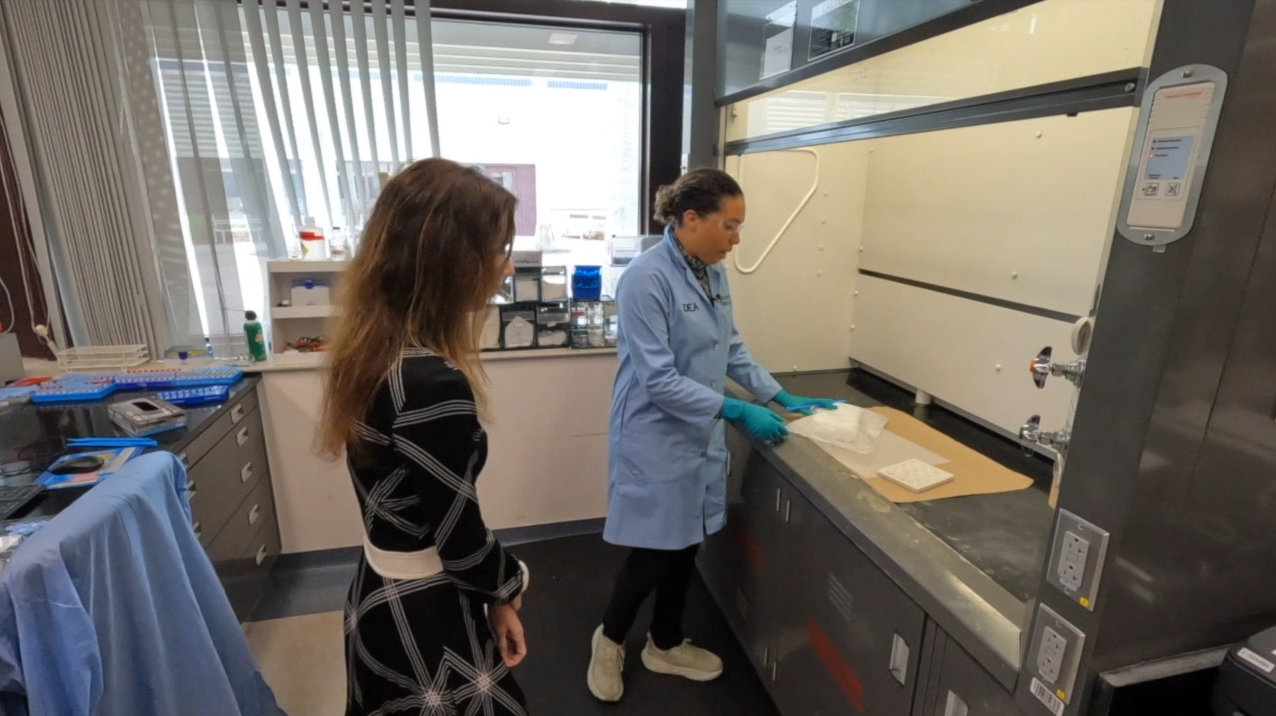
"Right here is a kilo of cocaine," DEA forensic chemist Jenna Hamilton shows us during a recent visit.
Hamilton and Alyssa Sanchez are among 20 chemists on site who spend most of their workday analyzing the makeup of drugs DEA agents have seized during investigations.
"Yes, this is the first step in analyzing cocaine,” Hamilton shows us as she places a drop of a chemical solution in a tray of cocaine samples. “If it doesn't turn blue, then we'll continue with additional testing to see what it is or if it is an unknown,' she explained.
Both chemists are still in their 20s and fresh out of college.
"Being in the forefront of everything of the war on drugs. It's fantastic," Hamilton said. When asked what her friends think of her job, Hamilton chuckles and said, “They think it is so cool. I mean, who else can say, 'Oh yeah, you know, I tested cocaine today,'" she said.
It's also a job that's unpredictable. America's illegal drug supply is rapidly evolving, with more frightening and deadlier substances appearing for the first time — and others making a return, including, as we recently reported, the deadly synthetic opioid fentanyl and carfentanil, which is a large animal tranquilizer.
"This turned out to actually be about 16% fentanyl, and it also contains carfentanil, which is a multitude of times more potent than fentanyl, which is scary," Sanchez said.
When asked how many people that amount could kill, given that 2 milligrams of fentanyl can kill one person and the sample contained 1,000 grams, the answer was simple: a lot.
For drugs chemists have never seen before, the lab is equipped with more sophisticated equipment — including a Nuclear Magnetic Resonance machine, or NMR. It functions like an MRI machine for unknown narcotics, breaking them down to the molecular level.
Catterton explained that NMR is more commonly used now given the infiltration of lesser-known controlled substances in America’s illegal drug scene.
“WE’RE CONSTANTLY PLAYING CATCH UP.”
What ends up in the DEA's Miami lab will likely land in its evidence vault, where about 50,000 pieces of evidence are currently stored, worth billions of dollars on the streets.
Most of it is cocaine.
Drugs seized remain in the vault until their corresponding court cases move through the legal system, a process that could take months or even decades. Eventually, everything stored there is destroyed in an incinerator, about 300,000 pounds last year, roughly 15 tons a month.
"The world is changing with drugs. They're consistently moving and shifting, designing new compounds to forego our controlled substance acts, and then we're constantly playing catch-up," Catterton said.
It's a part of America's war on drugs rarely seen by the public — the science and scientists breaking down the chemical blueprint of a black market that continues to kill.
Share Your Story with Katie
Katie LaGrone focuses on making sure Florida’s laws actually work and her investigations have gotten results. If you know of a policy or law that’s not working how it’s intended, send Katie a message below.
.

Saudi flight from Tampa, secret FBI probe reveal possible Saudi support network for 9/11 hijackers
Twenty years after the Sept. 11 attacks, more than 80,000 records compiled by the Tampa FBI Field Office remain classified. Newly declassified documents are pointing to a possible secret Saudi support network for the hijackers. Soon after the attacks, the FBI uncovered that 15 of the 19 hijackers were from Saudi Arabia.
