

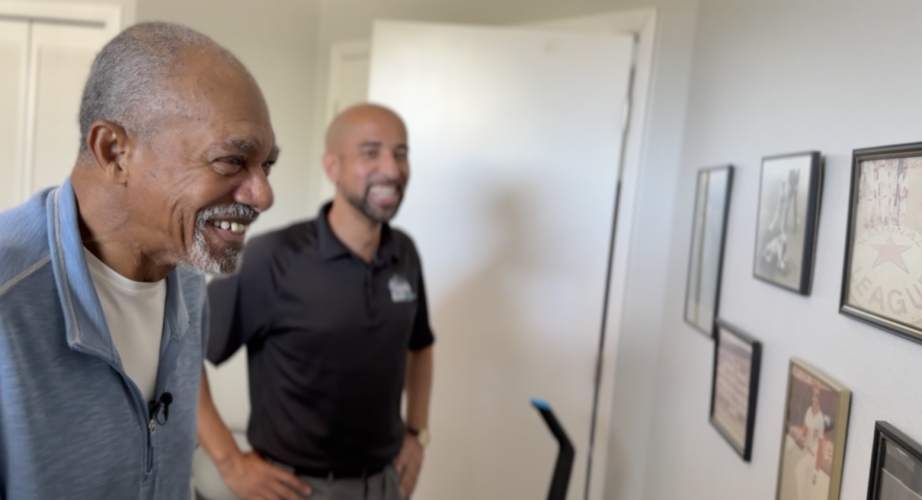


ODESSA, Fla. — Dave Cash was on the field when the Pittsburgh Pirates made history on Sept. 1, 1971 — he just didn't know it yet.
The former All Star infielder, now a resident of Odessa, Florida, was a member of the 1971 Pittsburgh Pirates — a team that won the franchise's fourth World Series title that season. But it was a regular season game on Sept. 1 of that year that cemented the Pirates' place in baseball history, when manager Danny Murtaugh fielded the first all-minority lineup in Major League Baseball history.
WATCH: Dave Cash talks about the lineup that changed Major League Baseball
Cash said he didn't realize how big of a deal that lineup card was until the next morning.
"Didn't realize it until I read it in the paper. It didn't occur to me that we did something special. We were looking at it as just another ball game," Cash recalled.
Cash recalled that teammate Gene Clines was the first to notice something was different about that lineup.
"I remember [Pirates centerfielder Gene Clines] coming and saying 'Hey, the clubhouse boy just said the Homestead Grays are in town,'" Cash said. "So we go out on the field, and we look around. All of sudden, one, two, three, four, five…it was all brothas. Gene said 'We got all brothas out here.' I didn't even realize it. Nobody realized it. I don't know if [Pirates manager Danny Murtaugh] realized it or not. But that's what happened. And we became part of history."
That historic night was part of a championship season for Pittsburgh. The Pirates went on to win the 1971 World Series, overcoming obstacles along the way — including a no-hitter thrown against them by one of the most dominant pitchers in baseball history.
"It was amazing," Cash said when talking about their championship run. "Bob Gibson had thrown a no-hitter against us in that same year. We came back after that adversity, and we dominated. Put it that way," Cash said.
Cash's path to the major leagues was shaped by adversity long before that September night. A multi-sport star who grew up in the projects of Utica, New York, Cash idolized Jackie Robinson, and said he ran into some of the same racial barriers Robinson had faced decades earlier.
"I encountered some of the things that he encountered when he played," Cash remembers. "It taught me a lesson. It taught me how to deal with adversity. It taught me how to deal with people at that time. Because you couldn't say too much. They were lynching people of color at that time."
Cash said there were moments early in his career when he nearly walked away from the game entirely. In his first year, he and his roommate were separated because of their races.
"My roommate was Rich Grimaldi, and he was my high school teammate," Cash explained. "We both had played, and they wouldn't let me stay in the room with him because he was white and I was Black. That was part of the experience, but after that it was all about baseball."
Supported by his mother, his teammates and his managers, Cash said those experiences ultimately made him a better player and better person.
"It galvanized me and made me stronger because I knew I could do what I could do," Dave added. "I knew I could play. Glad I went through that experience. It made me a better person, a better man," Cash said.
Cash's legacy extends beyond the baseball diamond. He was a three-time All-Star during his 12 MLB seasons. During his All-Star 1976 season, he coined a phrase that would later become nationally recognized — "Yes we can," — a rallying cry that President Barack Obama would go on to use years later.
"They asked, 'Do you mind him saying it?' I said 'No! Of course not. C'mon,'" Cash laughed.
For Cash, though, the game itself has always been at the center of everything.
"Baseball was my love, my passion. Something that I dreamed about playing. And I loved it."
Share Your Story with Kevin

Tampa Bay 28 Sports Anchor Kevin Lewis knows what happens on the field ties us together. From parents coaching kids to young athletes achieving life-long dreams, Kevin shares stories we can all celebrate. Reach out to him below.
.

Bradenton community responds after 20-year-old volleyball star dies from disease that affects 2 in a million
The 20-year-old IMG Academy volleyball star and Under Armour All-American died Sept. 16 after a three-month battle with the rare blood disorder — even though doctors had found her a 100% bone marrow match, her mother, Tanya Mack tells Tampa Bay 28 reporter Haley Zarcone.
