




TAMPA, Fla. (WFTS) — A judge has ruled the Florida Department of Corrections (FDC) violated federal law when it seized a civil rights settlement from an incarcerated Pasco County man and pursued more than a half-million dollars from him through a cost of incarceration lien.
WATCH: Judge: FDC seizure of inmate settlement violated federal law
The Tampa Bay 28 I-Team first reported on this case in 2024.
The ruling centers on Jason Baez, who sued the department after officers at Santa Rosa Correctional beat him so severely he lost sight in his right eye. Baez settled that civil rights lawsuit for $60,000. After he attempted to transfer the funds to his family, the Department of Corrections filed a motion seeking $547,850.50 — charging $50 a day for the length of his 30-year sentence.
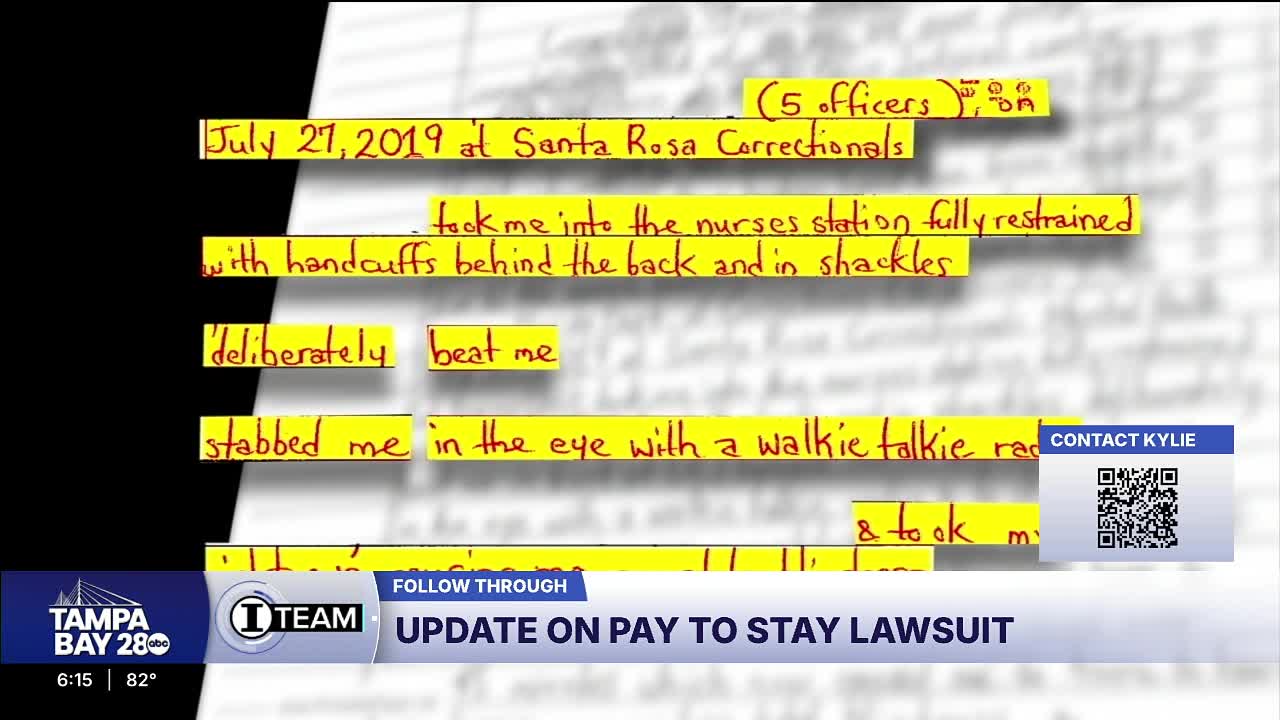
In a letter to the judge objecting to the motion, Baez described the incident that led to his lawsuit.

"5 officers at Santa Rosa Correctional took me into the nurse's station fully restrained with handcuffs behind the back and in shackles, deliberately beat me and stabbed me in the eye with a walkie talkie radio. And took my right eye, causing me complete blindness," Baez said.
Baez was sentenced to prison in 2006 for the second degree murder of his roommate in Pasco County.
The $50-a-day incarceration fee — known as Florida's "pay-to-stay" law — is a lien the state can file against incarcerated individuals for the cost of their imprisonment. Critics call the practice unconstitutional. Court records the Tampa Bay 28 I-Team reviewed over the years, show the FDC has moved to collect the fee when an incarcerated individual wins a civil rights settlement against the prison system.
Kelly Knapp, an attorney with the Southern Poverty Law Center, a nonprofit specializing in civil rights, said the department's use of the lien follows a pattern.
"One of the patterns is they file the liens against people who have filed civil rights lawsuits against them," Knapp said.
Of the roughly 80,000 people in the Florida Department of Corrections, Knapp said the department has chosen to file these liens against a few hundred.
Related:
Pay to stay: Florida inmates charged for prison cells long after incarceration
Pay to stay: Judge calls out Florida prison system collection methods as retaliation
In July, a federal court sided with Baez.
"The federal court determined that it is unconstitutional for the State of Florida to use a cost of incarceration lien to take Jason Baez's civil rights settlement," Knapp said.
But the state had already taken the money. After Baez deposited his settlement into his inmate trust account, the state obtained a lien through his sentencing court and withdrew the full amount.
"They took every penny," Knapp said. "And so now the question is — what do we do about it now that the state has already taken that money?" Knapp said.
Knapp said the ruling carries broader implications for how civil rights settlements function within the corrections system.
"I think we can all understand that it's just inherently unfair or unjust for correctional officers to be able to use such excessive force, that it partially blinds and disfigures someone, and then to lose all accountability for those — for that misconduct, through the state getting all of the money back. That it paid. To make the victim whole. And to deter these actions from happening again. It just obliterates the entire purpose of civil rights settlements," Knapp said.
Following the court order, the Southern Poverty Law Center said it is speaking with other individuals whose civil rights settlements were taken through these liens.
The FDC has yet to respond to the I-Team's requests for comment.
Share Your Story with Kylie
Kylie McGivern works tirelessly to get results for the people of Tampa Bay. Her reporting has exposed flaws in Florida’s corrections system and unemployment process. Reach out to Kylie and our I-Team if you need help holding state leaders accountable.
.

'My heart breaks': Woman describes helping injured students after deadly school bus crash in Polk County
A woman on her way to work Monday morning found herself helping injured Winter Haven High School students after a school bus crash that killed two people.