

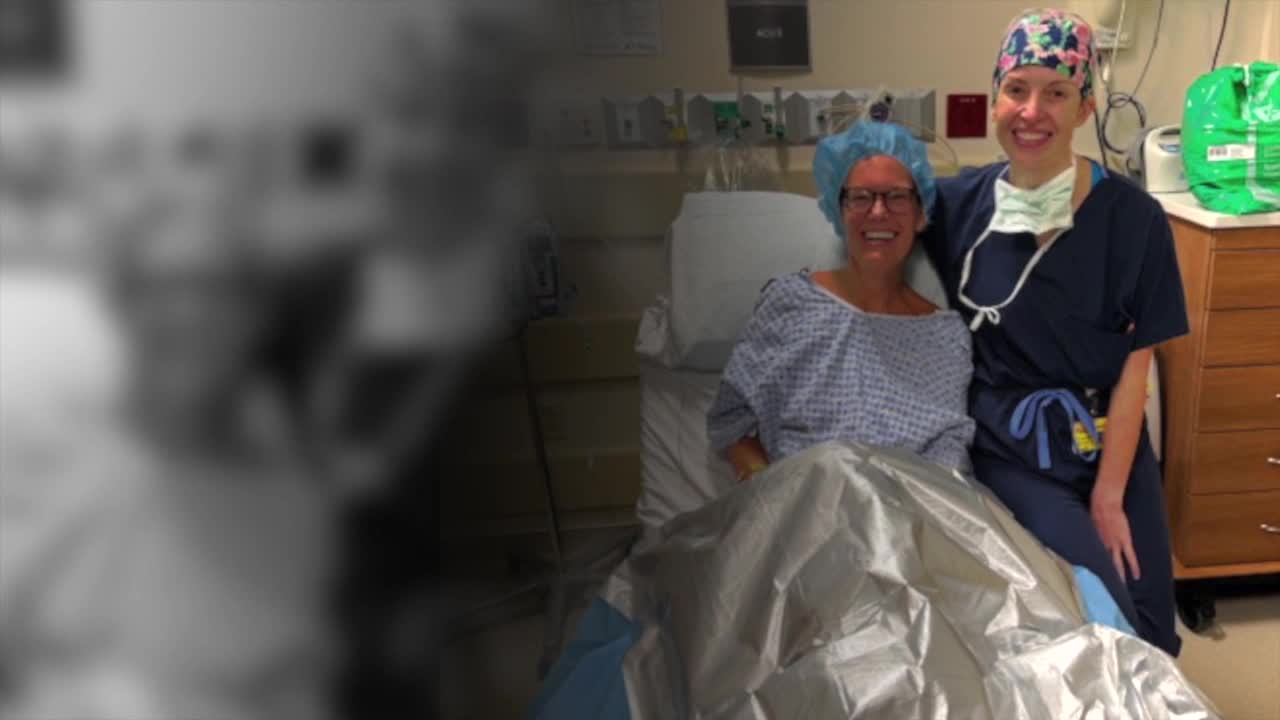


A recently diagnosed breast cancer patient and her surgeon are speaking out after her insurance company denied coverage for a reconstruction procedure less than 24 hours before it was scheduled.
Three months ago, Beth Clark, 48, was diagnosed with invasive ductal carcinoma — the most common type of breast cancer.
"I don't think I really had time to digest it. It was like, okay, we're going to just figure out what we do next — how do we get rid of this?" Clark said.
Her answer was a full double bilateral mastectomy with reconstruction.
"As scary as having that more invasive surgery was, I just wanted to cut out any possibility of ever having to do this again," Clark said.
Clark had the mastectomy, but less than 24 hours before her reconstruction surgery, her insurance company, Anthem Blue Cross and Blue Shield, denied coverage for the procedure.
"This is the time when I would anticipate that my insurance company would have my back and would be more than supportive of getting this taken care of and getting me healthy again," Clark said.
According to her denial letter, the surgery — which involved a surgical mesh called GalaFlex — is still considered "investigational" and "there is no or not enough proof it improves health."
GalaFlex is a synthetic surgical mesh that has become a controversial treatment for breast reconstruction. While it is popular among plastic surgeons and approved by the FDA for some uses in the body, it is not approved for breast reconstruction and is still considered an off-label, investigational, and experimental treatment.
In a 2023 letter to health care providers, the FDA reiterated its stance on the treatment, stating its “efficacy and safety for breast cancer patients have not been determined.”
But Dr. Alician Billington, Clark's plastic surgeon, believes its time insurance companies take a second look. She uses GalaFlex mesh on most of her breast reconstruction patients and, while she acknowledges no treatment is risk-free, she says the product is less risky than other options with proven success.
"This product is giving my patients the least amount of complications, and other plastic surgeons as well," Billington said.
"Look at all of this data that we already have out there that has made this for many of us the gold standard in breast reconstruction with implants," Billington said.
Billington has been a vocal critic of insurance denials, joining a growing group of doctors taking their frustrations to social media and calling out insurers by name. She recently shared Clark's denial and took part in a viral dance with friends to call for policy changes.
"We're requesting that they do a review of the published literature to see the updates that have been made,” Billington said.
Last year, after Investigative Reporter Katie LaGrone and photojournalist Matthew Apthorp shared breast cancer patients' stories of denial as part of our ongoing "Patient No More" series, Cigna became the first — and, to date, only — major insurer to start approving GalaFlex for breast reconstruction.
In response to Clark's denial, a spokesperson with Anthem Blue Cross and Blue Shield said it regularly reviews coverage policies "to ensure they're based on medical evidence and aligned with the latest treatment standards and expert recommendations," adding that without FDA approval, the mesh "does not currently meet the standards required for coverage by our medical policy."
Read Anthem’s full statement:
“We regularly review our medical coverage policies to ensure they’re based on medical evidence and aligned with the latest treatment standards and expert recommendations. The GalaFLEX mesh is not FDA-approved for breast reconstruction surgery and does not currently meet the standards required for coverage by our medical policy; however, we cover many other evidence-based alternatives. We have been in communication with Ms. Clark’s physician, and she still has the right to appeal the decision.”
Despite her insurer's denial, Clark got her reconstruction surgery with the GalaFlex mesh a little more than a week ago, thanks to Billington.
"She worked tirelessly and found a mechanism to make that happen," Clark said.
As for concerns about the treatment's lack of FDA approval, Clark calls it a matter of trust and who, she said, has earned her trust.
"My medical care team, they are performing that work, and they are seeing the results, and they are seeing patients that are having these incredible results and outcomes, and that's where, if I'm going to hedge my bets, that's where I'm putting my money," Clark said.
Clark and Billington are still fighting the denial. Meanwhile, a new bill has been introduced to modernize the Women’s Health & Cancer Rights Act, a federal law created to protect breast cancer patients from being denied treatments as part of their cancer journeys.
Share Your Story with Katie

Katie LaGrone focuses on making sure Florida’s laws actually work and her investigations have gotten results. If you know of a policy or law that’s not working how it’s intended, send Katie a message below.
.

Bradenton community responds after 20-year-old volleyball star dies from disease that affects 2 in a million
The 20-year-old IMG Academy volleyball star and Under Armour All-American died Sept. 16 after a three-month battle with the rare blood disorder — even though doctors had found her a 100% bone marrow match, her mother, Tanya Mack tells Tampa Bay 28 reporter Haley Zarcone.
