

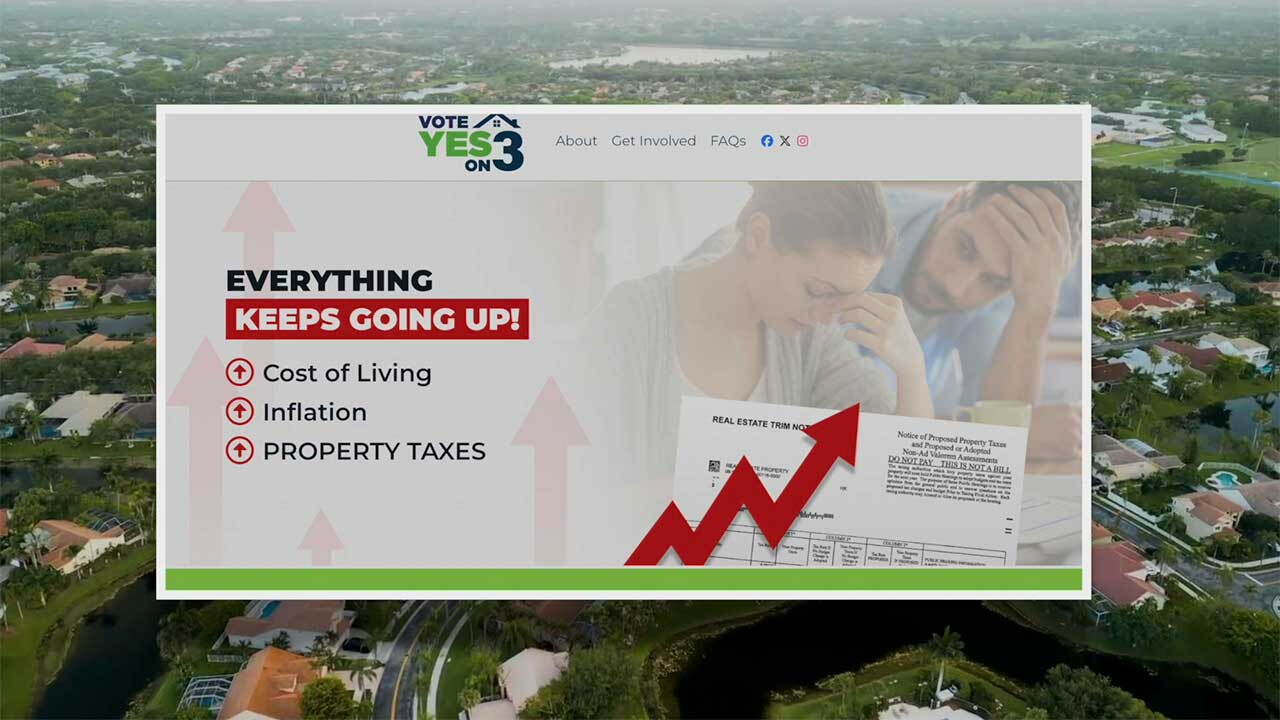


TALLAHASSEE, Fla. — Florida Realtors has a new sales pitch: a property-tax cut.
The association is putting $10 million behind Vote Yes on 3, giving supporters of the proposed constitutional amendment a major financial backer after a summer of organized opposition.
WATCH BELOW: Florida Realtors puts $10M behind Amendment 3
The new campaign centers on a straightforward argument: Buying a home is only part of the affordability challenge. Families also need help paying to keep it.
"Affordability doesn't end at closing. There's lots of costs that go into homeownership. For example, insurance, repairs, property taxes," said Margy Grant, CEO of Florida Realtors.
Amendment 3 would increase the homestead exemption for non-school property taxes to $150,000 in 2027 and $250,000 in 2028, with inflation adjustments afterward. The larger exemption would reduce the value of qualifying homes subject to those taxes.
The measure would also lower the annual assessment-growth cap on non-homestead properties, including rentals and commercial buildings, from 10% to 5%. That cap applies to assessed values used to calculate taxes; local tax rates could still change.
Grant said the changes would help homeowners retain more of their earnings and give rental and commercial property owners more predictability.
"Amendment 3 provides the opportunity for homeowners to literally receive money that they've earned and keep more of it," she said.
The campaign arrives as Gov. Ron DeSantis has said he will help promote the amendment in some capacity, despite wanting a larger property-tax cut.
Opponents argue the promised savings could show up elsewhere on residents' bills.
"You might pay a couple of thousand dollars less for your property taxes, but you're going to wind up paying more as the cost shifts onto fees, additional assessments," said Edie Ousley, a spokesperson for Vote No on Amendment 3.
The state's Revenue Estimating Conference projects that the amendment would eventually reduce annual local, non-school property-tax revenue by about $11.8 billion if approved. The estimated losses begin at roughly $4.93 billion in fiscal year 2027–28 and grow over time.
Cities, counties and public-safety groups opposing the amendment warn that those losses could force cuts to services, higher fees or additional assessments.
"Are you going to have to pay a fee to use your local library? What about fire assessment fees, storm water, additional storm water fees?" Ousley said.
Asked about those concerns, Grant said the impact would vary across Florida's 67 counties and expressed confidence that local officials could make decisions to manage it.
Both sides now face a campaign to shape how voters understand the measure.
An Aug. 18 Sachs Media survey of 800 Florida voters found 63% support overall and 37% opposition. That puts support three percentage points above the 60% required for passage, within the survey's overall margin of error of plus or minus 3.5 percentage points.
The survey tested both the original and revised ballot language. Support was 65% among voters shown the revised version and 60% among those shown the original. Pollsters said that difference was not statistically significant.
Voters will decide Nov. 3 whether the Realtors' latest pitch closes the deal.

Pasco County mom of 5 takes in 3 children left without food or power whose mother faces neglect charges
Jasmine Young, a mother of 5, opened her home to three neglected girls as their mother faces child neglect charges for leaving them without food, power or water.
