



TAMPA, Fla. — From the white sands of Fort De Soto to the red-clay brick-lined streets of Ybor City, Tampa Bay played a pivotal role in the Spanish-American War — and its legacy endures 127 years later.
Construction on Fort De Soto began in 1898 to protect Tampa Bay.
WATCH: Fort De Soto & Ybor City: The Spanish-American War's lasting impact on Tampa Bay
Today, the ruins of Battery Bigelow greet swimmers at Fort De Soto Park—a reminder of the war with Spain that once defined the area.
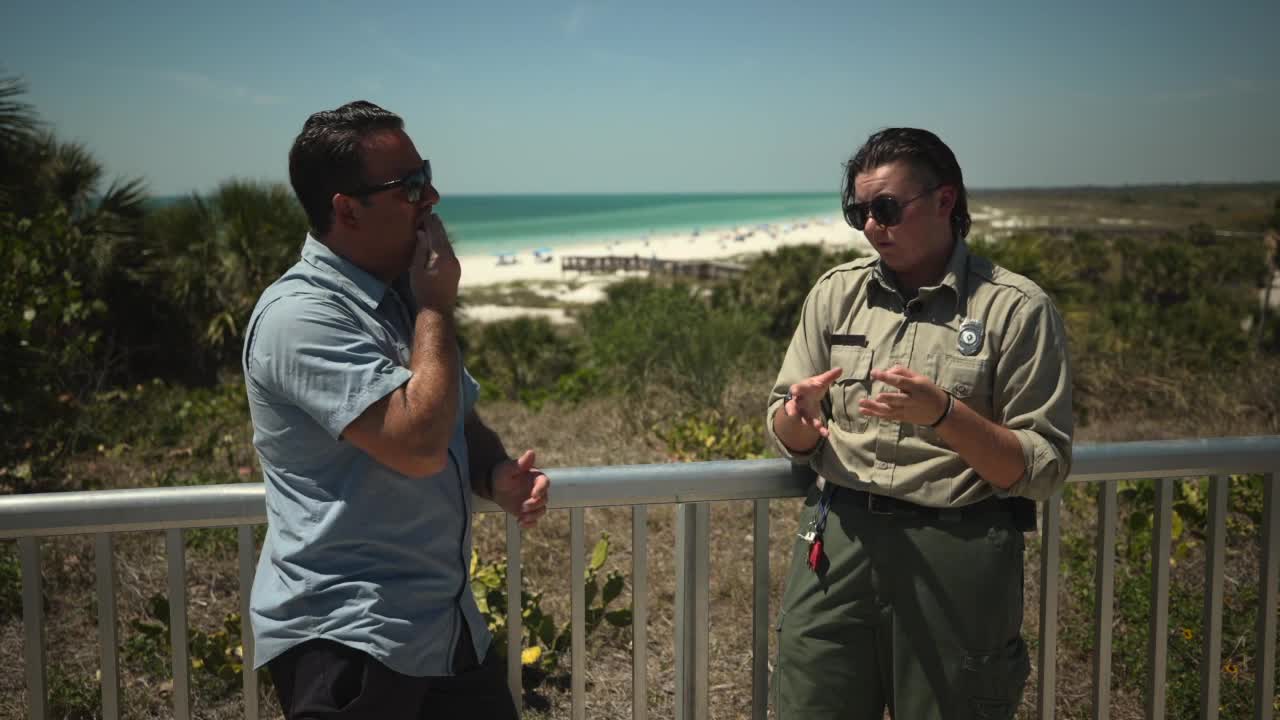
Jack Van Gundy, a park ranger at Fort De Soto Park with the Pinellas County Parks and Conservation Department, gave a walking tour of the fort — outside and inside, behind concrete walls 8 to 20 feet thick, where gunpowder and artillery rounds were once stored.
"So they put this fort here because this is where incoming ships would be coming from," Van Gundy said.
The Spanish-American War lasted only about four months.
"But they were pretty much done and dusted in four months because of the US naval power, the ships we had remaining from the Civil War, the northern forces pretty much just crushed them. We went to Cuba, and we took them out," Van Gundy said with a smile.
"America, baby!" Tampa Bay 28 reporter Michael Paluska exclaimed.
"Yeah, pretty much it was a really strong, unifying cultural event for the US, because it was our first conflict we were fighting in a freshly reunited so Northern and Southern soldiers fighting on the same side for a similar cause, which was independence from a force that was becoming tyrannical," Van Gundy said.
The fort's guns never fired at the enemy. But the site's history stretches far beyond 1898.
Long before 1898, however, this site already had a military past. In the 1850s and early 1860s, a U.S. Army Corps of Engineers expedition came through to survey all coastal defenses — and one of its members would later become one of America's most infamous figures.
"Right before the Civil War in the 1850s, early 1860s, a US Army Engineer Corps came through here to survey all coastal defenses. And the person actually leading, or part of that expedition, was Robert E Lee, back when we were still unified, before the Civil War," Van Gundy said.

"Probably walked along those sands," Van Gundy said.
Decades later, during World War II, the site took on a new purpose as a bombing range — a subsidiary of MacDill Air Force Base.
"And the pilot and co-pilot who dropped the bomb on Hiroshima practiced out here over these waters," Van Gundy said.

Looking back even further, before any military fortifications, more than a thousand years ago, the Tocobaga Indians lived at the site from 1000 to 1500 AD — 500 years, more than double the time America has existed as a nation.
While Fort De Soto reveals military history, forty miles away in Ybor City, another chapter of the war's legacy unfolded.
Max Herman, founder of Tampa Bay Tours, leads visitors through Ybor City, where the past still shapes the streets people walk today.
"Ybor City is the birthplace of the Spanish-American War," Herman said.
Herman says José Martí's voice — a key figure in the struggle for Cuban independence — helped ignite the revolution right in Ybor City.
"It starts with three, four people, eventually 3000 right here, in this spot, right here, all standing there," Herman said. "This was already the cradle of Cuban independence before Miami was even on the map. This was where there were thousands of Cubans rolling cigars, drumming up the revolution here behind Jose Marti, one of the biggest legends in Cuban history. And this was the spark? It was at that point he realized the fire of the revolution had been lit. It's time to strike. You know, with everybody behind me, the weapons are waiting, let's go do it. And that was the inspiration."
30,000 troops camped in Ybor City. The Port of Tampa is where they sailed to Cuba — and into the history books. Among them was a future president.

"Teddy went through Ybor City in the Port of Tampa before he headed to Santiago, Cuba, to start the Spanish-American War. And, well, he, of course, became a hero storming the hills of San Juan," Herman said.

"When Teddy Roosevelt marched down these streets, you can imagine people taking their hats off and waving them and wooing. There's Teddy Roosevelt. Imagine the ovation that he must have felt on top of his horse as all the Cubans around him knew he was the hero who was going to get them independence," Herman said.
Just across the Hillsborough River, Clara Barton — the founder of the Red Cross — picnicked on the grounds of the Tampa Bay Hotel waiting to take supplies to Cuba. It is now the campus of the University of Tampa.

These regional events had consequences that reverberated worldwide.
"Winning the Spanish-American War got US territories like Puerto Rico and the Philippines. Guam eventually got us negotiating the Territory of Hawaii to be ours as well. And it gave independence to lots of countries in Latin America and that. And you know, if you put the connections together, eventually, you get us to the Panama Canal," Herman said.
Herman says many visitors are surprised to learn how much history has passed through this region.
"A lot of people don't realize it, and you'd be so many, so many people come on my tour, and they're like, boy, I would have just driven through this little town and thought it was cute. It changed the world," Herman said.
Both guides agree that the story of Fort De Soto — and Tampa Bay — is bigger than any single moment in time.
"But so much happened here before you know, America was even a thought in somebody's mind. And things will continue to happen here, no matter what happens to us in the future, and this structure will probably be here for a very, very long time," Van Gundy said.
This story was reported on-air by Michael Paluska and converted to this platform with the assistance of AI. Paluska and our editorial team verify all reporting on all platforms for fairness and accuracy.
Share Your Story with Michael

A lot goes into the price of paradise and Michael Paluska focuses on every aspect. From the job market and housing to how Florida’s growth impacts our state’s wildlife. Send Michael tips to keep these important conversations going.
.

Bradenton community responds after 20-year-old volleyball star dies from disease that affects 2 in a million
The 20-year-old IMG Academy volleyball star and Under Armour All-American died Sept. 16 after a three-month battle with the rare blood disorder — even though doctors had found her a 100% bone marrow match, her mother, Tanya Mack tells Tampa Bay 28 reporter Haley Zarcone.
