

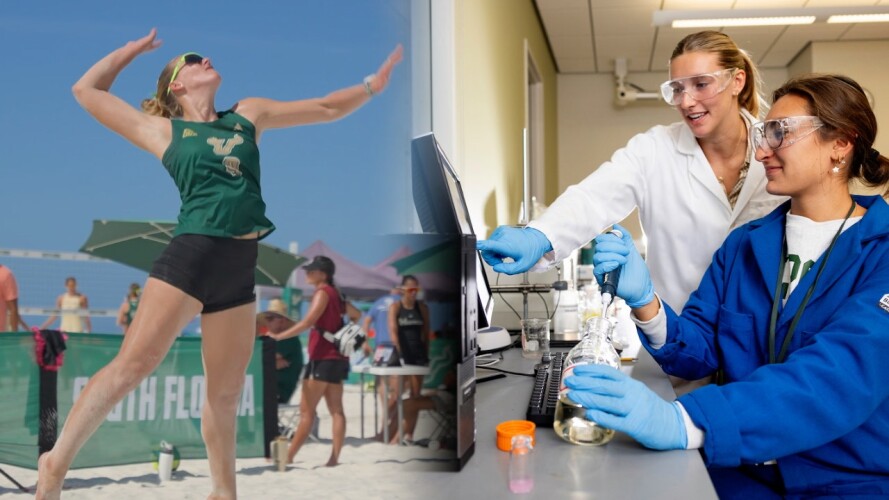


TAMPA, Fla. — When South Florida beach volleyball player Addison Bounds graduates this August, she'll leave the sand behind. But for the former Division-I athlete, the competition is far from over.
Instead, she's channeling that same competitive drive into building her own company.
WATCH: USF beach volleyball player creates company to prevent drink spiking
"Yes, I am a very competitive person," Bounds said. "I grew up in a competitive family. That has served me well in athletics and off the court."
After helping launch the University of South Florida's beach volleyball program during its inaugural season, Bounds is now the CEO and co-founder of Elora, a startup focused on preventing drink spiking.
The company is developing miniature chemical sensors embedded into jewelry that can detect drugs in beverages before someone takes a sip.
"Just use your finger or a straw to transfer a drop of the beverage onto the detection zone," Bounds explained.
"The sensors are internal, so you can't see them at all. We're using proprietary fluid delivery systems to move that drop of the beverage onto our electrodes. It's similar to what continuous glucose monitors use. Instead of detecting glucose in your blood, we're detecting the presence of date rape drugs in your beverage."
If a drink tests positive, users receive an alert on their phone, and their location can be sent to trusted contacts through the app.
"I have a lot of friends who have had their drinks spiked, and I have a lot of conviction around the issue," Bounds said.
While studying at Cal Poly, Bounds saw firsthand how common drink spiking had become on college campuses and in nightlife settings.
"Fifty-six percent of women have unknowingly consumed spiked beverages," she said. "It's a really big problem, and I feel really passionate about women's safety in general and sexual assault prevention."
To bring the idea to life, Bounds reunited with former Cal Poly teammate Kiara Robichaud, whose background in biomedical engineering helped turn Elora from a concept into a developing product.
"We're aiming to detect all four of the main date rape drugs: Rohypnol, GHB, ketamine, and benzodiazepines," Bounds said. "Each drug has a unique electrical signature when a charge is applied. By identifying where those peaks occur, we can determine what substance is present in the drink."
So far, Elora has received more than $95,000 through grants and startup competitions, putting the company closer to its initial fundraising goal of $160,000.
Beyond helping individuals protect themselves, Bounds hopes the technology can also help prevent drink spiking altogether.
"By collecting this data and including location tags, we can hold venues accountable if they're not contributing to safe environments for their patrons," she said.
From helping build a collegiate volleyball program to developing technology with the potential to protect others.
Share Your Story with Kyle Burger

For Tampa Bay 28 Sports Anchor Kyle Burger, pride in our local teams goes beyond college and the pros. Sports connect us as communities and families. You can connect with Kyle to share your passion for your local athletes below.
.

Is the beach public or private property? Hotel owner goes head-to-head with City of St. Pete Beach in lawsuit
The battle over a beach is now headed to federal court. St. Pete Beach is going head-to-head with a local hotel owner over the issue of who owns the sand.
