

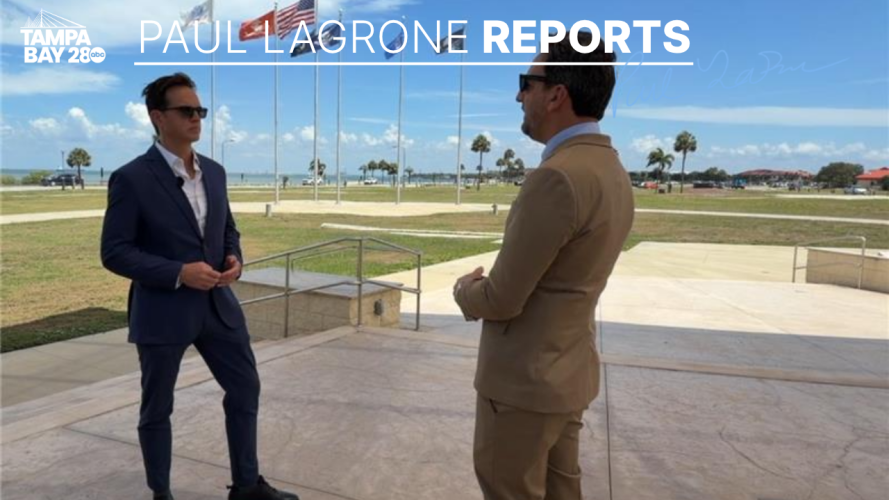


TAMPA, Fla. — The story of America is often told through its cities, its leaders, and its wars. But here in Tampa Bay, part of that story lies behind the gates of MacDill Air Force Base.
For generations, MacDill has helped drive the growth of our region, shaped our local identity, and connected Tampa Bay to events unfolding around the world.
WATCH: MacDill Air Force Base shaped Tampa Bay and remains at the center of America's global military mission
Now, as America approaches its 250th anniversary, Tampa Bay 28 anchor Paul LaGrone looks at the base’s remarkable legacy and its continuing role at the center of global affairs.
When America projects power around the world, when military commanders respond to crises, and when decisions are made that can alter the course of events thousands of miles away, there’s a good chance it starts right here.
MacDill Air Force Base in Tampa is home to U.S. Central Command. It is the nerve center overseeing military operations across one of the most volatile regions on Earth. Now at a moment when tensions with Iran once again dominate global headlines, MacDill’s role has never been more relevant.
But long before it shaped world events, it shaped Tampa Bay.
As America celebrates its 250th birthday, the story of MacDill is also the story of a growing nation and city.
Established in 1941, MacDill quickly became one of the nation’s premier military airfields during World War II. But its impact stretched far beyond national defense.
“We always associate Tampa as a military town, having evolved out of Fort Brooke, out of the territorial defense of the new territory of Florida; it really kind of established its legacy from the very beginning in that. But the fact that once the Air Force came here and made it the headquarters for all Air Force bases in the southeastern United States around World War Two really cemented its legacy as a town of air power,” said Stephen Ove, MacDill Air Force Base Historian.
The base is named after Colonel Leslie MacDill, an aviation pioneer whose military career helped define the early days of American flight.
As military personnel and their families arrived, Tampa expanded around them. Businesses opened, neighborhoods grew, and roads followed. The economic and cultural impact would be felt for generations.
“We used to call it, during the war, Florida's Air Base City, because it wasn't just MacDill, it was also Drew Army Airfield, where the airport is. Then you have Pinellas Armory Airfield, where Pinellas Clearwater National is, and also Hillsborough Army Airfield, Brooksville Army Airfield, Sarasota Army airfield. There's literally dozens and dozens of bases just in our vicinity, in Florida and across the southeast that were headquartered out here,” said Ove.
Even some of Tampa’s most recognizable landmarks trace their roots to military aviation. Dale Mabry Highway carries the name of Captain Dale Mabry, one of Florida’s early aviation heroes. Today, thousands drive on the roadway every day. Many never realize they’re traveling on a living piece of Tampa military history.
“So, the Corps of Engineers helped construct Dale Mabry Highway. And the reason they selected Dale, maybe he was awarded, an early Air Force aviator, a balloonist who crashed and perished with the Roma. And so having the connection to Florida, his father was a Supreme Court justice. That was, really, a good person to honor, with in a period of time when there really weren't a lot of people that had perished yet in the wars,” explained Ove.
For more than eight decades, MacDill has evolved alongside Tampa Bay. New aircraft arrived, missions emerged, and new generations answered the call. And with each chapter, the connection between the base and the community grew stronger.
Today that connection extends far beyond Tampa Bay. MacDill is home not only to America’s air refueling mission but also to CENTCOM, which is the headquarters responsible for military operations across the Middle East.
“And I think that just growing up here, I remember in the Gulf War, and, and watching the news, even back then, knowing that might be what I want to do one day and watching General Norman Schwarzkopf and knowing that where I live, it was playing this vital role in the mission, and, and was restoring confidence. I think, for a lot of people, in the wake of the Vietnam War and how that mission was pulled off in the Gulf War, and then the Super Bowl that year, in 1991, you know, Whitney Houston singing the national anthem. And patriotism was something that people, you know, proudly displayed. And it, it, it was rooted here. I mean, this is where the work was being done,” said LaGrone.
“Absolutely. Another important event in American history that really ties to the history of the Special Operations Command. The central command here at the base was the Iran hostage crisis from 1979. So really, that resulted in the creation of Central Command as a modern command in 1983. And it also resulted in the creation of a unified Special Operations Command, through another congressional act in 1987,” explained Ove.
From the buildings overlooking Tampa Bay, military leaders monitor conflicts, coordinate allies, and help guide America’s response to the world’s most dangerous challenges.
For most Americans, those decisions feel a world away. But here in Tampa they’re happening in our own backyard.
As America prepares to celebrate 250 years of Independence, MacDill stands as a reminder of how local history and national history often become one and the same.
A base that built a city, a city that supported a mission, and a mission that today reaches around the Globe.
The story of MacDill is ultimately a story about leadership, service, and sacrifice from the people working around the clock to ensure America’s next 250 years are as strong as its first.
Share Your Story with Paul

Tampa Bay 28 Anchor Paul LaGrone grew up in Plant City, so he’s seen firsthand how that part of Hillsborough County has changed over the years. As Tampa Bay 28’s leading political anchor he knows state and local politics impact decisions we make at home. Paul wants to hear how state policies impact you. Just use the form below to send him a message.
.

Bradenton community responds after 20-year-old volleyball star dies from disease that affects 2 in a million
The 20-year-old IMG Academy volleyball star and Under Armour All-American died Sept. 16 after a three-month battle with the rare blood disorder — even though doctors had found her a 100% bone marrow match, her mother, Tanya Mack tells Tampa Bay 28 reporter Haley Zarcone.
