

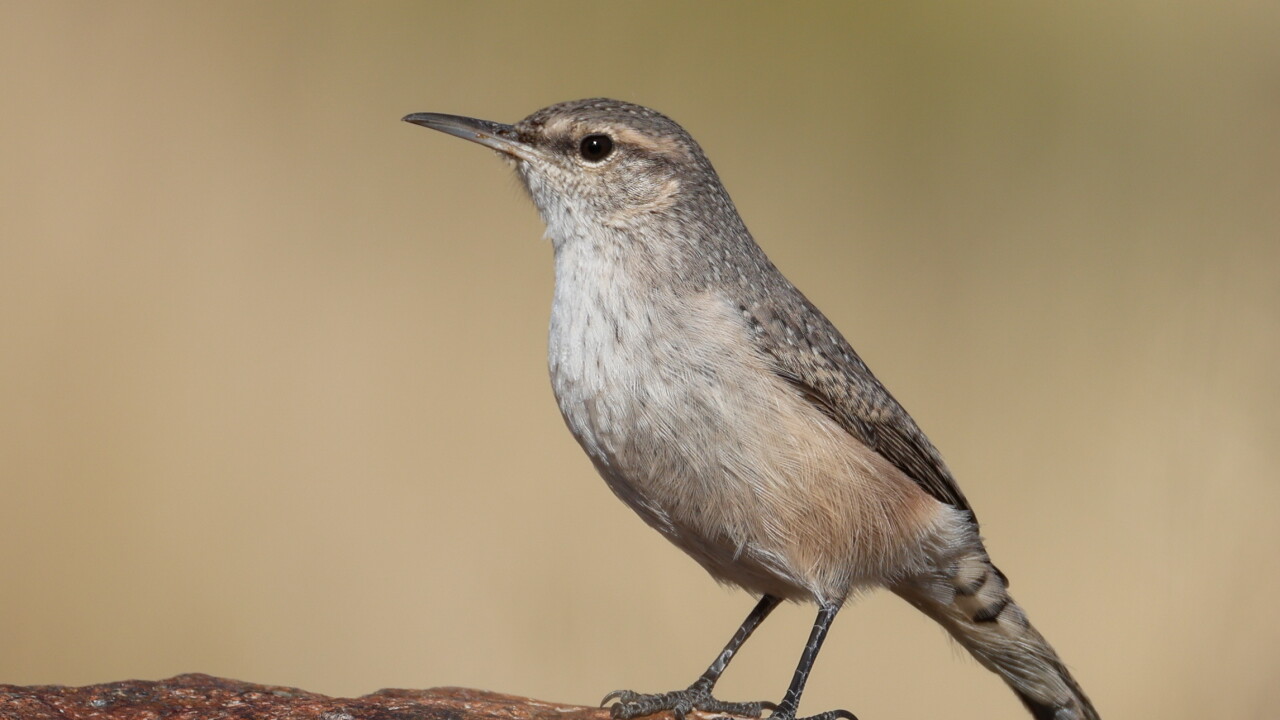


ST. CLOUD, Fla. — Alex Marine says he spent two days trying to capture a photograph of a Rock Wren near Utah’s Great Salt Lake.
He traveled to the bird. He waited for the right moment. He took the photograph through his camera.
Then Instagram flagged the image as “likely made with AI.”
“So with that photo in particular, it actually took me two days to get that shot,” Alex Marine told Tampa Bay 28 reporter Michael Paluska.
Alex was on a photography expedition at Utah’s Great Salt Lake.
The Marines are both wildlife biologists and fine art wildlife photographers. They take photos as a hobby. The label was more than a technological mistake. They said it called into question the work that went into capturing a real moment in nature.
“So it it was a lot of time and and work and and joy and excitement that went into taking that photo. So to see it get discredited and flagged as AI immediately was surprising and disheartening,” Alex Marine said. “The first day I went out, found where the wren was hanging out, figured out its habits. I spent time just watching it and getting familiar with it, and by the time I knew like where it wanted to be, the sun had come up and the lighting wasn't ideal. So I went back the next morning to get the the like better lighting on the bird, the more like personal close-up shot.”
The Marines spoke exclusively with Paluska about what they say is a growing concern: technology intended to identify artificial intelligence-generated content instead casting doubt on photographs created by people in the real world.
Paluska met the couple in St. Cloud, at Chisholm Park Public Boat Ramp, as they photographed birds and showed Paluska the Rock Wren image Instagram had flagged.
Alex Marine pulled up the file to compare what he captured with what he posted to social media.
“This is the one that was flagged as likely made by AI, and this is my edit of it,” Alex Marine said.
But while reviewing the image, he realized he had done even less to the photograph than he initially remembered.
“I didn’t do anything to that one besides cropping it. I thought I had an edit on it,” he said.
“Didn’t even edit it. I just cropped it. I never realized that. That's great,” Alex Marine said with a laugh.
The Rock Wren wasn't the couple's only concern.
Marine said Instagram also displayed information questioning the identification of birds in two other photographs.
In one case, he said the platform indicated that a bird he identified as a King Rail was actually a Virginia Rail.
“The overview stated that I had misidentified that bird, and it was a Virginia rail instead of a
King rail. It is a King rail, but he didn't misidentify the bird,” Alex Marine said.
Another case involved a Rufous-vented Ground-Cuckoo the couple photographed after traveling to Costa Rica.
“We went to Costa Rica for this bird,” Alex Marine said.
“The AI about this photo labeled as a misidentified Great Currasow. It was a Rufous Vented Ground Cuckoo. So three photos that I've noticed,” he said.
The experience has left the couple confronting an unusual problem: how photographers prove that something captured through a camera lens actually happened.
While photographing the couple, Paluska turned his camera on himself to document the process.
“I got Mary. We got Alex over here. We're we're shooting this in camera. This is not AI. This is not generated. This is a real deal. This is what we have to do now. We have to like show that we're actually shooting, so AI doesn't tell us that we're liars,” Paluska said.
For the Marines, the issue extends beyond the credibility of an individual photograph.
The couple are birders and wildlife biologists first, and they see photography as a tool to help people develop a connection to animals and nature.
“You can't love what you don't know, and you can't protect what you don't love,” Mary Marine said.
She worries AI labels could lead people to question whether the wildlife, places and moments shown in photographs are real.
“It’s now stealing your credibility, and so it steals your work to create like better generated content. And then because of that content, it can now steal your credibility, which is such a big deal,” she said.
Paluska reached out to Meta, Instagram’s parent company, for an explanation about why the photos were flagged and how its AI labeling system works. We have not received a response.
For the Marines, the issue reaches beyond how social media platforms label photographs. They worry that if people stop trusting what they see, it could become harder to connect audiences with the wildlife they are trying to protect.
“If you can't trust what your eyes are seeing, if you can't trust people, and you can't trust art to be reality and to be a reflection of something that people are seeing, we completely close off the majority of people from getting to participate in the protection and conservation of, you know, some of the most beautiful things on this planet, including birds,” Mary Marine said.
She believes social media companies need to reconsider how their policies affect artists whose work may be incorrectly associated with artificial intelligence.
“The only thing that we can really do to stop this witch hunt on artists and to kind of stop the double theft that's happening to artists, is to look at the policy and refocus it from protecting the corporations to protecting the people, and I think that that's the only answer,” she said.
For Mary and Alex Marine, the concern is no longer simply whether people will appreciate a photograph.
It's whether they will believe the photograph is real at all.

HOA said yes, but the CDD says no: Sun City Center homeowners ordered to remove backyard fences
For years, homeowners in one Hillsborough County neighborhood had fences around their backyards — fences that were approved by their homeowners' association. But now, another organization with government powers says some of those fences are blocking drainage easements and have to go, at the owners' expense.
