

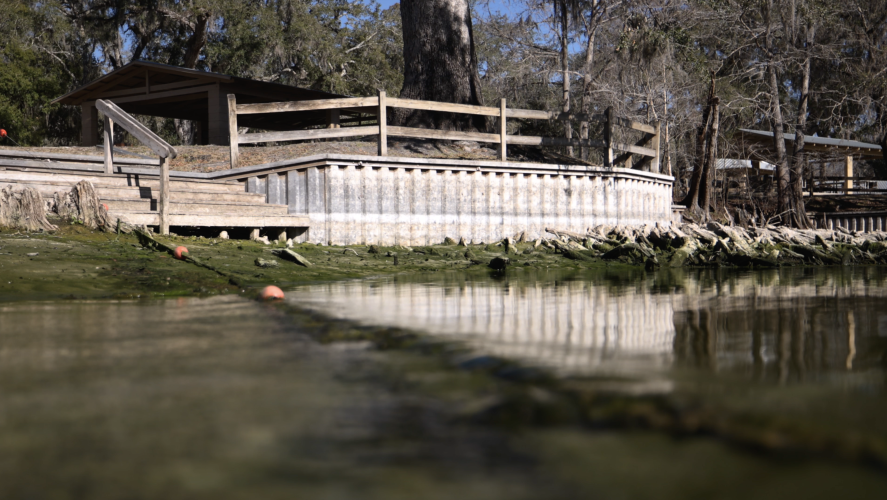


HIGH SPRINGS, Fla. — Florida has the largest concentration of freshwater springs anywhere in the world, and the Floridan Aquifer supplies drinking water to almost 10 million people. But an extreme drought — the driest in 25 years — is threatening that resource, and the rapid expansion of hyper-scale data centers could add new pressure to an already strained system.
According to a University of Michigan study, balancing the need for water and power to keep data centers cool is nearly impossible.
“Some individual data centers use hundreds of millions of gallons annually, dwarfing the usage of entire communities, the data centers are within. Most facilities use over 10 million gallons (38 million liters) of water per year,” the study noted. “On average, a single data center can consume up to 2 megawatt hours (MWh) of electricity, which is roughly the equivalent of the power consumption of a small town. Data centers consumed more than 4% of U.S. electricity in 2023, with estimates suggesting that consumption could rise to 12% by 2028.”
WATCH: AI Boom VS Florida’s Water: Could data centers tip our natural springs to a breaking point?
As AI drives a surge in demand for these facilities, Florida is quickly becoming a hot spot for potential development, and local leaders are now deciding whether these projects get built.
"These data centers are the backbone of technology. They're the backbone of this whole AI, I don't want to even say movement — that is the future," Citrus County District 1 Commissioner Jeff Kinnard told Tampa Bay 28 reporter Michael Paluska.
Kinnard tells Paluska a company called Deltona Corp. submitted an application to rezone more than 800 acres as part of an expansion of Holder Industrial Park.
The industrial park is located in the Kings Bay Spring Group Springshed.
“And what caught my attention was in the list of permitted uses, they've named specifically data centers there,” Kinnard said. “Now, I think that the text, the existing text on the 500 acres of industrial piece, would have already allowed a data center to be built, but apparently, Deltona has requested that they put that in there specifically. We want to make sure, first of all, that it could be a very good thing for our community, the investment, the jobs, could be very good for our community, but we want to bring them here on our terms. Our unemployment stats are not good. The last time we saw was roughly 7.5% unemployment, which is the third-highest in the state of Florida. That's not good. And so we want to make sure that we can be part of that. And maybe, maybe there's some, some collateral businesses that come off of that as well by having something like that in our community.”
“You’re willing to hold their feet to the fire, not see those dollars and cents they're throwing at you, and say, ‘if it's not good for this community, we're walking away?’” Paluska asked.
“100% this is too special a place to let one single entity, you know, diminish what makes Crystal River and Citrus County so special,” Kinnard responded.
"Where do you think this goes if there isn’t regulation on these massive centers?” Paluska asked Haley Moody, Director of the Howard T. Odum Florida Springs Institute.
"If a large data center or another industry that uses a lot of water comes into that spring shed area, it can have a real devastating impact on that spring," Moody told Paluska.
Floridians already use more than 6 billion gallons of fresh water per day, according to the Florida Department of Environmental Protection. The state's springs are under severe stress. Of the 1,115 springs documented by the Florida Department of Environmental Protection, Moody said an estimated 80% are impaired.
Impaired is just another way to say polluted. And, the more we take, the more our springs are impacted.
“The US Geological Survey estimates that just over 90% of Florida's residents and tourists rely on our groundwater for our drinking water and all of our other uses,” Moody said. “The largest consumer of that groundwater in Florida is the public supply category. So that's people that are connected to a public or privately owned utility company, that's a lot of us, and in that category, closer to 60% of the water being used is for outdoor purposes.”
In 2023, National Geographic photographer Jason Gulley took Paluska out to document the pollution crisis, where once-blue waters are consumed by algal blooms, snuffing out life in ecosystems that were once thriving. Little has changed.
Moody described what unchecked data center growth could mean for the state.
"Well, I see springs going dry. I see private wells going dry. I see sinkholes forming. I see the land collapsing. I see people moving out of Florida. I see it impacting our tourism industry, which is huge here, you know, I think, ecosystem collapse. I think that's, you know, that's something that could happen," Moody said.
In good times, when rainfall is plentiful, the aquifer recharges, and springs thrive, but that’s not what’s happening right now. According to the U.S. Drought Monitor, 98 percent of the state is experiencing some level of drought, with over 67 percent in “severe drought”, the most since 2001.
"You can think about it as trying to fill up a cup that's already full. It's got to find its way out somewhere. It's going to spill out. And that's what a spring is," Moody said.
But extreme drought does the opposite — wells run dry, and springs retreat.
At the University of Florida, Erik Deumens, Senior Director of UF Information Technology, gave Paluska a rare behind-the-scenes tour of HiPerGator AI, "the fastest supercomputer owned and operated by a university in the U.S," Deumens said.
The fans inside are louder than a jet engine, and the margin for error is essentially zero.
"If the air cooling system failed, how long until meltdown?" Paluska asked.
"It's four minutes," Deumens said.
Unlike some hyperscale data centers that rely on outdated evaporative cooling systems that consume millions of gallons of water, UF uses a closed-loop system.
"The water that is circulated by these pumps actually comes from a cold water tank, 12,000 gallons of cold water," Deumens said.
Deumens said the technology exists for large data centers to operate the same way, but the infrastructure is expensive, and it requires more energy.
"They do have the money! They have billions of dollars. They have the money. It's just there. They think it's cheaper, right? They like to get more profits for them," Deumens said.
He said government policy could force a change.
"What states and cities should do is they should tax them for using their water right, so that it becomes so expensive that it's cheaper for them to do what we do, which is to chill the water right and have a closed loop," Deumens said.
Commissioner Kinnard said there are no active data center proposals in Citrus County at this time. Still, the county wants to update local ordinances to protect Crystal River and its natural springs before any proposals move forward.
Public hearings on the Holder Industrial Park rezoning application are scheduled for March 5 at 9 AM at the Lecanto Government Building located at 3600 W Sovereign Path, Lecanto, Florida 3446.
This story was reported on-air by Michael Paluska and converted to this platform with the assistance of AI. Paluska and our editorial team verify all reporting on all platforms for fairness and accuracy.
Share Your Story with Michael

A lot goes into the price of paradise and Michael Paluska focuses on every aspect. From the job market and housing to how Florida’s growth impacts our state’s wildlife. Send Michael tips to keep these important conversations going.
.

'Left in the dark': Families say they weren't notified during Aviata evacuation
Tampa Bay 28 heard from multiple families with similar questions and concerns about the lack of communication.
