

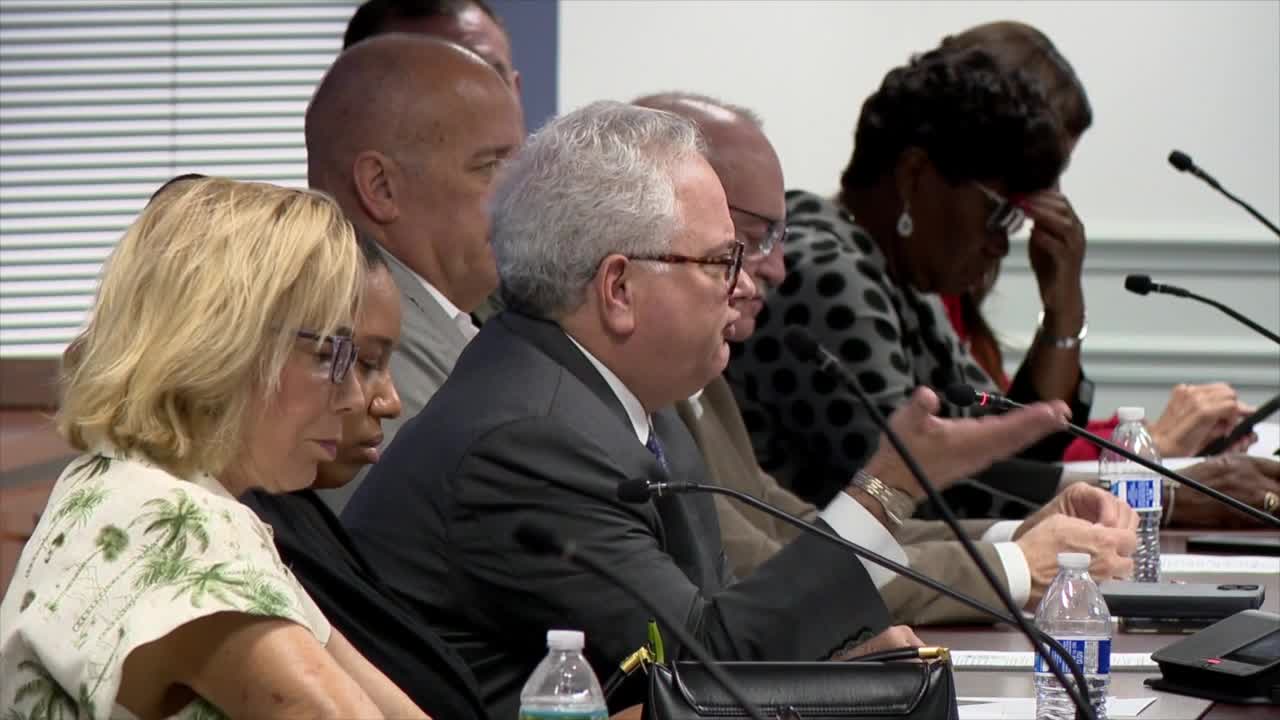


TAMPA, FL (WFTS) — A $10.3 million road project intended to improve access and safety near the proposed Tampa Bay Rays stadium is moving forward, but Hillsborough County transportation leaders say widening two roads will not be enough to address the larger changes expected in West Tampa.
The Hillsborough Transportation Planning Organization approved an amendment Wednesday to its fiscal year 2027-2031 Transportation Improvement Program. The amendment adds nearly $7 million to planned operational and safety improvements along Tampa Bay Boulevard and Air Cargo Road.
Watch report from Jada Williams:
The project’s previous total was $3,407,714. The amended total is $10,283,642, including $9,952,621 for construction, $31,412 for construction-support operations and $299,609 for additional construction support.
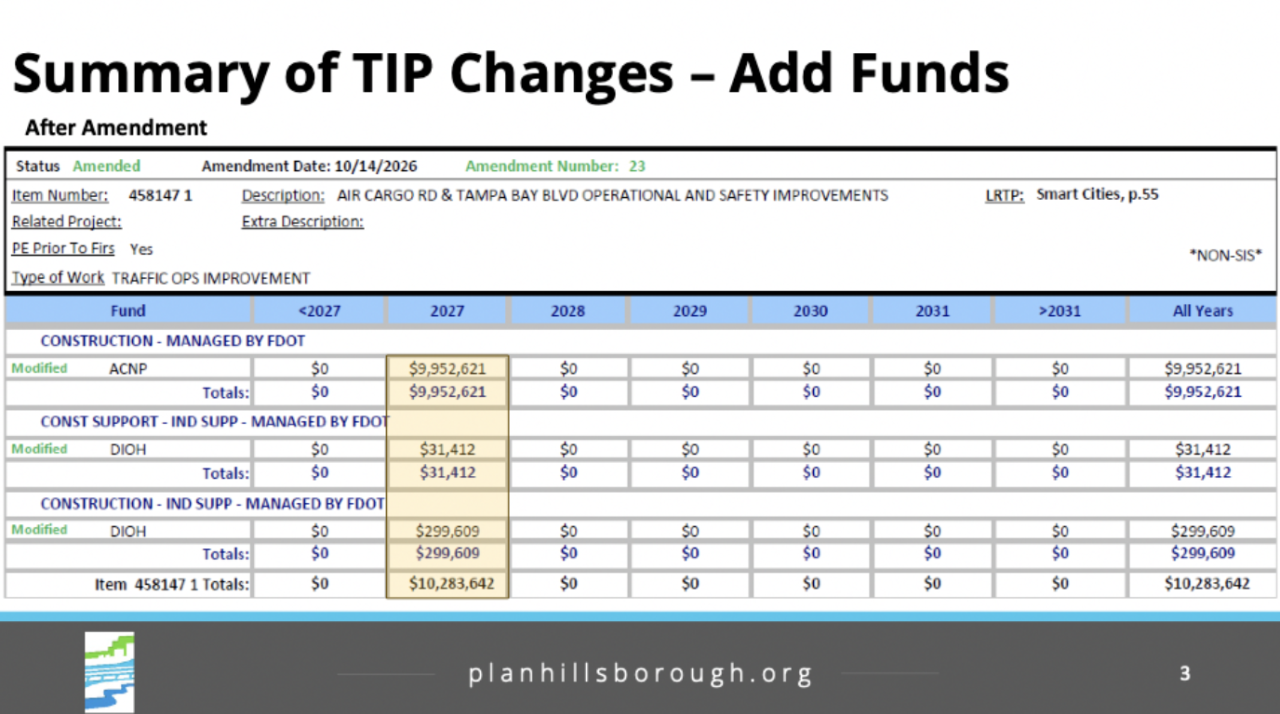
The work is scheduled for 2027 and includes widening portions of Tampa Bay Boulevard and Air Cargo Road from two lanes to four, resurfacing, sidewalk construction, roundabout upgrades and two new traffic signals.
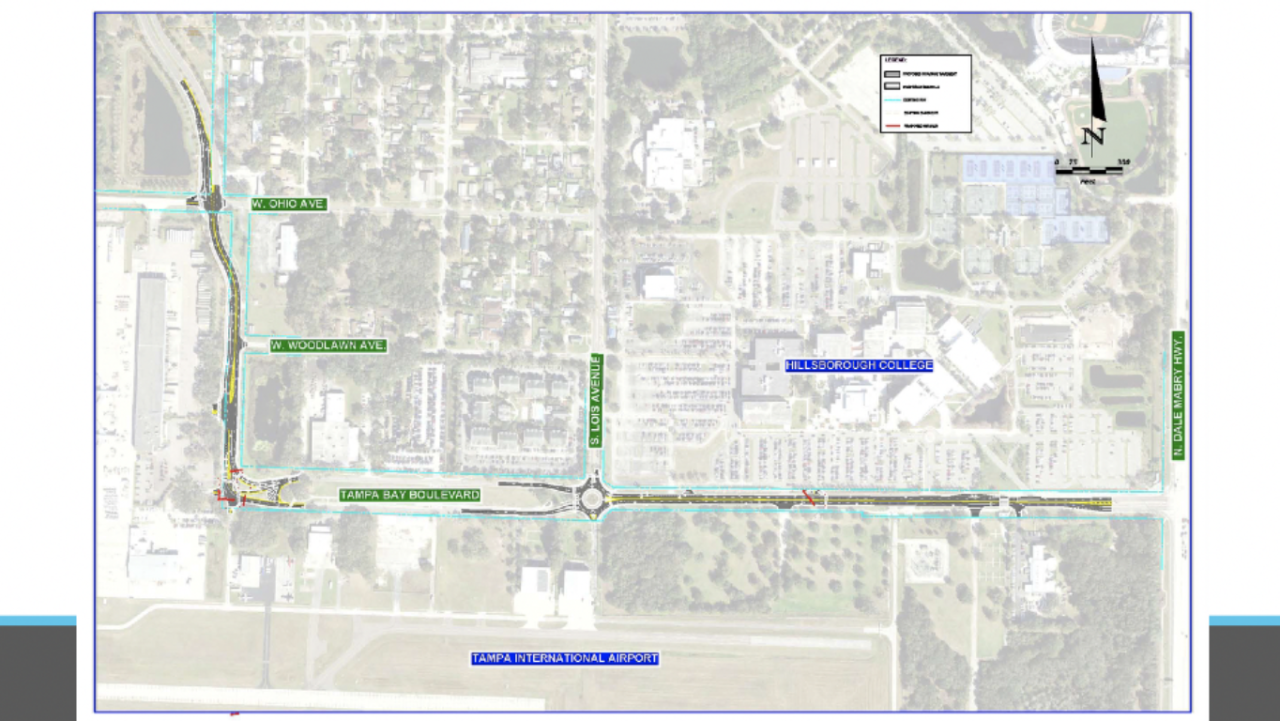
During the presentation, staff explained that Tampa Bay Boulevard would be widened along portions of the corridor where only two lanes currently exist. A section that is already four lanes would not require widening.
The existing roundabout at South Lois Avenue and Tampa Bay Boulevard would be expanded from one lane to two. The intersection of Tampa Bay Boulevard and Air Cargo Road would also be extensively reconstructed to accommodate both airport traffic and traffic anticipated from stadium events.
Air Cargo Road would be widened to four lanes, and a new traffic signal would be added near the planned stadium entrance.
Why the project cost increased
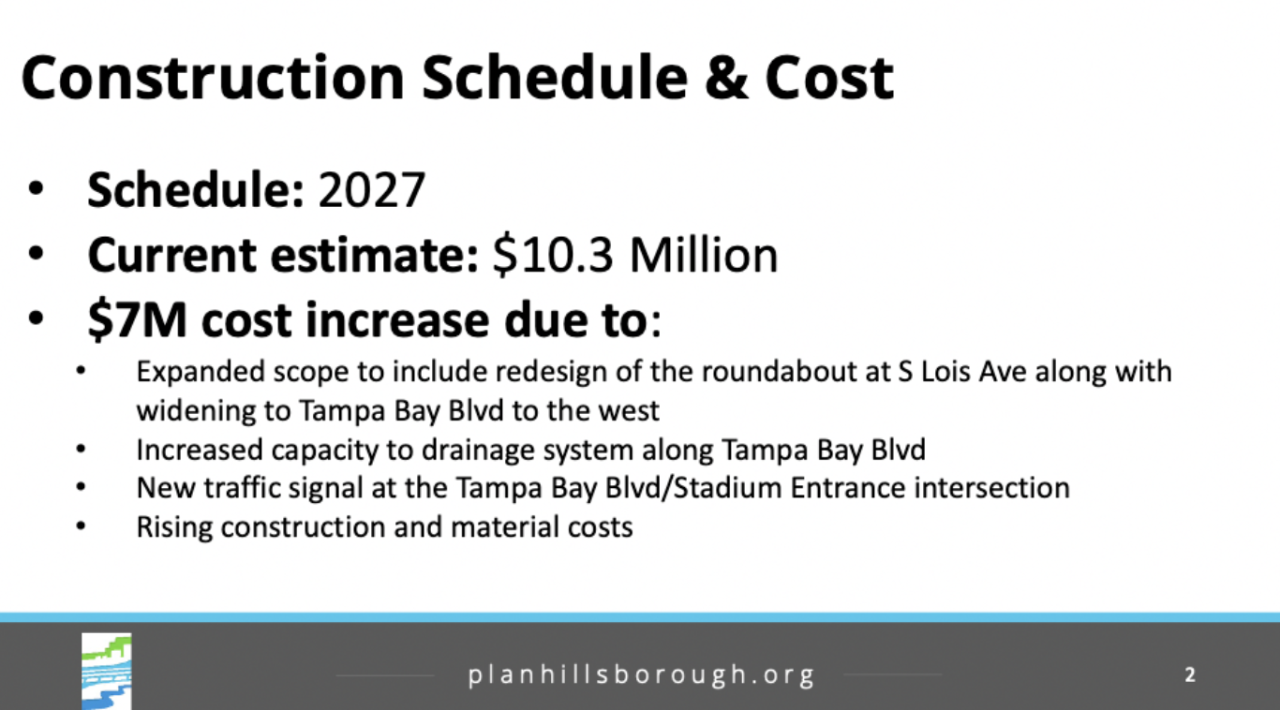
The approximately $7 million increase reflects an expanded scope and higher construction costs.
According to TPO presentation materials, the additional work includes redesigning the roundabout at South Lois Avenue, widening Tampa Bay Boulevard farther west, increasing the drainage system’s capacity and installing a new traffic signal at the stadium entrance. Rising material and construction costs were also cited.
Flooding emerged as a recurring concern during the board’s discussion. Staff described Tampa Bay Boulevard and Air Cargo Road as areas with known flooding problems and said the expanded project would try to mitigate those conditions by increasing drainage capacity.
Board members asked whether the additional $7 million would affect funding for other transportation projects in the Tampa Bay region.
Staff said it would not.
“That $7 million increase is a combination of state and federal funds that are coming from FDOT,” staff told the board. “They are from a statewide pot of reserves, so it’s not taking away from any projects in the Tampa Bay region.”
The comparative financial report identifies the primary construction funding as Advanced Construction National Highway Performance Program funding. State in-house operations support is listed separately.
Is this the entire stadium transportation plan?
One question raised outside the meeting was whether widening portions of two roads, adding lanes and building sidewalks represented the full transportation plan surrounding the proposed stadium.
I asked TPO board member and Tampa City Council Chair Alan Clendenin that question after the meeting.
“No, that’s not it at all,” Clendenin said. “That’s just part of the process.”
Clendenin said the area is also expected to receive pedestrian improvements beyond what Wednesday’s amendment included.
“We’re also going to have pedestrian bridges going over Dale Mabry,” Clendenin said. “We’re going to have better sidewalks, you know, pedestrian enhancements. There’s going to be a lot, a lot of transportation improvements.”
The distinction is important. The TPO vote approved the amendment for the Air Cargo Road and Tampa Bay Boulevard project. Other concepts discussed during the meeting and interview, including pedestrian bridges, aren't all included in that specific $10.3 million amendment.
Board members also emphasized that plans are developing quickly and that decision-makers and the public should rely on the most current project maps.
Neighborhood voices become part of the discussion
The meeting also focused on people who already live and operate businesses in West Tampa.
Board members discussed how stadium-related transportation planning could affect everyday travel for residents, rather than focusing exclusively on event-day traffic.
Board member and Hillsborough County Commissioner Harry Cohen referenced a recent presentation made to neighborhood leaders about work planned around the stadium district.
“Mr. Hunter gave a great presentation the other morning to a group of neighborhood leaders around the stadium that showed, in some level of detail, all of the different things that FDOT was going to be doing over the next couple of years,” Cohen said.
Cohen said the presentation included stormwater projects and helped explain where some of the region’s stormwater investment is being directed.
He argued that the TPO needs a similar regional view because many of its members will be asked to make decisions affecting the same connected area.
“I think we need to see the big picture and the big context,” Cohen said.
Cohen’s comments establish that neighborhood leaders received a presentation about the projects. The discussion did not fully describe residents’ responses or indicate that Cohen had personally conducted individual community interviews.
Pedestrian safety, sidewalks and street classifications
Several board members said growing vehicle capacity cannot be the only concern.
Clendenin urged the board to consider pedestrian movement and protection along Dale Mabry Highway, which he characterized as a high-speed roadway. He referenced pedestrian bridges but also stressed the need to protect people walking alongside the road.
The discussion also focused on whether another pedestrian bridge would be needed and how future pedestrian connections would function around the proposed stadium.
Members asked whether Tampa Bay Boulevard should be treated as a higher-priority street type and whether the City should apply pedestrian and vehicle standards consistently across comparable streets.
The conversation included the possibility of changing the roadway’s official classification, although staff explained that the City of Tampa would be responsible for determining any classification update.
Because the stadium area may differ from other parts of the city, members also discussed whether Tampa could eventually create specialized development guidelines for the district.
No final street-classification change or special development policy was adopted as part of the TIP amendment.
Rideshare, small businesses and daily travel
Potential locations for rideshare pickup and drop-off were also discussed.
The board did not select a location, but members acknowledged that rideshare traffic will have to be considered alongside private vehicles, pedestrians, airport traffic and surrounding businesses.
Public comments submitted before the meeting also called for the project to account for daily community needs.
In email comments, Alfonso Lopez expressed support for moving both transportation amendments forward. He clarified that he was not asking the board to delay funding or take action outside its authority.
Regarding Tampa Bay Boulevard, Lopez said improvements intended to support stadium activity should also improve routine travel for nearby residents and businesses. His comments called for reviews of pedestrian and ADA access, bicycle and transit connections, and the reliability of everyday trips.
Lopez also encouraged coordination with utility and stormwater agencies to determine whether necessary underground work could be aligned with roadway reconstruction. He argued that additions should be pursued only when there is a demonstrated need and a life-cycle savings.
His comments also raised questions about rideshare areas and construction's possible effects on small businesses.
Stadium and airport projects are increasingly connected
Cohen and other board members argued that the stadium cannot be studied in isolation from Tampa International Airport and the surrounding state road network.
Cohen expressed concern about the pace and coordination of projects near State Road 60, Interstate 275, the Howard Frankland Bridge and the airport.
“The ballpark and the airport have the two largest public investments or public-private investments, I should say, going on in the region,” Cohen said.
He argued that the stadium and airport districts are close enough, and increasingly interdependent enough, that the board needs to understand project schedules across the entire area.
Clendenin made a similar point after the meeting.
“There’s other types of how we’re going to accommodate the Rays stadium, the growth and expansion of Tampa International Airport, and what that means for transportation in that critical area,” Clendenin said.
Board members also raised the possibility that two stadium events could occur at the same time. That discussion included traffic, parking and emergency planning implications.
Another board member questioned whether resources should be spent studying overlapping events, citing public statements from Rays leadership that games would not overlap and that parking arrangements had been handled.
Those assurances did not end the broader board conversation about regional traffic and event planning.
What happens if the stadium does not move forward?
Board member Joshua Wostal asked whether the transportation money would remain available if a lawsuit or another unresolved issue prevented the proposed Rays stadium from being built.
Staff at the meeting did not provide a definitive answer and indicated that follow-up with another official would be necessary.
The exchange left an important question unresolved: which parts of the road project would move forward independently if the stadium project changed or failed to proceed.
The approved work also addresses existing transportation and flooding conditions, but the meeting did not establish the status of every project element under a scenario in which the stadium is not constructed.
Board seeks a broader regional review
Cohen proposed that the board receive a regional overview of transportation projects around the proposed stadium and Tampa International Airport.
He asked for a timeline showing when different projects are expected to begin and how they may overlap.
“We had two big things happening at the beginning of 2029, and we need to know exactly where we’re going to be when that happens,” Cohen said.
The board approved that request without opposition. During the discussion, Dec. 9 was identified as the earliest practicable time for the presentation to return.
The chair also raised the possibility of forming an ad hoc committee if board members later decide that the subject requires a deeper review. Cohen noted that the board’s membership may change following elections and local government reorganization meetings, but said future members could decide what committee structure is appropriate after receiving the regional information.
Additional study could examine the West Tampa stadium district
The meeting also discussed a possible benchmarking study for a West Tampa Rays district.
The proposed first phase could examine available transportation data, including pedestrian movement and delays, to help shape a future scope of work.
A more comprehensive second phase could require financial contributions from partner organizations, potentially including the county, city and Tampa Sports Authority.
That study was discussed as a possible future effort and should not be confused with the $10.3 million project approved Wednesday.
Questions about the stadium construction timeline
The proposed stadium is expected to open in 2029, but a previously anticipated September 2026 groundbreaking passed without a public groundbreaking event.
Clendenin said he remains confident the project can advance quickly once visible work begins.
“There’s a lot of things happening behind the scenes, a lot of work happening both within the county government, the city government, the Rays organization, the Florida Department of Transportation,” Clendenin said. “It’s all hands on deck.”
He said he expects groundwork to become visible in “weeks, not months,” with vertical construction potentially beginning in the spring.
Those statements are Clendenin’s expectations based on how he said he has been briefed. They were not presented as a formal stadium construction schedule during the TPO vote.
Clendenin also referenced the deconstruction of the existing campus and the process of moving students to a different school location as work that would have to occur before the larger development advances.
What the board approved
The TPO approved the Tampa Bay Boulevard and Air Cargo Road amendment by a 13-2 vote.
The approved financial plan raises the total programmed amount from $3,407,714 to $10,283,642.
The project includes:
- Widening portions of Tampa Bay Boulevard from two lanes to four
- Widening Air Cargo Road from two lanes to four
- Resurfacing
- Sidewalk work
- Expansion of the roundabout at South Lois Avenue
- Two new traffic signals
- Intersection improvements
- Increased drainage capacity
- Construction and operational support
The board separately approved Cohen’s request for a regional presentation examining projects around the proposed stadium and Tampa International Airport.
That broader review is expected to address questions the amendment alone does not answer, including how the projects will overlap, how pedestrians and residents will be protected, what simultaneous events could mean for the road network and whether the region’s construction schedule is aligned with the proposed stadium’s 2029 opening.
For West Tampa residents, the vote advances a defined road project. The meeting also made clear that the more difficult discussion about the neighborhood’s long-term transportation future is still unfolding.
Share Your Story with Jada
Jada Williams is focused on the issues that matter most to people in who live in Tampa and West Hillsborough County. From downtown Tampa to Town ‘n’ Country and Westchase, Jada works to bring you updates and solutions on everything from crime to infrastructure. Reach out to Jada below with your concerns for your neighborhood.
.

Pasco County mom of 5 takes in 3 children left without food or power whose mother faces neglect charges
Jasmine Young, a mother of 5, opened her home to three neglected girls as their mother faces child neglect charges for leaving them without food, power or water.
