

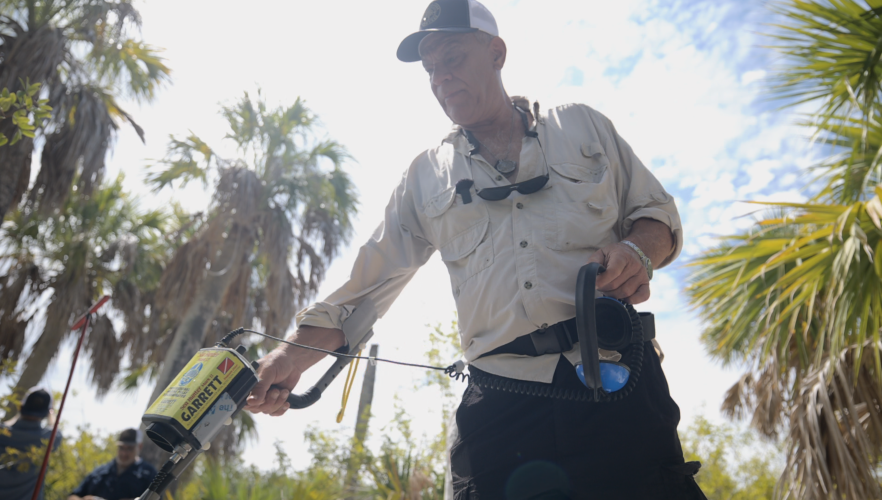


TAMPA, Fla. — Captain Joe Zsiga and his team from Epic Treasure Hunters took Tampa Bay 28 reporter Michael Paluska to a remote island that required two boat rides— a location they asked us to keep secret.
After reaching shore, the team from Epic Treasure Hunters bushwhacked through dense vegetation, watching for rattlesnakes and large spiders, to reach what Zsiga believes is where “X” marks the spot.
Watch full report from reporter Michael Paluska
Getting here is the culmination of years of research, digging deep into the archives and historical records.
“We're going to this undisclosed location; we do have permission to go there, so it'll all work out perfectly for everybody involved. And again, we've been here before, we have found stuff here, and it's a, it's a pretty interesting place. It's got a lot of history,” Zsiga said. “Just because we're targeting gold, the conquistadors were here, so it could be what 15th-century stuff.”
The team used metal detectors and probing rods to investigate the site. The detectors hit on something they believe could be a box of buried treasure buried deep underground — but getting it out will require heavier equipment.
"I guarantee that is not a tree down there," Zsiga said.
The team plans to return and dredge the hole.
Zsiga said the discovery, while incomplete, is not a setback.
"We do this on our own dime, but at the end of the day, you have to start somewhere, and it's not a failure. We know something's there, we just can't get it out of the ground yet, but we will," Zsiga said.
The pirates who may have buried treasure on the island remain unnamed — the team would not reveal that information.
"We know they were here. It's just a matter of who deposited what, where, and again, history only reveals so much magic," Zsiga said. "There's just no rhyme or reason, you can only follow the clues, and that's why we're here today.”
Not all treasure hunting happens on remote islands. Zachary Anness, owner of Beach Metal Detectives, rents out equipment and teaches people how to use metal detectors on the sand and under the waves.
”There's gold out there, there's treasure out there, and it can be found. It can be found by you," Anness said.
Anness gave Paluska a lesson on the beach. After some digging, Paluska pulled a ring out of the sand —Paluska’s first find.
"That guy right there is a treasure hunter, great job, Mike — congratulations, your first ring," Anness said.
Watch Tampa Bay 28 reporter Michael Paluska find his first "treasure."
At the Tampa Bay History Center, historian Rodney Kite-Powell put the treasure hunting tradition in context.
"Tampa Bay was a well-known bay,” Kite Powell said. “There was actually an incredible survey done by the Spanish in 1757 by this Spanish naval officer named Selly, and he really realized the value of Tampa Bay as a harbor, but also as a resource for timber, and so Tampa Bay was well known, so you definitely could have the idea of people coming in here, hide or coming in here just as temporary settlements, but from a permanent standpoint, nothing really was entrenched here until the late 1700s.”
And when the Spanish arrived, they believed Florida was full of gold. But that’s not the case.
“There’s no naturally occurring metal in Florida at all,” Kite-Powell said. “So, anything that's found here was brought here. The treasure was coming from Spanish fleets that were in Mexico or in South America. Those treasure fleets would then go to Havana, where they would get provisions and get everything they needed to make the transatlantic voyage back to Spain. And it was that voyage that was very dangerous in hurricane season, where a lot of the shipwrecks that we know about, like the Atocha, which is one of the most famous Florida shipwrecks that Mel Fisher found.”
“Gold fever, is it a real thing still?” Paluska asked.
"Of course,” Kite-Powell said with a smile.
“So there's been the search for sunken treasure along Florida's coast for a very, very long time, and the only thing is, there's probably more sunken treasure from shipwrecks than there would be buried treasure from intentional burying by pirates. That really wasn't something that was very common.”
The Tampa Bay History Center's Treasure Seekers room is a year-round exhibit dedicated to pirates, conquistadors, and shipwrecks, featuring plenty of real gold recovered over the years.
Shipwrecks happened on both the East and West Coasts of Florida.
But the most well-known finds have come from the Treasure Coast. Some historians estimate that $400 million in gold, silver, and jewels has been lost beneath the waves.
As the United States celebrates its 250th anniversary, the search for lost treasure off Florida's coast is a reminder that the spirit of exploration — and the dream of striking it rich — is as American as it gets.
“I live for this stuff," Zsiga said.
For Zsiga, the hunt is about more than striking it rich.
"Treasure hunting, it's about the gold and shiny stuff and expensive stuff, but it's also about history. And as we talked before, you know, if you can find a piece of history and share it with people in a museum or somewhere that can see that, and their kids and grandkids can see it, to me, it makes it all worthwhile," Zsiga said. “This is only one of many trips that we will have, and it won't end anytime soon."
Share Your Story with Michael

A lot goes into the price of paradise and Michael Paluska focuses on every aspect. From the job market and housing to how Florida’s growth impacts our state’s wildlife. Send Michael tips to keep these important conversations going.
.

Bradenton community responds after 20-year-old volleyball star dies from disease that affects 2 in a million
The 20-year-old IMG Academy volleyball star and Under Armour All-American died Sept. 16 after a three-month battle with the rare blood disorder — even though doctors had found her a 100% bone marrow match, her mother, Tanya Mack tells Tampa Bay 28 reporter Haley Zarcone.
