

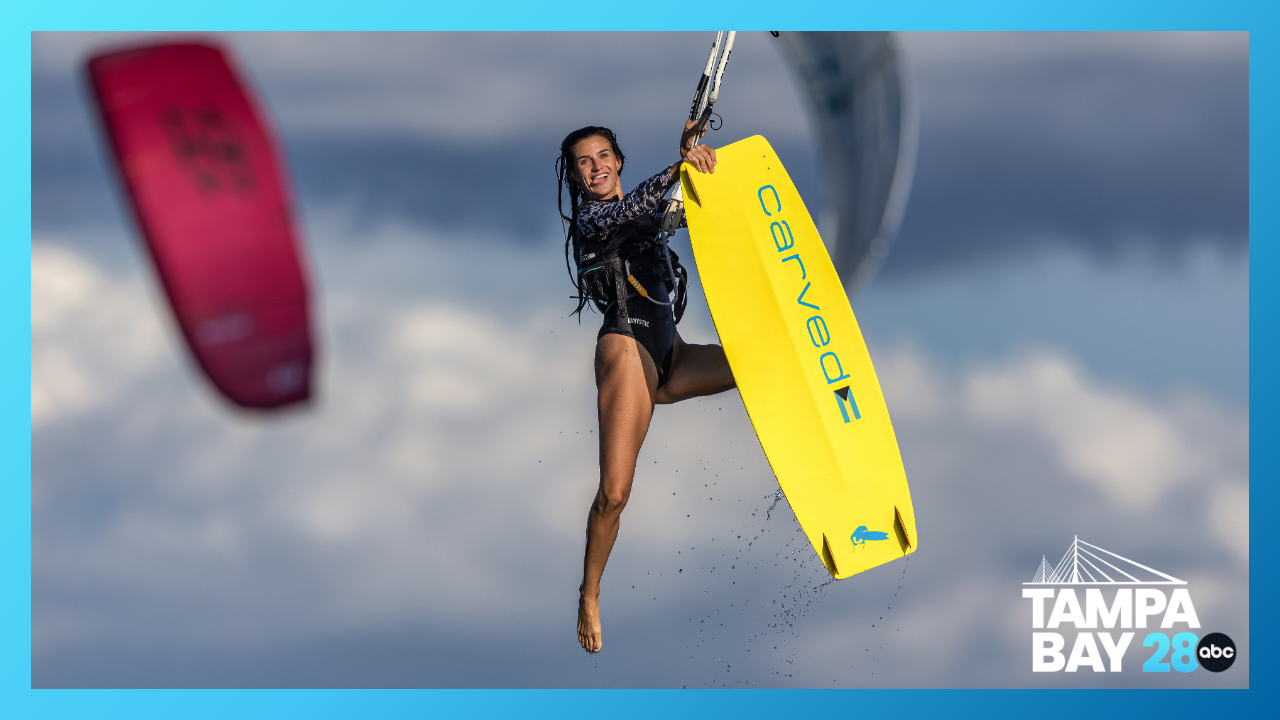


FLORIDA — Long seen as unlikely participants in extreme sports, women are reshaping the landscape by putting safety at the forefront.
Across extreme sports, women represent a significantly smaller share of participants, making up about 13% of skydivers according to the United States Parachute Association (USPA), roughly 35% in surfing and other ocean board sports, according to the Surf Industry Members Association, and around 19% of motorcycle riders, according to data collected by USA Today. These sports involve a lot of risk, making safety a critical part of every athlete’s approach.
From the sky to the water to the open road, women are proving that strength and caution go hand in hand, challenging long-held assumptions about who belongs in these high-risk spaces.
Tampa Bay 28's Frances Lin spoke with seven athletes across the area who say extreme sports give them something bigger than adrenaline.
For many, the draw starts with the feeling itself.
Whether they are surfing, wing foiling, skydiving, or riding motorcycles, they describe the experience as freeing, grounding, and deeply personal.
"I feel fabulous," said Kennedy Murrian, a kiteboarder. "I love being outside. I love being in the sun. I love being in the ocean. And I love getting a good workout."
Others describe it as a chance to clear their minds and be fully present.

"Just being on the water, getting sun, just the feeling, going down a wave. You can't really compare it to it," said surfer Savannah Bush.
For some, that passion started in childhood.
"Wakesurfing came around, and they introduced me and my older sister to it," said wakeboarder Brin Robinson. "I was about ten years old, so I've been doing it for a while now."
For others, it was the love of the ocean that drew them to the sport.
"It was this beautiful flight and dance that was gentle and powerful at the same time," said Elizabeth Cinquegrana. "I just knew I had to try it."

The athletes also spoke openly about what it means to build confidence in sports that have long been dominated by men.
"Once you are in free fall, the air doesn’t care if you are a man or woman," said Kelleigh Hall, a skydiver.
Still, one of the biggest challenges at first was intimidation. "I was scared, to be honest," said Murrian.
Having grown up in the ocean and around all kinds of surfers from a young age, Bush said, "Especially from a young age, it's kind of an unspoken air of almost feeling like you have to prove yourself. You know, just being a female in a male-dominated sport, it kind of just goes that way."
Ashley Hawkins, a biker, said, "When I first started riding, I rode with my husband and a lot of men."
In the sport of motorcycling, women account for about 19% of riders in the United States, according to Harley-Davidson Motorcycle Insurance and ScienceDirect.
Hawkins, who has been riding for decades, continued, "I rode with the men's group, and it was a lot of: well, you should do this. You should do that. And I did get some, I did get some people who, some even men, who were really great at teaching me. But it was a whole lot about. Yeah, you shouldn't do that. Or, no, you can't ride that kind of bike. I now have a Road Glide. It's one of the larger Harleys. And when I went to purchase it, someone, said, that's too big for you. You'll never ride it. Well, I bought it that same day just because that's what they said."
Safety was another point every athlete emphasized.
"That machine can either speak to you or kill you," said Lisa Stephens, another biker.
"We like to think that our clothes are a fashion statement sometimes, but they're really not. They are safety. So your vest would either be a leather, something breathable, but something that holds up should you go down. Obviously your helmet. You want to wear your helmet. Not only for insurance reasons, but for obvious reasons. Safety reasons. Glasses. They're not only the law, but they protect your eyes. Some ladies ride with their dogs, and they even have glasses."
Motorcyclists remain one of the most at-risk groups on the road, making up about 15% of all traffic fatalities nationwide, according to the National Highway Traffic Safety Administration (NHTSA). Plus, Florida consistently ranks as the deadliest state for motorcyclists, recording the highest number of motorcycle fatalities in the nation, with 668 deaths reported in 2023 alone, according to the National Safety Council.
In the Tampa Bay area, a series of deadly motorcycle crashes has been reported this month alone.
RELATED: Motorcyclist dead after Haines City crash: PCSO
The NHTSA reports 6,335 motorcyclists were killed in 2023 in the United States, the highest number on record, underscoring the importance of visibility and protective gear. Helmets remain one of the most effective safety measures, reducing the risk of death by up to 42% and significantly lowering the chance of serious head injuries.
"I really like riding in a group as opposed to myself alone because with the group, I feel like we're more visible," Hawkins said. "So people kind of tend to get out of our way when you're riding solo, I, I don't cars just don't pay as much attention to you. But also for me, I put LED lights on my motorcycle, so it's more visible."
As for skydiving, there are about 20 fatalities each year out of nearly 4 million jumps in the United States, according to USPA.
The organization said most accidents are caused by human error rather than equipment failure, highlighting the importance of training, awareness, and decision-making. Routine gear checks, proper maintenance, and clear communication before each jump are key safety measures that help reduce risk in the sport.
"Safety in skydiving comes long before we ever leave the plane," Hall said. "Before every jump, I do multiple gear checks. I'm making sure that my parachute system, handles, automatic activation device is exactly where it needs to be. And before every jump, we carefully go through it on the ground. We discuss exit orders, break-off altitudes, and landing patterns. So we all kind of know, like our roles in the sky."
For water sports, rip currents remain one of the deadliest hazards at U.S. beaches, responsible for about 100 deaths each year and the majority of surf zone fatalities, according to the National Weather Service. They can quickly pull swimmers and surfers away from shore, often faster than even strong swimmers can fight against.
Experts with the American Academy of Family Physicians say staying safe means checking surf conditions, swimming near lifeguards, avoiding rough waters, and never trying to swim directly against a rip current if caught in one.
Athletes in water sports said they take precautions by checking weather and water conditions, learning from more experienced athletes, and using the right equipment.
"Some safety precautions that we take are having our life jacket on at all times," Robinson said. "We also make sure that we're in an area where there aren't as many boats. So we want to make sure there aren't many obstacles around us. And we're keeping everybody that we're with safe."
When asked what they would say to a little girl who wants to join their sport, the message was consistent: Go for it.
"I would tell her that she absolutely belongs in the sport," Hall said. "Don't get intimidated by sometimes being the only woman."
A biker who emphasizes discipline and awareness on the road, Stephens said, "We are just another human being that's in a prettier form. We may look like the weaker, but we are not by any means."
Cinquegrana, a wing foiler drawn to the sport’s blend of movement and freedom on the water, said, "I would tell a little girl the same thing that I would tell an older girl like me, that if you want to do this, you really can."
For these athletes, the sports themselves may be different, but the lesson is the same. The freedom, challenge, and joy keep them coming back, and they want the next generation of girls to know there is room for them, too.

SUV crashes into Carrollwood restaurant, narrowly missing workers and customers
An SUV crashed into a Carrollwood restaurant Tuesday afternoon after the driver tried to avoid another vehicle in a shopping plaza.