

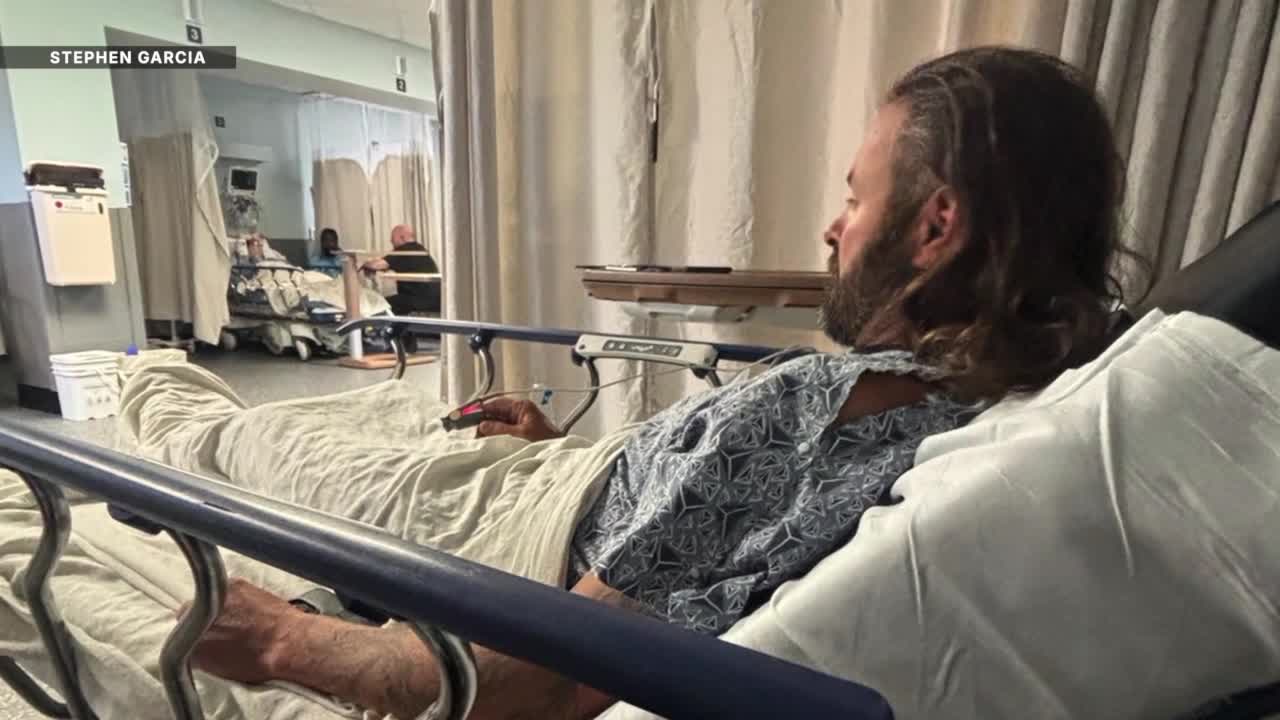


TAMPA, Fla. — A former college quarterback and Tampa native announced doctors have found "no evidence of the disease" after battling cancer for months.
Stephen Garcia, 38, was diagnosed with colon cancer earlier in 2026.
Garcia said prior to his diagnosis, he experienced sporadic abdominal pain and a change in bowel habits.
The former South Carolina Gamecocks quarterback said his symptoms were subtle.
WATCH: Former Gamecocks QB Stephen Garcia says 'no evidence of disease' found after stage 4 cancer diagnosis
"Ordered the MRI, came back and they found two lesions on the liver and that’s when they ordered the colonoscopy and the colonoscopy found the tumor in there and then that’s when they did the biopsy, found out that they were linked up," said Garcia.
He underwent six rounds of chemotherapy and five rounds of short pelvic radiation.
"Stage 4 means it spread outside of the organ system to other organs. In his situation, not only had it spread to his liver, but also to multiple organs and parts of his abdominal cavity," said Dr. Allen Chudzinski, Director of Robotic Surgery, Colon and Rectal Surgery at Tampa General Hospital.
Dr. Allen Chudzinski is Garcia's doctor who performed surgery to remove the cancer from his colon. Garcia also had surgery to remove tumors on his liver and a cancerous nodule on his lung.
After treatment for months, Garcia said doctors have found "no evidence of disease."
Garcia said he kept a positive attitude as he battled cancer.
"Just staying positive and telling yourself every single day that you’re going to beat this thing," he said.
"You know to hear him say that the cancer is completely out of my body, it was extremely humbling and, you know, the thoughts and prayers and, you know, everybody that’s kind of helped out throughout the way, I don’t know. It’s hard to describe to be completely honest with you," said Garcia.
Garcia said he has one more procedure scheduled for December and doctors may want to do additional chemotherapy as a precaution.
"After he’s had a take down of his ostomy, once that heals, we want to give him another few courses of systemic, that’s intravenous chemotherapy and, yes, the idea is we want to make sure any cells that are possibly floating around his system gets zapped and destroyed, said Dr. Chudzinski.
Dr. Chudzinski encourages people to advocate for themselves.
He also urges colonoscopy screenings at the age of 45, but screening should start earlier if you have a family history.
"It starts at age 45 for everyone unless you had a family member that had it at a younger age so if you had a family member at 50 then you wanted to get your colon screening done 10 years earlier at 40 and also not to ignore the symptoms," he said.
Symptoms of colon cancer may include: persistent bowel changes, constipation, rectal bleeding, abdominal discomfort and unexplained weight loss.
According to the Cancer Research Institute, in the United States, colon cancer and rectal cancer – collectively known as colorectal cancer is the third most commonly diagnosed cancer and the second leading cause of cancer-related death in both men and women.
"We can catch it, and we can cure it. Things like a colonoscopy, which goes in and removes any polyps from the colon, which it is painless to do, can stop and prevent colorectal cancer," said Dr. Chudzinski.
Garcia created a non-profit organization,"Quarterback Your Health Foundation," to bring awareness to the disease and expand access to preventive screenings, especially for people who are uninsured.
For more information, click here.
Share Your Story with Julie

Julie Salomone works to share the issues that matter to you. And navigating the job market is critical to affording the price of paradise. Julie also focuses on the day-to-day issues in Sarasota County, so be sure to reach out to Julie to start a conversation.
.

MacDill Air Force Base housing lawsuit grows to 105 military families alleging unsafe conditions, mold
A lawsuit against the company managing privatized housing at MacDill Air Force Base has more than doubled in size, with 105 military families now alleging they lived in unsafe and unhealthy conditions. The amended complaint represents more than 450 people and spans 924 pages.
