

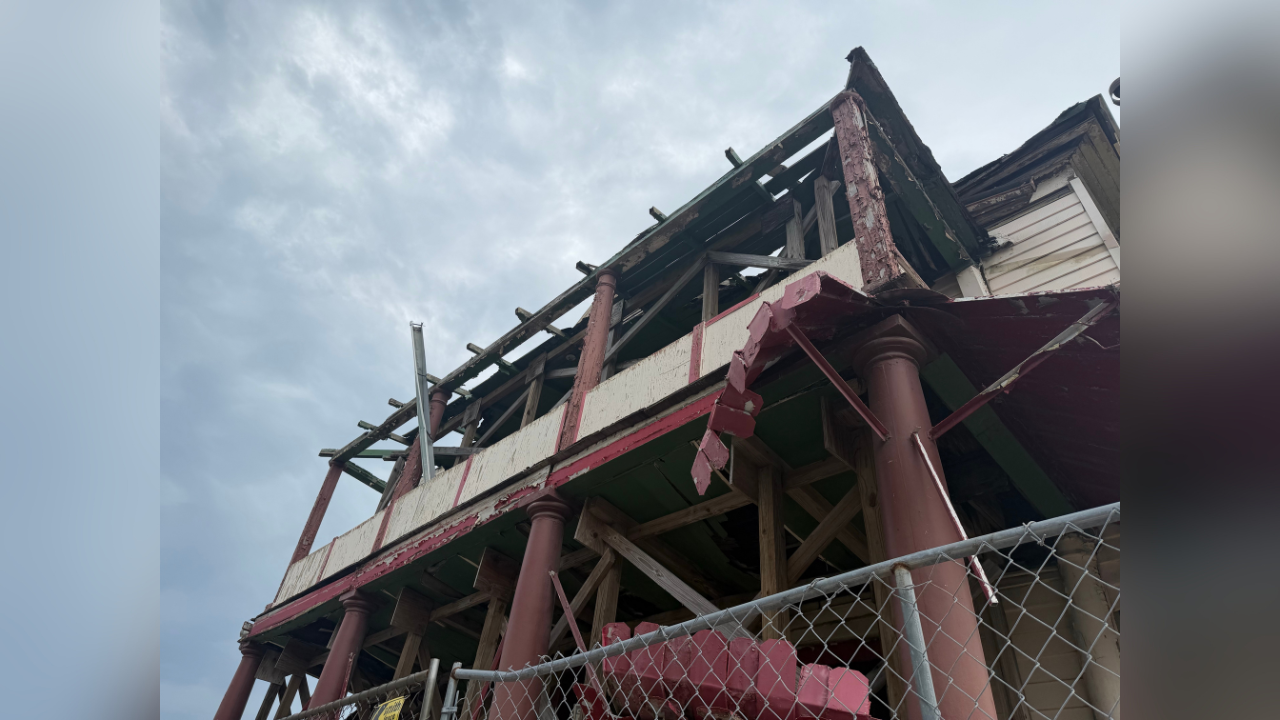


TAMPA, Fla. (WFTS) — For the first time in years, the Jackson House Foundation says the public will soon see something happen at 851 East Zack Street.
Just moments after the Tampa Community Redevelopment Agency board voted 5-2 to approve a $1 million reimbursement grant for the Jackson House restoration, Foundation Chair Dr. Carolyn Collins told me a construction contract will be signed before the end of the week and that cameras should expect to see workers at the site as soon as next week.
"In less than a week, we will have the contract signed," Collins said. "Today is Thursday."
WATCH: Jackson House Foundation says work could begin next week after Tampa CRA approves $1 million grant
Collins said the vote, while representing only about 25% of the estimated $4 million or more needed to complete the project, is the green light the foundation has been waiting for.
"It is a green light. It's a green light that says go, and it's a green light that can put us, in my personal opinion, 18 to 24 months out from opening the door and cutting the ribbon," Collins said.
I spoke with Collins after the vote. She said the construction management firm has already begun preliminary work without a signed contract, and that the foundation's attorney was reviewing the final contract language during the meeting itself.
"I jumped up and went out and let us speak to the lawyer because he just called me," Collins said. "He said, 'I'll have the contract fully reviewed before the weekend is over. It'll be back in your hands by Monday.'"
Collins said a press conference at the house will follow the contract signing.
"We will be doing a press release as soon as we sign this contract," Collins said. "We're going to do a press conference there, and we'll have a press release so that everybody knows where we're going."
A landmark born from segregation
The Jackson House is one of Tampa's most significant pieces of African American history. Moses and Sarah Jackson, who moved to Tampa in the 1800s, built the home at 851 East Zack Street in 1901. During the era of segregation, the multi-room boarding house provided lodging for Black residents and visitors, with guests sent from Robinson's Barbershop and the clubs on Central Avenue.
The building holds federal and state historic landmark status, making its restoration subject to strict preservation requirements that have complicated and extended the timeline for years.
A vote years in the making
The CRA grant had been allocated as far back as 2019 but was never formalized into a funding agreement. The Jackson House Foundation said it was not informed the money existed until Board Member Carlson told them at a city council meeting roughly two to three years ago.
The board's vote came after a lengthy and at times tense debate over accountability, the building's deteriorating condition, and whether the foundation had done enough to move the project forward.
Board Member Carlson, who said he has been involved in efforts to save the building since 2012, described the public's frustration and his own.
"The sides are falling off now, and that's what the public sees," Carlson said. "I personally promised Willie Robinson that I would help save it. I'm angry because the thing is falling apart."
Carlson also raised the possibility that political forces were working against the building's survival.
"There are political forces in the community who want it to fall apart, are going to clap and celebrate when it falls apart," Carlson said.
Board Member Alan Clendenin said the situation had become critical.
"If this goes on any further, there won't be a Jackson House to restore," Clendenin said.
A cave-in on the side of the structure occurred in the weeks before the vote, adding urgency to the discussion.
Foundation pushes back on criticism
Collins and restoration project Chair Dr. Angela Scott told the board the foundation has been working through an extraordinary number of obstacles, regulatory, financial, and logistical, that the public has not seen.
"We are trying to jump through every hoop that we've been given, and look like every time we achieve one, we get another one. But we're not stopping," Scott said.
Scott said the foundation holds multiple funding sources, each with its own rules and restrictions, and that none of those funds are simply available to spend.
"We are grant awarded. We don't have those funds in our hands where we can move forward today," Scott said. "As this get approved, we will have that money so that we can move forward on a project."
Collins told me after the vote that the disconnect between what the foundation has been doing and what the board and public perceive has been one of the most frustrating parts of the process.
"How is it we've been coming before them at least for the last four years, I would say three consistently, at least every two to three months, giving them a report, and they didn't even know," Collins said. "And why are they still asking when did we get the money? I understand where they come from because we wonder too."
Collins described the foundation's position plainly.
"We were finances poor, grant funds rich," Collins said. "We are building a historic house that you can't do what you want to do with it. We are mandated by federal law because we have a federal landmark. We have a state landmark, and we have a city and county. We must follow their guidelines."
Accountability clause debated, progress report added instead
Before the vote, Carlson moved to add a clause to the funding agreement that would cause the contract and money to expire within one year if the foundation had not substantially renovated the building.
"It's been sitting there since 2019, in an account, and the Jackson House Foundation has got to do something, or they need to sell it to somebody, or turn it over to somebody who's going to save it," Carlson said.
Collins pushed back, saying a punitive clause would be unfair given everything the foundation has navigated.
"I would ask that you not put that on us, just get us the money," Collins said.
Board Member Clendenen said he supported some form of deadline to create a pressure point and fulfill the board's fiduciary responsibility. He also pushed back on characterizations of the Accardi family's role in securing the easements on either side of the building.
"The Accardi's were not the benevolent company on this. We ended up having to give away a lot of land in order to be able to get that small piece of the slivers of dirt on either side of that structure," Clendenen said.
Board Member Viera said he preferred a more aspirational approach rather than a contractually binding cutoff.
The board ultimately approved the resolution with an amendment requiring a progress report at the next meeting, rather than a hard expiration clause. A separate motion directing staff and the Jackson House Foundation to return with an update at the board's September meeting also passed unanimously.

How the grant works and what it can and cannot pay for
CRA Development Manager Brenda Thrower and city attorney Shepard clarified for the board that the $1 million grant is a reimbursement grant, meaning the foundation must spend money on eligible construction costs before being reimbursed. Eligible costs are limited to physical construction materials and permanent improvements, what CRA staff described as "bricks and sticks." Soft costs such as architect and engineering fees are not eligible for reimbursement under the CRA grant.
"I don't want to leave the room today with anyone having a misunderstanding about what they can get reimbursed for," Thrower said.
CRA staff member Melissa Martinez explained that the grant went through a committee recommendation in 2022 but was never formalized into an agreement due to staff turnover and departmental restructuring.
"Managers left, director left," Martinez said. "I then was in charge of then putting all this together, and that's why I've been pushing it to put it forward to have an agreement."
Under the agreement, the foundation has one year to meet a series of conditions, including obtaining permits and demonstrating a funding plan. That period can be extended administratively for an additional year.

Invoice dispute leaves foundation without payment for completed work
City Administrator for Development and Economic Opportunity Abbye Feeley told the board that the foundation submitted invoices to the Tampa Bay History Center for reimbursement, but the History Center said it does not have the money. The funds were returned to the Vinick Foundation after History Center CEO C.J. Roberts departed.
"They then came to the city to pay those. We cannot pay those invoices. We do not have a way to pay them," Feeley said.
Collins said the foundation is not asking for money to be advanced, only for invoices to be paid once submitted.
"We're not asking for people to advance money, just pay the invoices, and we can keep moving," Collins said. "When we submit an invoice to you, pay the invoice."
Scott clarified that not all outstanding invoices are for work already completed. Some are for ongoing work, including invoices from the architect of record whose team cannot be paid without funds in the foundation's account.
"All of the invoices are not previous work," Scott said. "This is invoices so that we can withdraw the funds to pay them so that they can move forward."
Feeley also noted that the city holds a separate $500,000 state grant assigned to the city for the project, but said that grant cannot be activated until construction begins.

Questions about the Vinick Foundation's $1 million pledge
Carlson raised questions about a separate $1 million pledge announced by Jeff Vinick through his foundation around 2019. Collins confirmed that Vinick had asked the Tampa Bay History Center to manage those funds, and the History Center agreed. When Roberts departed, the organization returned the money to the Vinick Foundation.
Collins said the Vinick Foundation has not said it will not give the money to the Jackson House Foundation, and that conversations with Vinick Foundation staff are ongoing.
"The Vinick Foundation still have the funds," Collins said. "They was waiting as well to see progress."

Easements secured after years of negotiations
Collins confirmed the foundation now holds 10-foot easements on both the east and west sides of the Jackson House, which were required to meet fire code for reconstruction. The easements were secured after more than three years of negotiations with the Accardi family, with assistance from the city.
The foundation also gained approximately 7.5 feet of additional property at the rear of the house through the closure of an alley.
Feeley said the 10-foot easements were critical because fire code would not have allowed the building to be reconstructed as it was historically without them.
Collins told me after the vote that the requirement for those easements has long frustrated her, given the age of the building.
"Why are they trying to get 10 feet on each side of the house when that house was built before there was anything called codes?" Collins said. "If a house was built around 1900, codes went into effect in the state of Florida in the 1950s. We were there 50 years before there was such a thing as a code."

Historic preservation requirements add complexity
The Jackson House's status as a federal and state historic landmark means the foundation cannot simply demolish and rebuild. At least 25% of the original structure must remain to maintain historic status, and all work must comply with federal, state, and local historic preservation guidelines.
The foundation's contractor said less than 20% of existing materials can be reused and retrofitted into the restored structure.
"We could have built this house a long time ago. We could have built it much cheaper, and it wouldn't have been the historic Jackson House," Collins said.
Board Member Miranda noted that regardless of when construction began, the original lumber could not be reused.
"No matter when you start it, when you finish, it's what product you have at the end," Miranda said. "It'll be built to today's standards with the amenities that were left over from the house."

What the vote means and what comes next
I asked Collins after the vote how significant Thursday's approval was in the project's overall arc, from the decision to save the building to the day someone walks through the front door.
"I would say we're 25% in importance in this one because it is about 25% of what we are looking at," Collins said. "But it is a green light. It's a green light that says go."
Collins said the foundation plans to return to the CRA board to request additional funding once a contractor budget is finalized, a process she said could happen within a month.
Board Chair Young called for a meeting with the mayor, the CRA, the foundation, and all involved parties to align on the path forward.
"Everybody that's involved with this project, we're going to sit down and we're going to have a meeting," Young said.
Collins said the foundation has no intention of relocating the building or giving up on its downtown Tampa location, despite years of pressure to do so.
"Maybe if we had moved the house, taken it from 851 Zach Street, got it out of downtown Tampa, put it on any of those parcels of land that they've been begging us to move it to, we wouldn't be jumping through these hoops," Collins said. "But we are going to maintain that level of history in the city of Tampa, in Hillsborough County, in the state of Florida, and in this United States."
Collins said the board's vote Thursday was the last piece of a long puzzle and that the foundation is ready to move.
"This was the last piece," Collins said. "Now that they've signed it, now we definitely have the million dollars. Thank God that's passed."
Share Your Story with Jada

Jada Williams is focused on the issues that matter most to people in who live in Tampa and West Hillsborough County. From downtown Tampa to Town ‘n’ Country and Westchase, Jada works to bring you updates and solutions on everything from crime to infrastructure. Reach out to Jada below with your concerns for your neighborhood.
.

'My heart breaks': Woman describes helping injured students after deadly school bus crash in Polk County
A woman on her way to work Monday morning found herself helping injured Winter Haven High School students after a school bus crash that killed two people.
