

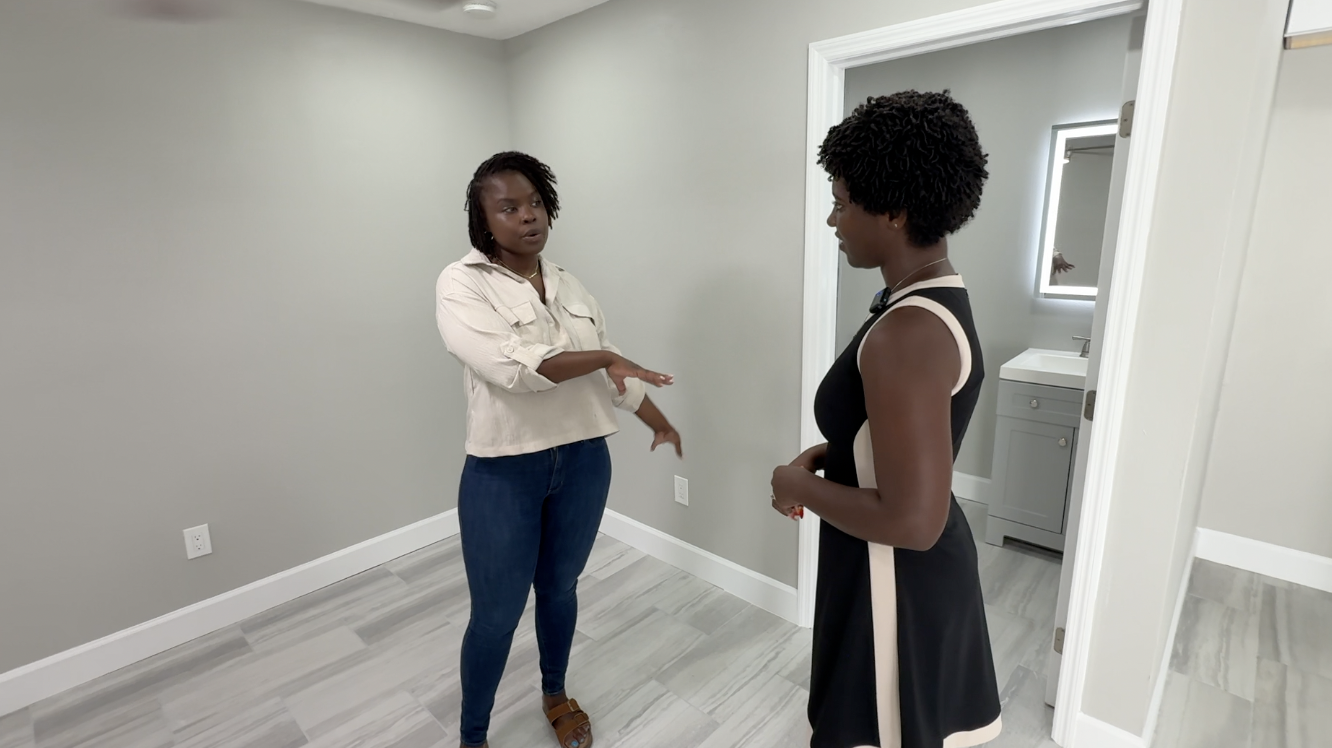


TAMPA, Fla. (WFTS) — Hope Kiriisa has big plans for her backyard.
The Sulphur Springs homeowner is nearing completion of an approximately 400-square-foot accessory dwelling unit, commonly known as an ADU, tucked behind her home. She gave me a tour of the space, walking me through an open-concept layout that includes a kitchenette with appliances, a living area, a bedroom space, a bathroom with a walk-in shower, and a washer and dryer. Construction is not yet complete, but the vision is clear.
Kiriisa is one of 28 Tampa homeowners who have started the process to build an ADU since the City of Tampa expanded its ADU regulations in 2024. Of those, 7 have completed construction. Her project is one piece of a much larger effort by the city to address a growing affordable housing shortage, and she is exactly the kind of homeowner city leaders say they hoped the rule changes would inspire.
WATCH: One Tampa homeowner's backyard project is exactly what city leaders say affordable housing needs
For Kiriisa, the decision to build came down to one simple reality: housing costs too much.
"The cost of housing has gone through the roof. I wanted to get a bigger house, but I figured, hey, why not utilize the space that I already have? And not only could it help me, it can help others," Kiriisa said.
She is not wrong. Tampa's home prices have climbed steadily as the city has grown, pushing many residents out of the homeownership market entirely. Rather than chase a bigger home she said she could not afford, Kiriisa looked at what she already had: a large backyard and a concrete slab left behind when a previous owner knocked down an older structure.
"It was a big backyard. I love hosting, so it was a big backyard and a slab," Kiriisa said. "So when I purchased the main house, they had knocked down an older house in the back, so it was just a big slab. So we just used that to party on. We really started from the bottom, and now we're here."
Now, that slab is the foundation of something far more useful.
Building it out
Kiriisa designed the ADU with flexibility in mind from the start. She did not want a space locked into a single purpose. She wanted options, and she built accordingly.
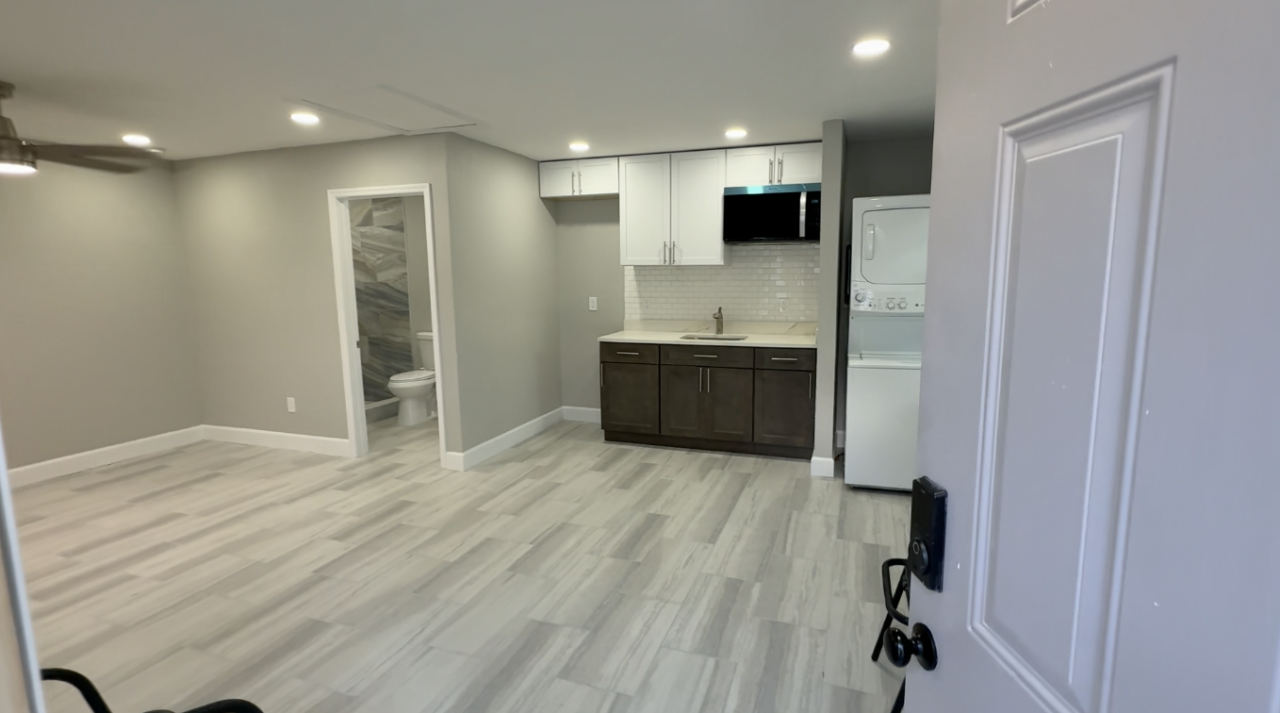
"I have aging parents, so I wanted to have that as an option in the future," Kiriisa said. "But I also wanted the flexibility to use it as a home office, a rec room or a rental unit. I wanted an open-concept space so that I could decide how to use it."
She said the city staff was receptive to that approach.
"They actually were. It's actually the less walls, the better. So that really worked out," Kiriisa said.
Her immediate plan once construction wraps is to rent the unit out. But she is already thinking further ahead, including the possibility of eventually moving her aging parents into the ADU and renting out her main home. The multi-generational angle is personal for her.
"Who's gonna cook the meals if they're so far away? You know, it's just our family culture. We like to keep our parents near. Having multi-generational generations under one household is not foreign to me. And if that is an option, I want to make sure it stays on the table and do my part," Kiriisa said.
The permitting process
Getting to this point was not easy. Kiriisa was candid about that.
"The permitting process was a beast. I'm going to be fairly transparent. There were a lot of changes that took place," Kiriisa said.
She received her permit in December and did not break ground until May, with much of that time spent on preparation and site cleanup. But she said the moment she stopped trying to navigate the process remotely and simply went downtown to talk to someone, everything changed.
"The moment I just went down there and talked to somebody, it was so easy. They walked me through. Matter of fact, I was there two days ago, and they printed out the paper. Somebody came out and talked to me. So, if you're having any hiccups, just go down there," Kiriisa said.
She also had straightforward advice for anyone considering a similar project.
"Have a great general contractor," Kiriisa said.
Kiriisa is a former City of Tampa employee, which is how she first learned about the Sulphur Springs neighborhood and eventually decided to put down roots there. That background gave her some familiarity with city processes, but even she found the permitting journey to be a learning experience.
What changed in 2024
Before the 2024 rule changes, ADUs were only permitted in Tampa Heights. City Council then expanded the allowable areas to include East Tampa, the Ridgewood Park and Riverside Heights area, and Seminole Heights. In those areas, an administrative approval is required through the development coordination office. Units are allowed to be up to 950 square feet.
The city also removed a previous requirement that the property owner live in the main home. Now, the property owner may live in either the principal structure or the accessory dwelling unit.
Abbye Feeley, the city's Administrator of Development and Economic Opportunity, said that change has encouraged more homeowners to consider ADUs as their lives and needs evolve.
"As people change in the chapters of their lives, they could perhaps downsize and be the ones living in the accessory dwelling, and then having a family, someone else living in the front unit," Feeley said.
She added that the city is also watching for potential federal funding that could help lower the barrier to entry for homeowners interested in building an ADU. HUD is looking at providing grant funding for cities to develop standard design plans that homeowners could use without hiring an architect.
"We would create a library of plans on file. Those plans would already have been reviewed by the permitting department as acceptable plans," Feeley said.
Feeley said city staff and client facilitators are available to sit down with homeowners, review their property, and walk them through what is possible. Homeowners can also visit tampa.gov/ADU to find out whether their property is in an eligible area and to review general standards. The city's permitting system is also open to the public and contains information on every permit across the city, including plans from completed ADU projects that could serve as a starting point.
ADUs as an affordable housing tool
Mayor Jane Castor said ADUs are one piece of a broader affordable housing strategy the city has pursued since 2019, when it set a goal of 10,000 affordable units.
"Accessory dwelling units give homeowners alternative housing opportunities to serve immediate family needs or create a possible rental opportunity," Castor said. "We are proud to see Tampa homeowners taking advantage of these opportunities and finding creative ways to make their homes work for them."
The city has built or is building more than 8,300 affordable units since setting that goal. Castor acknowledged the city will not reach 10,000 but said the work will continue through the end of the administration.

Castor said ADUs, while a smaller piece of the overall count, still matter.
"Every home, if you look at them individually, each ADU is somebody's home, and so that is really our goal: is to ensure that people have a roof over their head," Castor said.
Castor said she believes a broader shift in how homes are built is on the horizon.
"I think there's going to be a sea change in how we build houses in the future because there is a national need for affordable housing that we cannot manufacture quick enough," Castor said.
New state law expands affordable housing options
A new state law, Chapter 2026-179, signed by the Governor on June 26, 2026, and effective July 1, 2026, further expands the tools available to address Florida's affordable housing shortage.
The law requires counties and municipalities to allow multifamily and mixed-use residential development in areas zoned for commercial, industrial, or mixed-use, as long as at least 40 percent of the residential units are affordable rentals for at least 30 years. The provision also now applies to property owned by religious institutions larger than 3 acres that have housed a place of worship for at least 10 years.
Under the law, local governments cannot restrict the height of qualifying developments below the tallest commercial or residential building within 1 mile, or 3 stories, whichever is higher. Local governments also cannot use setbacks or stepbacks as a workaround to effectively limit height.
The law also expands the prohibition on discriminatory land use decisions to explicitly include housing that is affordable, meaning a local government cannot discriminate against a development based on its affordable housing financing. The state also waives sovereign immunity for housing discrimination claims brought under this section, meaning the state and its agencies can now be sued for discriminatory housing practices.
Additionally, the law directs the Office of Program Policy Analysis and Government Accountability to evaluate the potential of tiny homes to meet Florida's affordable housing needs, as well as the use of mezzanine finance to stimulate the construction of owner-occupied affordable housing. Both reports are due to the Legislature by Dec. 31, 2027.
Local governments may also now provide density bonus incentives to landowners who donate property for affordable housing for military families receiving the basic allowance for housing.
Short-term rental concerns and new state law
The growth of ADUs is also drawing attention to how the units are used. On Aug. 5, Hillsborough County Commissioner Joshua Wostal addressed concerns raised during a public meeting about short-term rentals and the challenges code enforcement faces in regulating them.
Wostal pointed to SB 1548 as a potential new tool. The legislation changes the word "may" to "shall" when it comes to local governments implementing ordinances addressing ADUs, and includes language requiring property owners to account for any lost parking when converting a space, such as a garage, into an ADU or short-term rental. It also requires the primary resident to continue occupying the property if an ADU on the site is used as a short-term rental.
"I think that those are very powerful tools that will enhance the sheriff and code enforcement to take serious action," Wostal said.
Castor said the city discussed short-term rental regulation at a staff meeting and supports the state taking steps in that direction.
"I think that there does need to be more regulation on short-term rentals in the state of Florida, and it's nice to see that the legislature is taking steps in that direction," Castor said.
How to get started
Homeowners interested in building an ADU can visit tampa.gov/ADU to find out whether their property is in an eligible area and to review general standards. City staff and client facilitators are also available to meet with homeowners, review their property, and walk them through the process.
Share Your Story with Jada

Jada Williams is focused on the issues that matter most to people in who live in Tampa and West Hillsborough County. From downtown Tampa to Town ‘n’ Country and Westchase, Jada works to bring you updates and solutions on everything from crime to infrastructure. Reach out to Jada below with your concerns for your neighborhood.
.

'My heart breaks': Woman describes helping injured students after deadly school bus crash in Polk County
A woman on her way to work Monday morning found herself helping injured Winter Haven High School students after a school bus crash that killed two people.
