

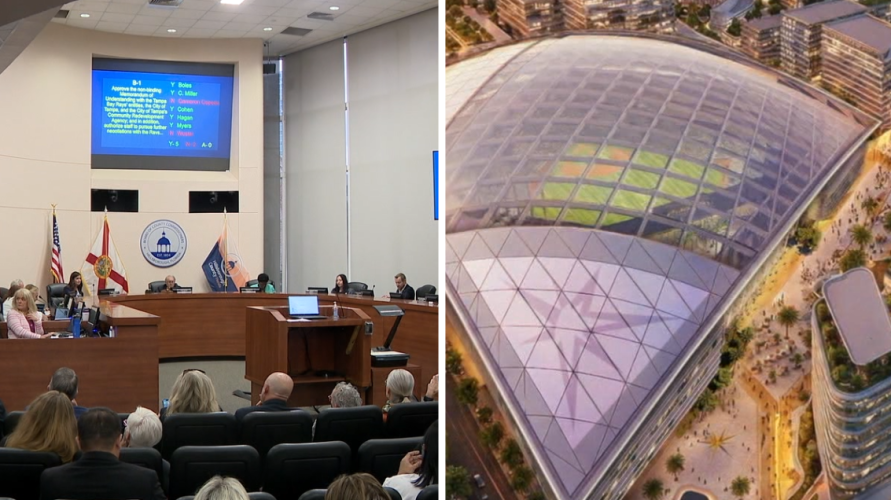


TAMPA, Fla. (WFTS) — Hillsborough County commissioners voted 5-2 Wednesday to approve a nonbinding memorandum of understanding with the Tampa Bay Rays, the city of Tampa, and the city of Tampa Community Redevelopment Agency, advancing negotiations on a proposed $2.3 billion ballpark and mixed-use development on the Hillsborough Community College campus at Dale Mabry.
The MOU does not constitute a final agreement. It establishes a framework for continued negotiations and authorizes county staff to return to the board with definitive documents if those negotiations prove successful.
WATCH: RAYS STADIUM DEAL: Here is where each Hillsborough County commissioner stands
The proposed development is a three-phase, mixed-use project centered on a new 31,000-seat ballpark within a roughly 121-acre ballpark district. The Rays have set an April 2029 deadline for ballpark completion to participate in the 2029 Major League Baseball season.
The Rays have requested $976 million in public subsidy from the county, the city of Tampa, and the city of Tampa CRA. The proposed public funding sources include:
- Community Investment Tax (CIT): $440 million total — $360 million from the county, $80 million from the city — structured as a pay-as-you-go approach over four years, with no bonding
- Tourist Development Tax: $263 million in bonding, plus $40 million from existing reserves, with a potential additional $35 million bond if future capacity allows
- Cash reserves: Up to $103 million in unrestricted county reserves
The governor has pledged $150 million to rebuild and revitalize Hillsborough Community College as part of the broader development proposal. No local funds are designated for college revitalization. The state has also donated land and committed to certain transportation improvements.
As it currently stands, the Rays have committed to covering any cost overruns beyond the $2.3 billion estimate. The county would own the ballpark after construction. Private-use areas within the development would be subject to property tax.
Economic projections from development consultant AECOM, based on data provided by the Rays, estimate approximately 7.6 million square feet of development in the ballpark district over 30 years, with a $2.2 billion fiscal impact from ad valorem taxes, sales taxes, and tourist development tax. Phase one assessed values are estimated at $1.1 billion in 2034. Total assessed values for the entire stadium district are estimated at $4.8 billion by 2058, including tax-exempt facilities such as the ballpark and Hillsborough Community College.
County staff outlined several issues that remain unresolved and must be addressed in definitive agreements, including:
- Funding backstop and surety for a portion of the CIT funding
- Source of funding for capital expenditures, or ongoing maintenance
- Future development mix and minimum private development valuation
- Ownership of non-ballpark land underlying private development
- Revenue sharing for parking and other revenue sources
- A formal community benefits agreement
Staff guiding principles throughout negotiations have included protecting the county's AAA credit rating, minimizing development risk by requiring all private financing to be secured before local funds are committed, and restricting public funds to areas of the stadium with a direct public benefit.
The proposed development site is located within the Drew Park Community Redevelopment Area, a zone long identified for strategic reinvestment and revitalization.
The city of Tampa is scheduled to consider the MOU the following day, Thursday.
Where each commissioner stands
Chair Ken Hagan — Yes
Chair Ken Hagan called Wednesday a monumental day and said it marks the closest the county has ever come to finalizing an agreement with the Rays in more than 16 years of work on the issue. He framed the MOU as an enormous milestone rather than a final commitment.
"Today is a monumental day in our efforts to not only secure a forever home for the Tampa Bay Rays, but to reach an agreement on a generational project that will be the largest development in Hillsborough County's history," Hagan said.
Hagan acknowledged critics of the deal but said many opponents would reject any agreement that involves public dollars.
"I've learned throughout this journey that for many of the opponents, not all, but many, no deal will ever be good enough unless there's zero tax dollars being utilized," Hagan said.
He urged commissioners and city council members to take a broad view of the project's potential.
"There's zero downside to letting Bonnie and staff continue to negotiate in order to reach the best possible deal for the county and the taxpayers," Hagan said.
Commissioner Christine Miller — Yes
Commissioner Christine Miller made the motion to approve the MOU and drew comparisons to past public-private partnerships in the region, including Amalie Arena (now Benchmark International Arena) and Raymond James Stadium, both of which she said were initially viewed as risky investments but became economic drivers for the community.
"Tampa Bay was not built overnight. It was built because leaders were willing to step back, look at a bigger picture, and invest in our future for this community," Miller said.
Miller cited the Tampa Sports Authority's reporting that Taylor Swift's concerts in the county brought in more than $1 million in tax revenue and said the region's ability to attract major events depends on continued investment in public assets.
She also pointed to a recent $100 million FDOT appropriation toward the Lithia Pinecrest road project; funding that had previously been expected to come from the CIT, as evidence of the state's interest in seeing the project succeed.
Miller said the MOU is consistent with a unanimous 7-0 vote the commission took months earlier.
"This will not create an additional tax burden on our residents. I would not have, and will not, support that," Miller said.
Commissioner Donna Cameron Cepeda — No
Commissioner Donna Cameron Cepeda voted against the MOU, citing concerns about the use of the CIT for the stadium, the proposed draw on county reserves, and what she described as broad public opposition to the deal.
"I believe that we should not allow the CIT to be used for the new stadium. We have so many important infrastructure projects that would be pushed back," Cameron Cepeda said.
She also raised concerns about using $103 million in reserves, given the county's vulnerability to hurricanes.
"We live in a hurricane zone, and we need to keep our monies and our cash reserved. There are emergencies that come up, as you can well see from the past hurricanes that we've had," Cameron Cepeda said.
Cameron Cepeda said she heard opposition from residents across the political spectrum and that the public's voice should be the deciding factor.
"As we can see, the super majority of the people do not want this, and for that reason I will not support it," Cameron Cepeda said.
Commissioner Gwen Myers — Yes
Commissioner Gwen Myers said the project addresses two of the most consistent concerns she hears from Hillsborough County residents: the need for jobs and housing. She said the development could bring nearly 12,000 jobs to the community.
"The citizens of Hillsborough County constantly expressed that we need jobs and we need housing, and this MOU that we're working on today will give us that," Myers said.
Myers said she held a town hall meeting the night before the vote and addressed those concerns directly with constituents. She also said she wants to ensure that Visit Tampa Bay's funding is protected and replenished as part of any final agreement, noting the economic impact of events the organization has helped bring to the region.
She pointed to the 2024 voter-approved CIT referendum, which she said explicitly included public facilities as an eligible use of the tax.
"The voters voted for that in 2024. I helped champion that to get it passed," Myers said.
Commissioner Chris Boles — Yes
Commissioner Chris Boles, a 30-year veteran of the fire service, addressed head-on the concern he said he heard most from constituents: that the MOU would come at the expense of public safety.
He said nine fire stations already identified for construction using CIT dollars are protected and not affected by the stadium proposal.
"The idea that this replaces those stations, that's just not what the facts show," Boles said.
Boles said the deeper public safety challenge is not building stations but staffing them, and that the CIT is a construction tool, not a staffing tool.
"It constructs things, but what it doesn't do is pay for the people who are working there year after year after year," Boles said.
He said his support for the MOU is conditional on the development delivering real economic results, taxable value, jobs, and an expanded economic base, and pointed to the Water Street development as a model.
"I'm not from a yes or no position on the stadium. I'm asking, does this really move the needle and become a catalyst?" Boles said.
Commissioner Harry Cohen — Yes
Commissioner Harry Cohen said the choice before the board was not between the MOU and a perfect agreement, but between moving the process forward or letting it collapse.
Cohen said he was on the Tampa City Council when the Water Street development was approved and did not anticipate at the time how transformative it would become.
"You do have to have some faith in our community in order to make a step forward on a vote like this," Cohen said.
He noted that Tampa police came out in support of the proposal, calling it an enhancement to public safety. He also said the development could strengthen the Tampa Convention Center's appeal by adding an entire new neighborhood of hotels, restaurants, and amenities nearby.
Cohen addressed the issue of Major League Baseball expansion, saying the cities competing for expansion teams are doing so because they believe a new franchise can serve as a catalyst for economic development.
"If you believe only half of the forecast made by AECOM, this will be a home run in terms of the return on investment from the CIT investment," Cohen said.
He said voting no would end the process entirely.
"To say no puts the whole thing to bed, it's over, and the Rays will be out of here before you can blink," Cohen said.
Commissioner Joshua Wostal — No
Commissioner Joshua Wostal voted against the MOU and used his time to question county staff directly about the deal's financial terms and risks. He challenged staff on the use of general fund and property tax dollars, the draw on reserves, and the enforceability of a "do no harm" clause included in the MOU.
"Today is a monumental day. A monumental betrayal to the taxpayers of Hillsborough County," Wostal said.
Wostal confirmed with staff that general funds, which are predominantly derived from property taxes, are part of the proposed funding mix. He also noted that interest payments on the proposed tourist development tax bonding could add approximately $300 million to the total public cost, bringing the local taxpayer burden to roughly $1.3 billion.
He questioned whether the county has received documentation to substantiate the $2.3 billion ballpark cost estimate, including detailed site plans. Staff confirmed that information has not yet been provided.
Wostal raised concerns about the impact on existing commitments to the Tampa Bay Lightning and Tampa Bay Buccaneers, the indoor sports complex at Mosey, Visit Tampa Bay funding, and the county's cultural assets program. He also questioned whether the CIT is currently underperforming relative to original projections, which staff confirmed.
Wostal argued that any use of public funds for the project should be put to a vote.
"Any move for approval of the usage of our taxpayer-funded [dollars] should be made to put on the November ballot, so the taxpayers have an appropriate voice to signify their support," Wostal said.
He also asked county administrators directly whether any of them had been asked or advised to move the deal forward to meet a state legislative deadline tied to the release of state appropriations. Staff said they were not threatened but acknowledged reading reports that state representatives were waiting on the local MOU before moving forward with funding for the college and transportation improvements.
Wostal called the do no harm clause in the MOU unenforceable.
"I liken the do no harm clause as the tactic of a used car salesman," Wostal said.
What community members are saying
Not everyone who attended the meeting left with the same takeaway. I spoke with three people outside after the vote.
Michelle Dyson has worked in stadium concessions for 14 years. She said she drove overnight from Virginia to attend a job fair to work for the Rays. She says the team's future directly affects her livelihood.
"We have to keep them here in Tampa Bay. We can't afford to lose them to somewhere else. We need the jobs and the stability," Dyson said.
Dyson said she also works at Raymond James Stadium and other venues and has seen firsthand what those investments have meant for the region. She pushed back on skeptics of the deal.
"The naysayers are just worried, which has concern, but we do have a proven track record," Dyson said. "You're never going to convince everybody, but hopefully we can convince enough to prove it."
Dyson said the new ownership group's financial commitment gives workers like her a sense of relief.
"It's been 28 years, so it's time. We finally have an ownership group that's willing to give the money, and that makes the employees feel like a little bit of lift off their shoulders," Dyson said.
Maggie Dougherty drove in from Plant City and said she came not for herself, but for younger residents struggling to get ahead.
"My niece lives with me, and they're trying to save for a house. They work very hard, and things are too expensive. Why don't we help those young people out instead of billionaires?" Dougherty said.
Dougherty said she was not shocked by the financial concerns raised during the meeting but was surprised by how county staff responded to Wostal's pointed questions.
"I was surprised how unprepared they were to answer his questions," Dougherty said.
She said she appreciated Wostal's approach throughout the process.
"I appreciate him fighting for the citizens," Dougherty said.
Dougherty said Plant City has its own pressing needs that she feels are being overlooked.
"It needs more roads. It's growing quickly, and the roads aren't big enough, and there's also a lot of flooding out there, and we need that addressed," Dougherty said.
Alejandro Noriega said he supports the deal and pointed to the Water Street development and the Atlanta Braves' stadium district as examples of what public investment in sports infrastructure can produce.
"If you want to succeed, you have to spend money to do things," Noriega said.
Noriega said he understands the concerns about public funding but believes the long-term economic return justifies the investment.
"I understand that people are skeptic and fearful, but in the world we work, if you don't use the money, you lose it," Noriega said.
He said the Rays' recent attendance numbers, including sold-out games at Steinbrenner Field following hurricane damage to Tropicana Field, demonstrate the region's appetite for the team.
"Baseball has been in our DNA since the very beginning," Noriega said. "We need to keep the team. Sports brings people together, and sports makes money."
Share Your Story with Jada
Jada Williams is focused on the issues that matter most to people in who live in Tampa and West Hillsborough County. From downtown Tampa to Town ‘n’ Country and Westchase, Jada works to bring you updates and solutions on everything from crime to infrastructure. Reach out to Jada below with your concerns for your neighborhood.
.

'My heart breaks': Woman describes helping injured students after deadly school bus crash in Polk County
A woman on her way to work Monday morning found herself helping injured Winter Haven High School students after a school bus crash that killed two people.
