

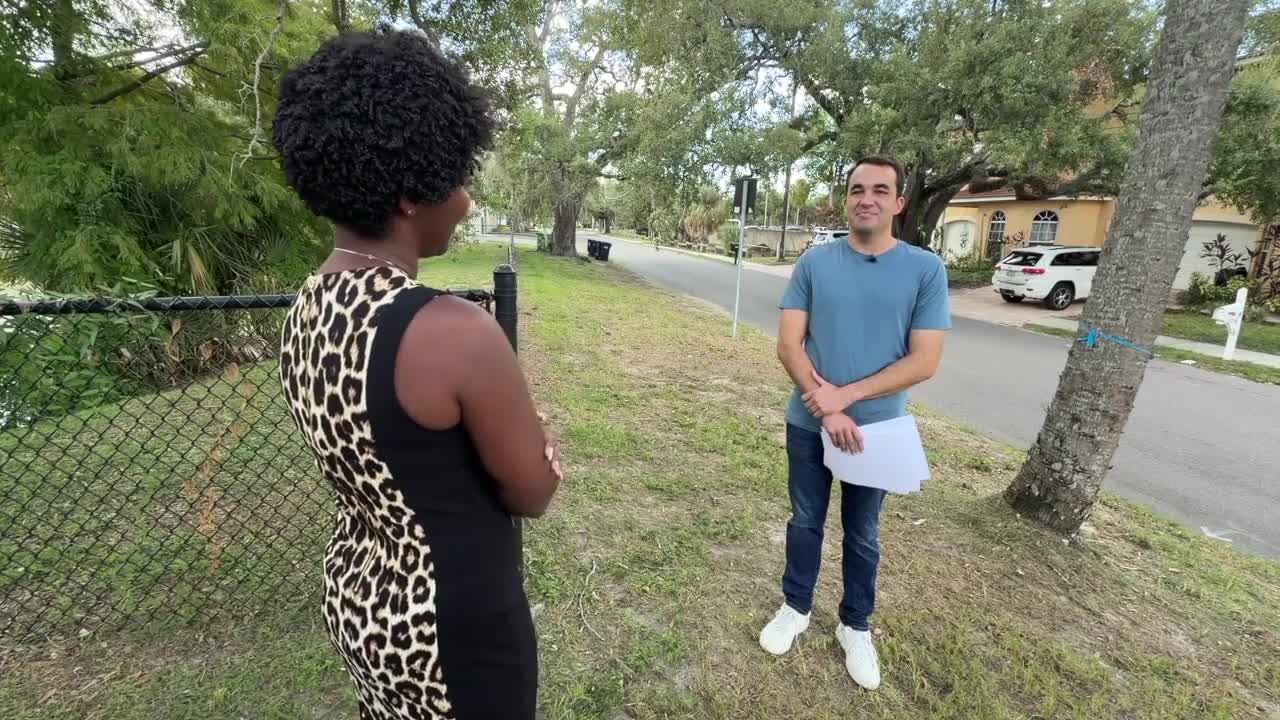


TAMPA, Fla. — Tampa homeowners who have watched stormwater swallow their streets and seep into their homes for years got the news they had been waiting for when Tampa city council approved the South Howard Flood Relief Project on Thursday.
The project will construct an underground drainage system beneath South Howard Avenue, routing water that currently pools in streets and homes directly into the bay. For residents of Parkland Estates and Palma Ceia Pines, the vote was the result of years of advocacy, frustration and flood damage.
WATCH BELOW: Flood relief project approved, but legal fight may lie ahead
But the South Howard Business Alliance, which formed specifically to oppose the project, is not backing down. The group says the plan is flawed and that attorneys were in the room during the hearing taking notes.
Vote had homeowners watching their heart rates
Tina Adams has lived in her Parkland Estates home for 26 and a half years. She was in the council chambers for the vote, and she said the tension was physical.
"My Apple Watch kept going off high heart rate, and Harry, who's sitting next to me, said, 'Breathe deeply, breathe deeply,' because it was definitely a nail biter till the end," Adams said.
Her neighbor Hary Coleman described what the flooding has cost his family in personal terms.
"It took everything. We moved out of our house for six months," Coleman said.
Coleman said his family was displaced from October 2024 through April 2025 following the hurricanes, missing Halloween, Thanksgiving, Christmas, New Year's and Valentine's Day at home. His children were 6 and 11 at the time.
"We were getting messages from neighbors around saying, 'When are you guys gonna come back?' We tried to stop by as often as we could. We came and still cleaned up our yard because we knew Halloween was right around the corner and we wanted to make sure the broken bits of glass and house and everything were not in the sidewalks so people weren't injured," Coleman said.
Coleman said the flooding does not just damage property. It cuts residents off from the rest of the city entirely.
"Fire trucks will even stop and not enter the floodwaters because that's a very expensive vehicle. You're cut off from everything in the rest of the city when those storms come. Even if we would have built up higher, the streets are still impassable. We still can't get to basic city services," Coleman said.
Adams pointed to aging infrastructure as the root of the problem.
"The water comes out of the storm drains, and that's what flooded our homes because the pipes are too small. They're 75 to 100 years old, and they need to be replaced," Adams said.
Father of young children says there was no plan B
Bill Kolega, a Palma Ceia Pines homeowner, reviewed the full engineering report himself before taking a position on the project. He said the data convinced him the project would deliver real benefits to his neighborhood, including road-level relief during storms.
"With a three-year-old and a five-month-old, what really worries me is, am I going to be able to make it to a school two blocks away to pick him up, or worst case, we need to go to the doctor or the hospital. How would we get there?" Kolega said.
Kolega said he was visibly nervous during the hearing because he understood what a no vote would have meant.
"I'm sure you could see me kind of hunched over and nervous because I knew the implications of if it was voted down because there's no plan B. We go to the back of the line."
In the week before the Sept. 17 vote, Kolega started a petition in support of the project. It gathered nearly 600 signatures.
"There's no coordination by the mayor's office or anything like that. People were sharing it to their friends, friends of friends, all throughout Tampa. If you look at the people who actually signed, it's throughout Tampa. There's a misconception that it's only this neighborhood who wants this project."
He also pushed back on the argument that the project directs too much money toward one part of the city.
"If you look at the city's website, there's actually about 15 major stormwater projects in progress, about to start or wrapping up. The implication that nothing's being done and this is the only thing being done is inaccurate," Kolega said.
Business community says project is built on broken promises
Steve Michelini, a representative of the South Howard Business Alliance, was direct about how he views the council's decision.
"They made a decision. I think it was a bad decision. I think the plan will not work," Michelini said. "They took people's hopes and dreams and they sold it to them, but they're going to find out it's broken promises."
Michelini said the alliance has been tracking inconsistencies between what city staff and project engineers have said publicly and what appears in sworn depositions and official documents.
"When we present what we have, it's sworn documents, factual statements on the record. They deny it. When they get up to city council, I don't get it," Michelini said.
He said he feels for the homeowners who are counting on the project to deliver relief, but he does not believe it will come quickly.
"I feel badly for the people in Parkland and Palma Ceia Pines," Michelini said. "They're expecting something to happen right away that's going to help them. It's not. It's at least five years away if it goes through on that timeline."
The alliance's goal throughout the roughly two-year process, Michelini said, was to send the project back for a redesign, not to block flood relief altogether.
"We wanted a project that would solve the problem. We didn't want a project that was the only solution to a very difficult issue," Michelini said.
Now that the vote has passed, the group is turning to attorneys.
"Every legal possibility will be examined and explored, and the attorneys were in there, sitting there, taking their notes and monitoring the hearing," Michelini said.
Homeowners say they want to move forward together
Despite the opposition, Adams said she hopes the business community will eventually come around.
"You can't control other people's behavior and what they do, but you can choose how you respond to it. I just want to be unified. I want to work together. I think sooner or later, they're going to have flooding problems over there too," Adams said.
Coleman echoed that sentiment, noting that the project was designed in 24 sections specifically to minimize disruption to businesses along South Howard.
"One of the things that I kind of drew out of it, especially hearing city officials talk about it, is they've never done a project like this where they've divided it into 24 sections. They went as small as possible to provide the least disruption to the businesses," Coleman said.
Kolega said his family moved to the neighborhood in part because of the South Howard business corridor, and he does not see residents and businesses as adversaries.
"One of the main reasons we moved to this neighborhood was the proximity to those Soho businesses. We go there four to five times a month at least. I'm just really hopeful that in the future we can all work together and really come together as a city," Kolega said.
Coleman said the project carries meaning beyond the people it will immediately serve.
"It's meaningful relief to people who have been flooded and chased out of their homes, their sanctuaries where they're supposed to be safe. And the fact that city council was able to do this for those families means the world to all of us," Coleman said.

Saudi flight from Tampa, secret FBI probe reveal possible Saudi support network for 9/11 hijackers
Twenty years after the Sept. 11 attacks, more than 80,000 records compiled by the Tampa FBI Field Office remain classified. Newly declassified documents are pointing to a possible secret Saudi support network for the hijackers. Soon after the attacks, the FBI uncovered that 15 of the 19 hijackers were from Saudi Arabia.
