

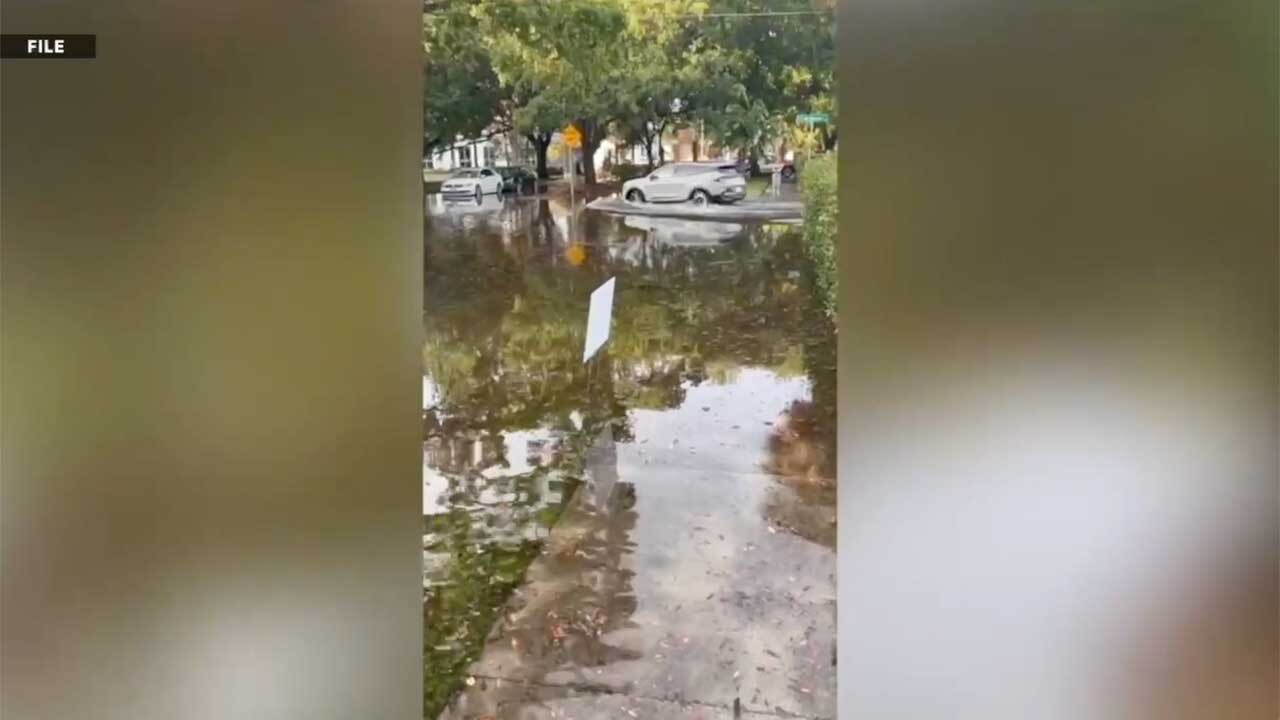


TAMPA, Fla. (WFTS) — The city of Tampa and the SoHo Business Alliance agree that South Tampa flooding is a serious problem but disagree sharply on how to fix it.
"This is a problem that has been going on for decades," Brandon Campbell, the city of Tampa's mobility director, said.
WATCH BELOW: Tampa flood relief plan faces pushback from SoHo Business Alliance
The dispute centers on the city's South Howard Flood Relief Project, a $100.4 million plan the city says is the most practical and cost-effective way to deliver flood relief to South Tampa neighborhoods that have suffered for decades. The SoHo Business Alliance says the plan is flawed, potentially far more expensive than advertised, and that a better alternative exists. The alliance is asking City Council to pause the vote and authorize a side-by-side technical comparison of both plans before committing to either.
"We were challenged to provide a reasonable model. We've done that. We hired our own consultants for economic impact, our own attorney, and our own design engineers. We stand on what we presented," Steve Michelini, general manager of the SoHo Business Alliance, said.
Background
South Tampa flooding has been studied for roughly four decades, with the first formal basin alternatives developed as far back as 1983. The affected area includes Palma Ceia Pines and Parkland Estates, neighborhoods served by aging infrastructure that engineers on both sides acknowledge has not kept pace with development and demand.
The city identified South Howard as a priority project when its stormwater assessment was adopted in 2016. Campbell said it is the last of the major projects being built under those 2016 stormwater assessment dollars.
The city's design engineers spent 18 months evaluating approximately two dozen alternatives before settling on the South Howard corridor as the preferred route. The project has a signed and sealed preliminary engineering report more than 3,000 pages long, which the city says is publicly available on its website.
"We've studied about two dozen alternatives over the last 18 months, and we have selected the most practical and the most the best way forward. It is the way to get flood relief to those neighborhoods the most efficiently and the most cost-effective way," Campbell said.
The SoHo Business Alliance does not dispute that flooding is a serious problem. But it says the city's chosen solution is the wrong one, and that the process leading to it has been marked by changing plans, withheld records, destroyed documents, and public presentations that do not match what city staff and consultants have said under sworn deposition.
The city's plan
The South Howard Flood Relief Project would route a new stormwater spine down South Howard Avenue from Bayshore Boulevard to Swan Avenue, connecting to the Tampa Hillsborough Expressway Authority's system at the Selmon Expressway and discharging into the Bay via the Bayshore outfall.
The project carries a guaranteed maximum price of $100.4 million. Of that, $7.7 million has already been approved by City Council, with $92.7 million pending approval for construction. Campbell said the $92.7 million covers construction all the way to the AMI pond near Memorial Hospital and will provide significant flood relief into Palma Ceia Pines and Parkland Estates as a standalone project.
"We will provide significant flood relief into Palma Ceia Pines and Parkland Estates with this standalone project as a $92.7 million dollar construction cost," Campbell said.
The city also released a video showing projected flood relief from the system over the duration of a five-year, eight-hour storm event, modeled hour by hour using engineering software. Campbell said the video was produced in response to community questions about how Palma Ceia Pines would benefit from the project.
"That video that we put out yesterday includes a snapshot on the hour, every hour, throughout the duration of a storm event. That is done with modeling software. Ordinarily, when we're considering these kinds of projects, we'll take a look at sort of the worst case or the peak of flooding in the before and after conditions. Because there were additional questions about how does Palma Ceia Pines benefit from this project, we decided that it would be helpful to the community to see over the duration of a storm event what that actually looks like," Campbell said.
Campbell said construction must proceed from the bay upstream, and that the project would take three years to reach the Swan Avenue area.
"Palma Ceia Pines will see significant relief with this project. It will take three years for us to get from the bay up to the Swann area, but that's the way these projects have to be built. We have to start at the downstream end, and we have to work our way upstream so that we build the capacity that we're pushing stormwater into," Campbell said.
The city has also entered into a draft interlocal agreement with the Tampa Hillsborough Expressway Authority, which Campbell described as an $11 million commitment from the authority in exchange for a connection to its system. That agreement has been uploaded to the City Council agenda for the Sept. 3 discussion.
On the question of pumps, Campbell said the city's design avoids relying on them where possible.
"Anytime we can avoid relying on pumps, that would be the preferred method. Pumps have resiliency drawbacks. They need to have backup generators. They have to have some sort of housing for those pumps. We would expect if we were building three pumps into this, we'd have longer-term maintenance costs of those pumps, as well as additional intrusions into the neighborhood, with the need to identify space for those structures," Campbell said.
On construction disruption, Campbell acknowledged that every project involves some level of disruption but said the city has a fully developed phasing plan available on its website.
"With every project, of course, we have to work with the adjacent property owners, with EMS, with fire and police response, and every project has some level of disruption, and we will manage that disruption as best we can," Campbell said.
The city says it has been selected for a $10 million Resilient Florida grant and anticipates additional grant funding as construction progresses, pointing to the MacDill 48 project as an example of how the Resilient Florida Grant Program awards funds as construction advances.
"The Resilient Florida Grant Program is one that tends to award grants as construction has commenced and as it progresses. It's what we saw on the MacDill 48 project. It's part of the reason we had funds from that project to move into South Howard earlier this year, and we anticipate that we'll have a really strong chance of additional grant funds beyond that $10 million that we have been selected for with the Resilient Florida program," Campbell said.
Campbell said the city is confident in its plan and ready to move forward.
"Our project has been thoroughly studied. We have a signed and sealed preliminary engineering report on the website. It's 3,000 plus pages long. It is well considered, and it is ready to go to construction," Campbell said.
City Council will hear the city's proposal Thursday, Sept. 3. A final vote is scheduled for Sept. 17.
The alliance's objections
The SoHo Business Alliance says the project has changed significantly from what the city originally described to businesses and residents, and that sworn depositions from city employees and consultants directly contradict what the city has been telling the public.
Michelini said that roughly two and a half years ago, city officials told approximately 50 businesses and affected parties gathered in a meeting that construction would involve closing only one lane, with flagmen maintaining access to all businesses.
"Don't worry, we're only going to close down one lane. We're going to have flagmen, and we're going to work with your businesses so you don't have anything to worry about," Michelini said city officials told the group at the time.
He said the plan has since changed to a curb-to-curb excavation, 20 feet deep and 20 feet wide, running the entire length of South Howard Avenue from Bayshore to Swan Avenue. Since South Howard Avenue averages only 24 feet wide, the alliance says construction would effectively occupy the entire roadway for the duration of the project, which is estimated to last 43 months.
Michelini also said the original justification for routing the project down South Howard Avenue has collapsed. The city originally told the public it would use an existing culvert beneath the CSX railroad tracks, avoiding the need to excavate under the tracks. The alliance says the city has since discovered that culvert is not only unusable but partially collapsed, not connected to the stormwater system, and contains holes in the bottom that allow groundwater to flow in.
The latest proposal, Michelini said, calls for closing the railroad tracks for four to six weeks to excavate and install a new culvert, a permit he said he doubts CSX will approve.
"The justification that they originally told us is gone," Michelini said.
Michelini also raised concerns about funding, saying the city had presented two $25 million grant applications to the public as pending when both were denied by state reviewers from the Florida Department of Environmental Protection and the Southwest Florida Water Management District. He said city staff, under sworn deposition, acknowledged that a payment to the Tampa Hillsborough Expressway Authority listed publicly as $11 million was actually $2 million.
The alliance also raised concerns about the city's stormwater budget, saying 65% of stormwater assessment funds go to salaries, with nothing allocated for maintenance or additional field staff and equipment. Michelini noted the city's current budget decreases maintenance spending by $1 million, calling it outrageous given the widespread flooding problems across the city.
The alliance also says TECO has not agreed to underground its utility lines along the project corridor, despite the city continuing to show undergrounding as part of the project in public presentations. Michelini said TECO told the alliance it would cost an additional $200,000 per establishment to connect to an underground system. The alliance also says the city has never disclosed or held public meetings about proposed streetscape changes tied to the project, including speed bumps on Howard Avenue, pocket driveways, and the closure of some business access points.
"This should be a utility plan, and strictly utility. It's designed to move water, and that's what it's supposed to do," Michelini said.
Edward de la Parte, counsel to the SoHo Business Alliance, outlined the alliance's full list of objections:
The original project justification is gone. The entire rationale for routing the project down South Howard Avenue was the existence of a usable culvert under the CSX railroad tracks. The city's own updated plans now propose either excavating the railroad to install a new 10-by-10-foot culvert, requiring a four-to-six-week railroad closure, or installing a new 72-inch pipe as a backup if CSX does not approve the closure.
The guaranteed maximum price is not fully guaranteed. The alliance says the contract excludes change orders, disposal of contaminated water from six DEP-documented contaminated sites along the route, hazardous waste disposal, land acquisition, repair of the AMI pond, and relocation of TECO power lines. The alliance also notes the city plans to seek authority to issue $26 million in long-term debt for the project. At current long-term tax-free municipal bond rates over 30 years, the alliance calculates that would add another $23.2 million in interest, bringing the total project cost to approximately $123.7 million.
The project would consume a disproportionate share of the city's stormwater funding according to the Alliance. The alliance says one project would use 40% of all available stormwater funds, leaving only 7% unencumbered for other projects citywide. The city's own chief financial officer told council in October that was not the plan. The alliance also says the project requires $54 million in matching funds the city has not identified a source for, noting that grant money cannot be used to match other grant money. The city disputed this, saying the project does not exhaust the stormwater fund and that a full financial plan will be presented to City Council.
The project route depends on two damaged structures with no repair costs in the contract. Documents obtained through subpoena from Atkins, the city's engineering consultant, show the Bayshore outfall has been sealed shut for more than 10 years, carries no water, has dropped joints and cracked slabs, and requires repair or replacement. The railroad culvert is not connected to the stormwater system and has holes in the bottom. Neither structure has repair or replacement costs included in the guaranteed maximum price.
Construction would devastate businesses along South Howard for 43 months. The 20-foot-deep, 20-foot-wide trench would run the full length of South Howard Avenue, while the city's own business assistance and street traffic programs are only funded for 30 months. There is no line item for monitoring, mitigation, or marketing support. Public information services for the entire project total $328,000, one-third of 1% of the contract value. The city's own traffic study projects emergency response times would increase from four minutes to seven minutes during construction. The alliance says no corridor-wide traffic study has been conducted.
The project would dig through six documented DEP contamination sites. The trench would pass through six DEP-documented contamination sites containing contaminated soil and groundwater. De-watering during construction, the alliance says, would release that contamination into surrounding properties and into the bay. The city's own engineers have acknowledged that de-watering would have a structural impact on neighboring buildings and adjacent infrastructure. None of the costs associated with handling contaminated water or soil are included in the guaranteed maximum price.
The $11 million from the Tampa Hillsborough Expressway Authority is not guaranteed. Under the draft interlocal agreement, the authority does not commit any funds until the project is fully funded, all permits are obtained, and no litigation is pending. The alliance has active litigation against the city, meaning the conditions are already not being met. The authority can walk away from the agreement entirely by Dec. 31, 2027. Campbell described the agreement as an $11 million commitment, but de la Parte said the contract language does not promise anything and that the $11 million is contingent on conditions the city cannot currently meet.
The project encroaches on 11 private parcels the city does not own. The city's own records show the project goes outside its right-of-way into 11 parcels, with no easement or acquisition plan in place. The guaranteed maximum price is based on the city acquiring land at Parkland Estates and Swan, which is not included in the contract price.
There is no water quality improvement in the project. The city has touted improved water quality as a benefit, but city staff said under oath there is no water quality treatment in the design plans or the contract.
The city is not maintaining its existing stormwater system. The AMI pond near Memorial Hospital is currently under a notice of violation by the Water Management District, has three to four feet of sludge, non-functioning pumps, and contaminated effluent. The alliance says the pumps at the AMI pond have not worked for at least 10 years. The alliance also pointed to the Hyde Park Pond at Rome and Swan as another example of a neglected facility, saying it is full of trash and debris and has not been cleaned. Michelini said the city has acknowledged it has not cleaned that pond due to concerns about contaminated runoff it would have to dispose of as an environmental matter.
The project does not provide flood relief for Palma Ceia Pines in Phase 1. The city's own engineering report states flood standards in Palma Ceia Pines are only met when future phases are constructed. Phase 2 is estimated at $60.1 million with no design, no budget, and no identified funding source. The alliance says the combined cost of both phases could reach $160 million to $190 million or more. The city disputed this, saying the project will provide significant flood relief into Palma Ceia Pines as a standalone project, with additional laterals available to enhance that relief in future phases. The alliance countered that under the city's own data, only seven structures in Parkland and Palma Ceia Pines that currently flood during a five-year, eight-hour storm event would be protected by the city's project.
Public records have been destroyed. The alliance says consultant Laura McElroy destroyed project emails and texts she has acknowledged were public records. The alliance has been seeking records for more than six months, obtained some only through court order, and says it still has not received all documents.
City Council is being asked to commit $100 million to a project with too many unresolved unknowns. The alliance says the AMI pond rehabilitation is not included in the contract, further investigation of the Bayshore outfall is still required, the expressway authority's $11 million is uncommitted, there is no shoring or de-watering design, no plan for handling contaminated water from the six DEP sites, no easement or acquisition program for the 11 private parcels, and no corridor-wide traffic or emergency response study despite more than 610 sheets of plans.
"These modeling programs, these animated modeling programs that they're showing, simply are not accurate. They are pipe dreams at best. They're not funded, and they're trying to scramble around to figure out how to pay for this by robbing Peter to pay Paul," Michelini said.
The alternative
The alliance retained David DeLoach, a stormwater and flood control engineer with nearly four decades of experience in hydrology, hydraulics, stormwater, and watershed management, to develop an alternative to the city's plan. DeLoach said his team used the same modeling framework and tools as the city's consultants, working from data obtained through public records requests, to allow for a direct comparison.
"We took the framework that was supplied through public records requests as they came in, and so we're using the same pipes and ponds and topography and all the design storms that the other consultants had used. So we have an apples-to-apples comparison," DeLoach said.
DeLoach noted that flooding in this area has been studied for roughly four decades, with the first formal basin alternatives developed in 1983. He said the complexity of the hydrology is precisely why the problem has persisted so long without a solution, and that his team reviewed all of that prior work before developing its concept.
"It's important to say that this has been studied to death. We don't propose to do a lot more study. We've looked at the work that was previously done, and used that to develop our own concept. And it's a novel concept compared to what's already been done," DeLoach said.
The alliance's alternative combines underground storage vaults and targeted conveyance improvements, rather than routing a new stormwater spine down South Howard Avenue, a road that DeLoach noted has never had a stormwater system running through it.
"South Howard, there is no spine stormwater system running through South Howard today. It was never envisioned to have stormwater going down the road, and so you probably have a lot of utilities that have been buried under that road," DeLoach said.
The plan calls for three underground storage vault facilities. The first would be built beneath the existing AMI pond site near Memorial Hospital, with a parking lot restored on top. The second would replace the existing Pond, converting the current open water body to a park on top. The third would be built at an open space within Parkland Estates, with the park surface restored above it.
DeLoach said the dual-use concept of placing storage beneath parks and parking lots is not new and has been demonstrated in multiple locations across Hillsborough County and throughout the country. He pointed out that the AMI pond itself was originally built with underground storage beneath its parking lot, a concept developed by Post Buckley engineers in the 1980s.
During a storm, the vaults would intercept and hold stormwater, knocking down peak flows before they can cause flooding. Gravity would carry water from the vaults into the existing storm sewer system and out to the bay. After the storm, pumps in the lower vaults would evacuate the stored volume and restore capacity within 36 hours, preparing the system for the next event.
"During the storm, storage intercepts and attenuates the short-duration peaks. It knocks the peaks off of the stormwater that's coming off the land. At the same time, we're allowing gravity to carry the water from those storage facilities. When they get to a certain level, they're going to spill over into the existing storm sewer system and go out to the bay. So we're not relying on pumping. We're letting gravity do the work during the storm, which is very important in terms of reliability," DeLoach said.
In addition to the storage vaults, the plan calls for upgrading existing conveyance corridors through Parkland Estates, following the path of a nearly 100-year-old storm sewer system built in the late 1920s. DeLoach said that system, along with a second system built in the 1950s along Cleveland Street, has never been upgraded to keep pace with development, leaving both overloaded and deficient in capacity.
By following the existing drainage path rather than cutting a new corridor down South Howard, DeLoach said the alliance's plan avoids the utility conflicts, contamination sites, and property access problems that he says will plague the city's project.
"By following this existing path, we're fairly certain that we're not going to have the same kind of utility complications that you would have by going, for example, down South Howard. In this case, by following this existing path of the existing system, we know in that footprint we're not going to have any big utility problems," DeLoach said.
The city's response to the alternative
The city of Tampa reviewed the alliance's alternative after receiving it and identified what it described as significant engineering problems that it says disqualify the proposal as a viable solution.
The city says the proposed storage vaults do not have enough capacity to manage the volume of stormwater generated during a five-year, eight-hour storm without significant additional upgrades to the existing drainage system, and that significant roadway flooding would remain even if the vaults were built as proposed.
The city also says the alternative route is approximately 35% longer than the South Howard route, increasing both construction costs and the time needed to complete the project. It says construction along the alternative route could require removal of a significant number of grand oaks and other mature trees, changing the character of affected neighborhoods.
The city warns that unless the existing drainage system is upgraded all the way to Hillsborough Bay, the alternative could actually increase flooding in the Palma Ceia neighborhood rather than reduce it.
On property acquisition, the city says upgrading the drainage system beneath the CSX railroad and Selmon Expressway could require acquisition of one or more homes or properties adjacent to the railroad in Palma Ceia, and that the CSX right of way presents a significant construction obstacle. The city says approximately 800 linear feet of the existing system that would need to be upgraded lies within the CSX right of way and very close to the railroad, and that CSX has a strict policy preventing construction within or near its right of way.
The city also says the proposed connection between the AMI pond and Parkland Estates crosses a privately owned parking lot and other private property, and that installing the proposed underground vaults would require demolition and reconstruction of the more than 2-acre privately owned AMI parking deck, requiring approval from HCA, temporary loss of hospital parking, and additional reconstruction costs not accounted for in the alliance's cost estimate.
On water quality, the city says the AMI pond currently provides permitted water quality treatment for approximately 60 acres of the watershed, and that construction of the proposed vault would eliminate that treatment with no replacement identified in the alliance's plan.
The city also raised concerns about the alliance's reliance on pumps to move stored water out of the vaults after a storm, saying pumps introduce the risk of mechanical failure during severe storms and hurricanes and require ongoing operations and maintenance. The city says the large pumps and backup generators required would need to be housed in a permanent structure not shown in the alliance's plan, creating a large, highly visible structure with significant noise and potential disruption to the surrounding neighborhood.
Finally, the city says the alternative calls for storing approximately 15 million gallons of stormwater underground, which would require extensive excavation and a large, complex, and costly structure.
"We have a responsibility to recommend a solution that we know will work. After extensive study and engineering, we have found only one solution that can remove the volume of water that we're dealing with," the city said in its response.
Campbell said the city stands behind its plan.
"Our project has been thoroughly studied. We have a signed and sealed preliminary engineering report on the website. It's 3,000-plus pages long. It is well considered, and it is ready to go to construction," Campbell said.
The alliance's position on the city's response
DeLoach pushed back on several of the city's engineering objections, saying a full apples-to-apples comparison has not yet been possible because the city has not provided its final proposed condition models, and that the alliance has only been working with the city's modeling framework for approximately one month.
"We need to do an apples-to-apples comparison, but we're getting very, very, very close to the performance that we've seen in some preliminary results from the city," DeLoach said.
DeLoach said the alliance is not asking City Council to adopt its alternative outright, but rather to pause and authorize a common-basis technical evaluation using one shared model before voting.
"We're going to be asking City Council to pause. Let us do an apples to apples comparison of this, just to make sure we're going down the right path. Really, any engineer should be able to take this project and put it into this model and make this comparison," DeLoach said.
On the question of construction footprint, DeLoach said the alliance's alternative would involve excavation approximately four feet deep and 10 feet wide, with work zones advancing block by block through the existing corridor, a dramatically smaller footprint than the city's 20-foot-deep, 20-foot-wide trench running 6,000 feet down South Howard.
"Our staged work can be in very short sections, rolling through the community with minimal impact and inconvenience to folks," DeLoach said.
Michelini confirmed that under the alliance's plan, neighbors would not be displaced. He said the existing pipe appears from available records to run along only one side of the road, leaving the other side accessible throughout construction.
"This pipe appears, we're not certain, but it appears from the records that it is only on one side of the road. So that would allow access on the other side of the road," Michelini said.
DeLoach said the three storage vaults could each be constructed within 12 to 15 months and could be built simultaneously by separate contractors, with conveyance improvements proceeding in parallel. The alliance estimates the alternative could deliver flood relief in as little as two years, compared to the four to five years it says the city's plan would require before residents see any benefit.
"We think that within two years, certainly, you should be able to fast-track and build this system that gives you the performance that we showed on the previous slide. And we think you can do it at a much lower cost," DeLoach said.
The alliance's Phase 1 alternative is estimated at $87 million. DeLoach said that while $87 million is still a significant investment, it compares favorably to a city plan he described as uncapped and potentially far more expensive once change orders, contamination remediation, land acquisition, and bonding interest are factored in.
"It's still a cost. I mean, we're talking about a lower cost, $87 million. That's a big project, right? But it's not this GMP of 100 million, which is not capped, which could be 120, could be 130, could be 140, and then to get Palma Ceia, theirs jumps to 160, which might be 180, 190. You know who knows where that's going to cap. So we're really comparing ours at about $87 million to what's currently in the executed GMP, which does not address Palma Ceia Pines for 100 million," DeLoach said.
DeLoach also said that if the city were to follow through on long-discussed improvements to the Cleveland Street Basin, which its own consultants have identified as a major contributor to flooding in the area, the combined effect would eliminate nearly all flooding in the watershed. Using cost estimates carried forward from earlier studies, the alliance projects that solving flooding in Palma Ceia Pines, Parkland Estates, and the Cleveland Street Basin together would cost approximately $154 million, compared to a city plan the alliance estimates could reach $160 million to $190 million or more for Phase 1 and Phase 2 combined, without resolving Cleveland Street.
"If the city were to adopt this type of approach for the Palma Ceia Parkland Estates area, and then follow through on the Cleveland Street promises they've been making and things they've been studying for four decades, you're going to see dramatic improvement and removal of flooding as being an issue in this watershed," DeLoach said.
The alliance also says it faces 22 separate permit and regulatory hurdles it intends to challenge, and that it will present evidence to the relevant regulatory agencies that the city's project does not satisfy the requirements for those approvals, litigating those issues if necessary.
"We're going to present this information to those regulatory agencies and if necessary litigate on those issues,"de la Parte said.
Michelini closed by calling on City Council to reject the city's plan and consider the alternative before casting a final vote.
"Does the project make sense on its own basis? Does it stand alone and make sense? If it doesn't stand alone,and you continually have to support it with crutches and band-aids, then it's not a good project. We're asking for the city to reconsider their position. We're asking for the staff to look at these alternative models. We were challenged to provide a reasonable model. We've done that. We hired our own consultants for economic impact,our own attorney, and our own design engineers. We stand on what we presented. It is backed up professionally,and it is backed up by the depositions that we presented to you, and simply the public presentation that the city's been making simply does not add up," Michelini said.
City Council will hear the city's proposal Thursday, Sept. 3. A final vote is scheduled for Sept. 17.

Pasco County mom of 5 takes in 3 children left without food or power whose mother faces neglect charges
Jasmine Young, a mother of 5, opened her home to three neglected girls as their mother faces child neglect charges for leaving them without food, power or water.
