



TAMPA, FL (WFTS) — Tampa City Council approved a $2.4 billion budget for fiscal year 2027, and a major theme running through the entire spending plan is one question: What happens if Amendment 3 passes in November?
Watch full report from Jada Williams
The amendment would expand the homestead exemption from $50,000 to $150,000 in calendar year 2027 and from $150,000 to $250,000 in calendar year 2028. It would also decrease the annual potential increase in non-homesteaded property from 10% to 5%. For homeowners, that could mean a smaller tax bill. For cities like Tampa, it could mean tens of millions of dollars in lost revenue every single year.
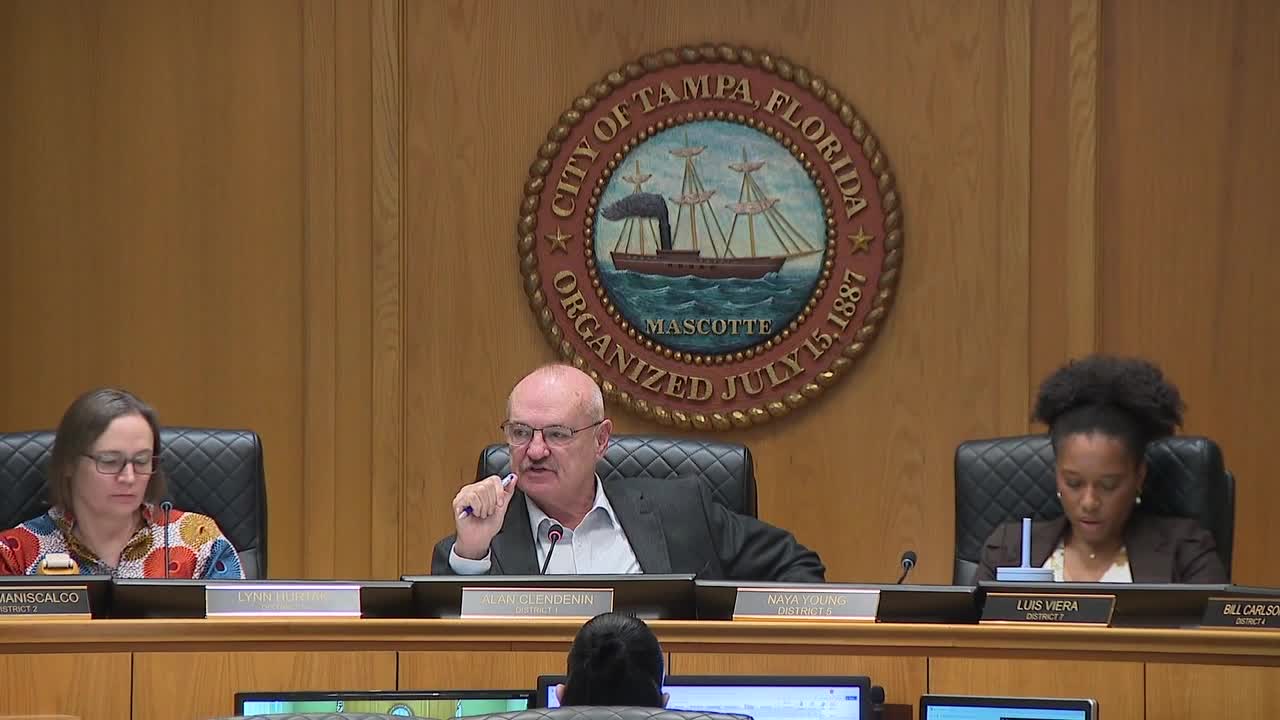
Tampa City Council Chair Alan Clendenin said the budget reflects that reality.
"We've moved forward with a very conservative budget, anticipating potential cost, the decline of our revenue because of what's hanging out there with Amendment Three," Clendenin said.
Clendenin did not mince words about what the amendment could mean for local governments across Florida.
"That's a kind of a guillotine hanging over the neck of municipal governments," Clendenin said.
During a budget workshop earlier this week, Tampa CFO Dennis Rogero walked council members through what the city's own financial projections show if the amendment passes.
"We anticipate that if this amendment is successful, of course, it will have a very, very adverse impact on the general fund revenues beginning fiscal year '28 and continuing, well, in perpetuity as far as I know. It will start out medium and escalate into very, very large decreases," Rogero said.
The numbers behind that warning are significant. If Amendment 3 passes, Tampa projects property tax revenue reductions of approximately $35 to $40 million in FY2028, growing to $60 to $65 million in FY2029, $65 to $68 million in FY2030, $68 to $71 million in FY2031, and $71 to $74 million in FY2032. That is a potential loss of roughly a quarter of a billion dollars over five years.
To understand why those numbers matter, consider this: Tampa's total fire and police expenditures for FY2027 are $431.9 million. The city's total property tax revenues are $397.1 million. The city is already spending more on public safety alone than it collects in property taxes. Any reduction in that revenue does not just affect parks or road projects. It hits the core of what cities must do.
Clendenin made that point directly.
"Our property taxes don't even cover what it costs for us to provide fire and police protection, so it just makes sense. If you don't have enough money to cover and property taxes pay for police and fire already, you cut it further. There's going to be reductions. You're not going to see roads repaved. You're not going to see parks improved. You're not going to see activities for youth, you know, after school," Clendenin said.
At a groundbreaking for a new fire station earlier this week, Tampa Mayor Jane Castor also made her position clear.
"A cut in our property tax would be a cut in TFR service, a cut in the police department service and certainly a cut in the myriad of recreational services, facilities, paving, you name it," Castor said.
Not all elected officials share that view. Hillsborough Commissioner Joshua Wostal supports the measure, pointing to spending on projects like the Rays stadium as excessive. Clendenin pushed back on that argument.
Clendenin also addressed the idea that Tampa has room to absorb cuts because of wasteful or excessive spending.
"The city of Tampa, specifically, which I can address, we have some of the lowest ad valorem property tax rates in the state of Florida for a large city, lower than all of our peer cities around us. So we've already running lean. There is no secret pot of cash sitting in a closet somewhere, just waiting for us to spend. We spend our money very, very judiciously, and we really take the taxpayer money very seriously," Clendenin said.
That lean operation is reflected in the city's staffing numbers. Tampa has 5,054 positions in FY2027, just 6 more than the 5,048 positions the city carried in FY2007, nearly 20 years ago. The city is only now returning to staffing levels it had two decades ago, even as Tampa has grown significantly in population and complexity.
With all of that context, Rogero described the approved budget as a deliberate holding pattern.
"The recommended budget is what we viewed as a sustainment budget, maintaining the services, hunkering down and retaining funding until we see, or saw, what would happen," Rogero said.
Clendenin said the council did restore some previously cut items during the budget process, but acknowledged there is still a long list of needs waiting for funding.
"Hopefully, some of the things that we've cut out of the program will be able to restore. Council did put some items back in, not fully back in, but some items fully back in. We have a lot of projects," Clendenin said.
If Amendment 3 does not pass, the city would have more flexibility to address some of those deferred needs, from road resurfacing and sidewalk construction to park improvements and after-school programs. If it does pass, city leaders say the consequences will be felt quickly and will only grow over time.
On Oct. 12, the council will reconvene to discuss how to divide remaining general fund and CIT dollars among projects that did not make the first cut.
Voters will decide on Amendment 3 in November.

Auto glass company salesman pushes questionable windshield replacement at Tampa dealership
A Service Pros Auto Glass salesman said filing an insurance claim would not affect insurance premiums.
