

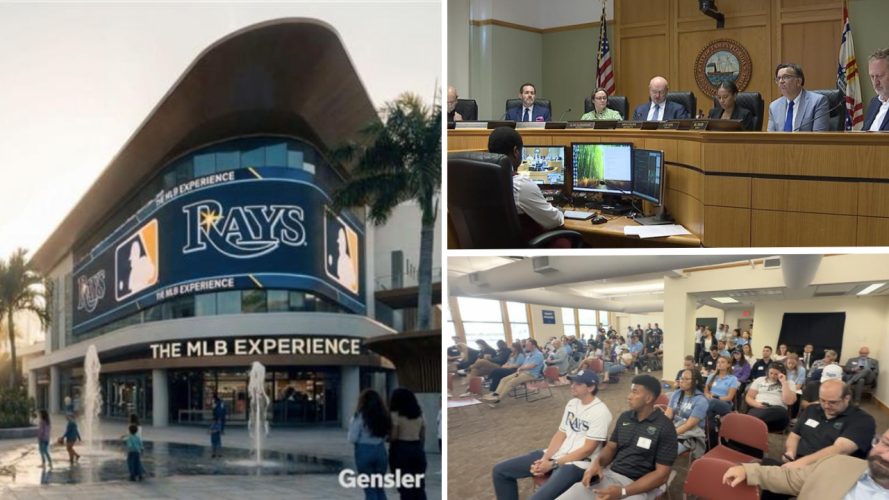


TAMPA, Fla. — The Tampa City Council voted 4-3 to approve a non-binding memorandum of understanding with the Tampa Bay Rays, advancing negotiations over a proposed new ballpark and surrounding development. The vote came one day after the Hillsborough County Commission approved the same MOU in a 5-2 vote, and followed two rounds of debate over public funding, community impact, and whether the mayor's office had bypassed the council in shaping the deal.
Council members Bill Carlson, Luis Viera, Naya Young, and Alan Clendenin voted yes. Charlie Miranda, Guido Maniscalco, and Lynn Hurtak voted no.
WATCH: Tampa City Council votes 4-3 to advance Rays stadium MOU; what each council member had to say
A separate vote on the Drew Park CRA component of the funding framework was tabled, leaving that part of the proposal unresolved as negotiations proceed.
The MOU outlines a proposed funding framework that includes $80 million from the city through the community investment tax, plus $360 million from the county in four annual installments of $90 million each. The agreement is non-binding, meaning either party can walk away from negotiations.
What the vote was and was not
Council Chair Alan Clendenin framed the vote in stark terms before the roll call, saying a no vote would end the conversation entirely.
"If we don't approve it, this stops the conversation. It ain't happening. This, it's dead. You kill it today," Clendenin said.
He argued that the $80 million in city funds should be viewed in the context of the broader investment it would leverage.
"It's $80 million that is going to be going towards a $2.3 billion cash dump into the city of Tampa, just for the stadium," Clendenin said. "You expand that through the 120 acres and the Hillsborough College and all of the other reconstruction and the hotels and all the other things are going to be constructed, it's six to $8 billion of economic activity for $80 million."
Clendenin also confirmed that already-budgeted CIT projects would remain on schedule.
"On the CIT revenue, the projects that have been budgeted will be able to accomplish on schedule," Clendenin said.
Councilmember Bill Carlson described the council as still in the lanes of discussion and feasibility rather than formal negotiation.
"I would argue we're still in those two lanes that we have yet to negotiate an agreement at this point, although this is a step in that right direction," Carlson said.
Carlson credited the Rays for agreeing to the non-binding structure of the MOU and acknowledged the role of city attorney Scott Steady in bringing in a CRA attorney to address feasibility questions around the Drew Park CRA.
"I want to give credit to the Rays for agreeing to the non-binding aspect of the MOU, so we can keep working," Carlson said.
He also noted that the two funding streams under discussion, the community investment tax and the Drew Park CRA, were not proposals that originated from the city.
"These were not proposals that started from the city side, they were brought in and, of course, vetted for us for discussion," Carlson said.
Councilwoman Naya Young: 'This is not simply about baseball.'
Councilwoman Naya Young voted yes, framing her support not as an endorsement of a stadium but as a commitment to pursuing community benefits for District 5.
"For me, this is not simply about baseball. This is about community impact and an opportunity to meet some of the real longstanding needs of communities in District Five," Young said.
Young was direct about what the vote meant and did not mean.
"This is not a vote for a stadium for me. This is a vote to engage in an intentional, transparent discussion about a potential opportunity now," Young said.
She outlined a list of outcomes she said must be part of any future agreement, including truly affordable housing at 80% area median income and below for residents, students, and constituents, quality jobs with living wages for residents, returning citizens, and youth, equitable investment that includes the East Tampa CRA, opportunities for small, local, and minority-owned businesses, expanded youth sports infrastructure including Little League fields, softball programs for young women, mentoring, and apprenticeships, and accessibility so that all residents can attend games.
Young also called for the East Tampa CRA to be included in any discussions about CRA extensions.
"While this proposal may be non-binding, I want to be very clear that my expectations moving forward are not," Young said.
She pushed back on the idea of shutting down the conversation entirely.
"Shutting down discussion without engagement is just as harmful as moving forward without any safeguards," Young said.
Young said she has heard from constituents on all sides and has shared their concerns with the potential partners.
"I have heard directly from the community on all sides. I'm listening closely to all of your concerns and feedback, and I have shared them with the potential partners. To all involved in this, these voices must not be lost or ignored," Young said.
She also said enforceable commitments and anti-displacement strategies must be built into any future agreement.
"Just saying we'll take care of it is not good enough. We need concrete commitments. Anti-displacement strategies must be a part of this discussion," Young said.
Young closed her first round of remarks with a broader message about the city's history of deferred investment.
"Let this moment serve as a reminder that years of deferred maintenance and capital improvements, that is citywide for all, and a history of unfulfilled promises to communities have left us with limited options, lowered public confidence in our will to do good, and increased pressure when opportunities such as this arrive. We can and we must do better," Young said.
In the second round, Young said she had personally communicated her concerns to the mayor, the city's chief financial officer, and the city attorney, and had expressed them directly to the Rays.
"As a representative of this district, I have to be able to explain to my constituents why or why not something is happening," Young said. "It has been expressed to both parties that it is very important that projects that we have already allocated funds to cannot be sacrificed."
Councilwoman Lyn Hurtak: 'The fundamental principle that guides my vote is being straight with the citizens of Tampa'
Councilwoman Lyn Hurtak voted no, citing the city's obligation to voters who approved the community investment tax under specific conditions and raising concerns about the council being excluded from negotiations.
Hurtak referenced a June 4, 2024, memorandum stating that CIT funds projected for Raymond James Stadium and Amalie Arena (now Benchmark International Arena) may be spent only on capital maintenance and repair, not on new structures or facilities.
"It clearly says the funds projected or proposed for Raymond James Stadium and Amalie Arena at the time may only be spent on capital maintenance and repair, and not on new structures or facilities," Hurtak said.
She said she obtained a list of projected CIT projects and shared copies with council members. Among the projects scheduled for the current year are Yellow Jackets improvements, Borrell Park renovation, Gadsden Park improvements, new MacDill Air Force access improvements on Interbay, and police and fire boats.
Hurtak said she also obtained projected CIT revenue figures from the city's chief financial officer, showing $35 million expected the following year. With $20 million going to the Rays, that leaves $15 million, short of the $28.8 million in already-promised projects.
"We have fought to get the Yellow Jackets. What we didn't get them in the West Tampa project, we fought for this. So, what you're telling them is we're going to have to choose between police and fire and them," Hurtak said.
Hurtak also cited research from economist J.C. Bradbury of Kennesaw State University, who is writing a book on publicly funded stadiums. She referenced the Cobb County, Georgia, experience with Truist Park, where a $300 million public contribution has generated an annual loss of around $15 million.
"The gains have been far too small to cover the county's debt service and other funding obligations. What spending may be imported into Cobb happens only during the baseball season. They have not seen a year-round attraction. Purchases within the surrounding district largely come at the expense of other off-campus area businesses, and that is exactly what I heard when going to these meetings," Hurtak said.
She said the core issue is honesty with Tampa voters.
"The fundamental principle that guides my vote here today is being straight with the citizens of Tampa. When the citizens of this city voted to approve the CIT, they were told why the tax was needed, what their tax dollars would be used for, and to gain their votes, they were told that the money would not be used on a new stadium," Hurtak said.
Hurtak said if CIT funds are to be used for a new stadium, the decision should go to voters, and any referendum should present the best possible deal.
"If CIT funds are to be used on a new stadium, that should be put to a vote by the citizens of Tampa. And if and when that referendum is on the ballot, we owe it to the citizens to make sure that the deal they are voting on is the best deal that can be made for our city, not a rushed deal," Hurtak said.
She also raised concerns about the council's limited authority to mandate minority- and women-owned business participation or union labor on the project, noting that state preemption has removed those tools.
"There is no EB office anymore. We will not be able to mandate women-owned minority business be used at all. We can't require unions to be used at all. The state has preempted us from all of these things," Hurtak said.
In the second round, Hurtak said the outcome could have been different if the administration had included the council from the start.
"If the administration or the Rays had come to us and asked us about the $100 million from the CRA or the $80 million from the CIT, they would have heard our concerns and brought us a deal we could approve," Hurtak said.
Hurtak said she had told the Rays, from her first meeting with them, that she preferred a tax increment financing district or a community development district to using CRA funds.
"I would rather see this as a TIF district or a CDD instead of using CRA funds. I think that is 100% the way to go, carve out this entire 130 acres, they could get more than $100 million, whatever they needed to bond to do that themselves," Hurtak said.
She warned that approving the MOU sets in motion a process that becomes increasingly difficult to reverse.
"This MOU is like walking into the Hillsborough River. Our feet go into the water with the MOU, but by the time that it comes back to us for a vote, clearly the water will be up to our noses and it will be hard to get out of the current," Hurtak said.
Councilman Luis Viera: 'Reasonableness mandates that we continue to go forward'
Councilman Luis Viera voted yes, acknowledging legitimate concerns on both sides but arguing that the question before the council was one of reasonableness.
"There are legitimate concerns that I obviously acknowledge, but to me the good far outweighs the bad in terms of moving forward at this time," Viera said.
Viera framed the decision using a phrase from Willie Nelson.
"Is it reasonable to stop right now and say, to quote Willie Nelson, turn out the lights, the party's over? We're not going to be talking anymore. We're walking away. We're going to burn the bridge. Why would we do that?" Viera said.
He said the vote is significant but not permanent.
"This is not a big deal. No, this is a very big deal. It's a very, very big step, right? It's the 10 suggestions, not the 10 commandments. We're not getting married, we're dating," Viera said.
Viera called on his colleagues to vote from conviction rather than pressure.
"My message to folks is to have courage. You can have courage and vote yes, you can have courage and vote no today, but whatever you do today, make it courageous, make it something that you're doing based upon what is right," Viera said.
He also addressed the political risk of the vote directly.
"Somebody said that people who vote for this are going to lose votes. I believe that, maybe I'm wrong, I believe that, but I'm willing to take that chance, because I think it's the right thing to do," Viera said.
Viera invoked past Tampa development decisions to argue against walking away.
"You take a look at some of the other big steps we've had here in our community, things like the Bucks, things like the Lightning, things like the Aquarium, things like Channelside, things like generation after generation not giving up on Ybor City," Viera said.
He expressed respect for Miranda despite their disagreement.
"Councilman Miranda, who I have a philosophical disagreement with, and I respect the heck out of, and it's such a pleasure to serve in a time with him," Viera said.
Viera said public safety support was a key factor in his decision.
"When I began with the Rays, I told them if everyday firefighters and everyday cops oppose this, you're going to have a hard time getting me. Public safety is issue number one. Not just are they not neutral, but they're actually supporting this," Viera said.
He said future negotiations must convert promises on public safety, HCC, affordable housing, ticket surcharges, revenue sharing, apprenticeships, and local hiring into binding commitments.
In the second round, Viera noted that he had personally inserted provisions into the MOU related to public safety funding.
"I actually did speak to the parties on it, because I insisted on some provisions there with regards to public safety dollars, and that's something that I inserted myself into for that, because that again, for me, that's one of many non-negotiables," Viera said.
He also reframed the financial argument, pointing to the county contribution.
"We're getting $750 million of county money put into the city of Tampa in exchange for 200 something million dollars from us. For every dollar we put in, we got $3 from Hillsborough County put right in our city of Tampa," Viera said.
Councilman Charlie Miranda: 'I told Mr. Babby way ahead I would not support this'
Councilman Charlie Miranda voted no, saying he had made his position clear to Rays CEO Ken Babby before the vote and cited financial risk to taxpayers as his primary concern.
Miranda pointed to language on page 10 of the MOU stating that the public contribution amount shall not be decreased, even if revenue falls short.
"The public contribution amount shall not exceed the public class cap. It is intended that the parties of the public contribution amount will not be decreased. Period. So that means if you don't have the money, you still got to pay for it. That's us, the city, that's you, the taxpayers," Miranda said.
Miranda noted that the county's $360 million CIT contribution is split into four annual installments of $90 million, and the city's $80 million contribution is $20 million per year, with no provision for a decrease if revenues fall short.
"Either I have the money, I don't have the money, I still got to find it," Miranda said.
He pointed to the city's pipe replacement program as an example of what happens when infrastructure costs spiral and funding runs short.
"The pipe program in the city went down. We're paying a million and a half dollars for a mile to put it up to make sure that the pipe for the next 100 years will be there. Guess what? Now it's four and a half billion a mile, and we had to stop it," Miranda said.
Miranda said he had a friend run the MOU through an AI analysis tool because he does not use computers, and he read the results into the record. The analysis flagged large public subsidies and opportunity costs, taxpayer repayment risk if project revenues underperform, narrowed future flexibility from pledging CRA tax increment revenue, long-term constraints on public control of a publicly funded asset, cost overrun and enforcement risk, and complications with tax-exempt and taxable bond financing.
"When I look at these things, and I keep looking at what the results are, and I look at the numbers on attendance, I look at the numbers on revenue, they either have a lot of money stashed away or they don't have no money at all," Miranda said.
Miranda said he has never supported public funding for Raymond James Stadium or Benchmark International Arena.
"That's why I told Mr. Babby way ahead I would not support this, and by the way, I have never supported any other tax at Ray Jay or at Amalie Arena," Miranda said.
In his second round of remarks, Miranda made the case that Drew Park's value to the city lies precisely in its industrial character and that the proposed development threatens to eliminate something irreplaceable.
"Drew Park is just that, it gives the people a chance to have a business. It is the only industrial area left in the city," Miranda said.
Miranda said Drew Park generates more jobs per square mile than anywhere else in Tampa, employing people in manufacturing, food production, auto repair, and other trades that do not require professional degrees.
"Not everybody can be a lawyer, not everybody can be a doctor, or anybody can be a ball player or elected official, but Drew Park is something very unique for the city," Miranda said.
He noted that Drew Park was once a military air base during World War II and said the neighborhood needs to maintain its industrial identity.
"It used to be an air base way back in the 40s during the Second World War, and it's a place where it needs to maintain itself as what it is for as long as it can, because creating more jobs per square mile than any place in the city of Tampa, and that type of business," Miranda said.
Councilman Guido Maniscalco: '$80 million is the speed bump in the road for me'
Councilman Guido Maniscalco voted no. Born and raised in Tampa, he said he has watched the city change over decades and remembers the original debates over the community investment tax and Raymond James Stadium. He said the MOU is historic, but that the $80 million CIT contribution is where he draws the line.
"The Rays and everything, you know, they're a wonderful organization. The best part of the Rays are the fans, you know, we all just agree on that. This MOU is historical," Maniscalco said.
Maniscalco said he was one of the supporters of the CIT renewal and told constituents it was business as usual.
"I was one of the supporters of it, telling people, just renew it. It's business as usual. Your taxes aren't going to go up. The percentage is going to stay the same," Maniscalco said.
He said the $80 million CIT contribution is his core concern, particularly because voters were told the money would not go to a stadium.
"When it was proposed to the people for renewal, we were very specific in saying it's not going to go to a stadium. And then they changed it to public facility, and then they had to get a legal opinion of what public facility could be," Maniscalco said.
Maniscalco said his definition of a public facility is something like the Riverwalk or a community center, not a stadium that requires a paid admission.
"We can't walk into Raymond James and have a picnic on the field, or sit in the stands and take photos," Maniscalco said.
He raised concerns about proposed state-level property tax reforms and their potential impact on city revenues, saying the CIT is a lifeline for basic services.
"The CIT is so broad that it goes to public safety. You can build a fire station, you can buy police cars, you can pave roads," Maniscalco said.
Maniscalco said the most common requests he gets from constituents are for road paving, sidewalks, police cars,and fire presence, and that his answer for years has been that the money is not there.
"My response for years was, we don't have the money for it. We don't have the money for a speed bump, but it's 80 million very precious and very important dollars. That's the speed bump in the road for me," Maniscalco said.
He questioned why the agreement could not be amended to replace the CIT contribution with state or private dollars, noting that Babby had said the Rays would cover cost overruns beyond $2.6 billion.
"The Rays will cover the overage. What is $80 million? Because at the end of the day, I need to face my constituents and the taxpayers," Maniscalco said.
He also asked whether the city's contribution could be structured as reimbursable.
"Why can't it be reimbursable? Reimbursable over a period of time, anything," Maniscalco said.
In the second round, Maniscalco raised a concern about negotiating leverage, saying that by including the $80 million figure in the MOU, the city had already shown its hand.
"You showed your cards, and the city said $80 million, we go for that $80 million," Maniscalco said.
He also said the council was shut out of the process entirely.
"This was negotiated within the parties without city council. I wasn't approached and asked, well, what do you think? What's going to get you to yes?" Maniscalco said.
Maniscalco said he had watched the Hillsborough County Commission receive a $100 million state contribution as part of its negotiations and questioned why the city's council members were not given the same opportunity to shape the deal.
"If I were to have been asked, or the city council members would have been a part of this, what's going to get you to yes, what do you need to do, how do I face the taxpayers and the voters?" Maniscalco said.
He said projects that constituents have been waiting years for will now have to be deferred.
"We're going to have to defer, cut, delay, because we promised this $20 million a year over four years, and we have to put these other projects that you've been waiting for on the back burner," Maniscalco said.
Councilman Alan Clendenin: 'This is city building in its finest example'
Councilman Alan Clendenin voted yes, arguing that the project is about more than baseball and represents a long-overdue investment in a neglected part of Tampa.
"I've been quoted as saying, this is not about stadium construction, it's about city building, and you have an area of the city of Tampa that has long been neglected," Clendenin said.
Clendenin described the current state of the area around the proposed site as a sea of grass-ridden parking lots, abandoned buildings, and adult-oriented businesses that are not family-friendly.
"Any of you that are brave enough to venture into Drew Park, you see some very interesting types of businesses mixed in that group of adult-type of establishments, which is not family-oriented," Clendenin said.
He argued that Drew Park deserves the same investment that other parts of the city have received.
"Why doesn't Drew Park deserve infrastructure? Why doesn't Drew Park deserve an investment from the city of Tampa that other areas of the city of Tampa has? Drew Park deserves it, just like downtown, Channelside, Ybor City, East Tampa, any of our other CRAs," Clendenin said.
Clendenin said density is essential to Tampa's long-term growth and that the city must find places to build rather than continue expanding outward.
"Density equals opportunity. We have the expansion of urban service area into the county time and time again, we're losing agricultural land, we're losing environmentally sensitive land. We have to be able to create density," Clendenin said.
He said the stadium is only a small portion of the 120-acre development and that the project will generate year-round economic activity, unlike a traditional football stadium.
"We're not just talking about the handful of games that Raymond James Stadium operates with. Even with the most successful stadium in the world, it sits mostly as a big empty concrete structure most of the year. You tie that with spring training in Steinbrenner Field, you tie it with the amount of activation of how many baseball games there are a year, concerts, this inside venue, you're talking about a year-long activation in one area," Clendenin said.
Clendenin pushed back on the argument that the CIT was never intended for stadium-related spending.
"Saying that CIT was not for stadiums, that is absolutely incorrect. It was intended from day one, and it's in there that we use it for infrastructure and improvements and maintenance on those facilities," Clendenin said.
He said that Drew Park residents and business owners deserve sidewalks, bike lanes, water, sewer, and flood-control improvements.
"They deserve Drew Park sidewalks, bike lanes, all the things that come with this, good water supply, good sewer, sewage, and flood control in Drew Park," Clendenin said.
Clendenin closed with a vision for what the project could become.
"This is city building, city building in its finest example, and it is the right project and the right place. It is going to be a world-class facility, it's going to be a world-class destination," Clendenin said.
In the second round, Clendenin made the economic case directly.
"$80 million to get $2.3 billion spent inside the city limits of the city of Tampa. That's just the stadium. You expand that through the 120 acres and the Hillsborough College and all of the other reconstruction and the hotels and all the other things are going to be constructed, it's six to $8 billion of economic activity for $80 million. Show me the table in Vegas, and I'm flying out tomorrow," Clendenin said.
Councilman Bill Carlson: 'I'm 99.9% sure I'm going to vote no when it comes back'
Councilman Bill Carlson voted yes but issued a stark warning about how he expects to vote when a binding agreement returns to the council.
Carlson said the process that produced the MOU was deeply flawed and that the mayor's office should have engaged the council far earlier.
"It's shocking that I thought I was the only one that wasn't approached. It turns out none of us were approached. It sounds like they, the mayor's office, should have had conversations with us, not in just the last few days to sell this to us, but to get us to help us buy into it. It should have been a collaborative approach," Carlson said.
He said the CRA Citizens Advisory Committee should also have been part of the process.
"The CRA, CAC should have weighed in talking about economics of it," Carlson said.
Carlson said he does not trust economic impact studies and argued the council should be examining opportunity costs instead.
"I studied economics at three different respected universities, and I don't believe in economic impact studies at all. I went, I studied under some of the best economists in the world, so that I could shoot holes in economic impact studies, and whether it's something I like or something I don't like, I don't believe them at all. The numbers are bs. What you have to look at is the opportunity costs, substitution costs of what you could spend the money on," Carlson said.
He pointed to a nearby development as an example of unequal treatment.
"Just down the street, there's a development called Midtown, which is a multi-billion dollar investment. There's one development in downtown that got $100 million from the last administration. This one would get subsidies, Midtown got zero, and there are other developments that get zero. Is it fair to everybody?" Carlson said.
Carlson said he believes the Rays have been negotiating in good faith, but that the council was not given credit for the concessions the team had already made because it was not part of the process.
"The Rays, I think, have been working in good faith, they put in a lot of concessions to the administration. Unfortunately, city council was not involved, the public was not involved from the city's point of view, and so they're not getting credit for all the things they've given up so far," Carlson said.
He also noted the Rays are pursuing state funding, which he said is a factor in the overall picture.
"They're also, besides the county money, they're also looking for state money, and so that's a factor in this,"Carlson said.
Carlson acknowledged the personal difficulty of the vote.
"The Rays fans, I understand your concerns, my mom and my kids are watching, and they're huge Rays fans as well, so however I vote, it will be difficult," Carlson said.
Before the roll call, Carlson said he had explored alternative funding structures, including a TIF district and a scaled-down CRA footprint, but the administration did not include the council in those discussions.
"I talked about a TIF. I talked about shrinking the CRA because the impact on the rest of Drew Park, we could take this area out of it and form a TIF. We could just shrink it down so it only includes that. Drew Park could have a separate kind of virtual CRA. There's all kinds of options that could be discussed. Unfortunately, the administration did not include us. I did talk to the Rays about those ideas, but somebody told them no," Carlson said.
Carlson said he does not believe in private sector subsidies as a general principle.
"My bottom line on this is that I don't believe in private sector subsidies. I don't think it's a good idea for the government to subsidize one versus the other. When people like in Midtown are paying 100% of everything, it's not fair to everybody else," Carlson said.
Despite that, Carlson said he voted yes on the MOU specifically to preserve the Rays' ability to pursue state funding for HCC.
"When this comes back to us, I'm like 99.9% sure that I'm going to vote no. But today, because the Rays ask only in regard to their ability to get state funding, I'm going to reluctantly vote yes, only for that possibility. But just as a warning, I am going to be voting no when it comes back," Carlson said.
Rays CEO Ken Babby: 'Don't send the Rays out of Tampa'
Rays CEO Ken Babby addressed the council directly, outlining concessions the team had made regarding the CIT and urging members to allow negotiations to continue.
Babby said the Rays agreed to commit the full $80 million to infrastructure, to shift from a bonding model to a pay-as-you-go structure at the city's request, and to provide a financial backstop for the city's CIT contribution.
"One thing the Rays agreed to do with $80 million is, of course, to commit for it to go 100% into infrastructure as represented in the MOU," Babby said. "Much against our desires, which were we initially intended to bond against the CIT, both at the city level and the county level, reluctantly, we agreed to move to a pay-go model, where it's paid over several years. I think that's worthy of noting that was an enormous concession."
Babby said the team also agreed to provide a backstop specifically for the city's portion of the CIT contribution.
"It was requested that specifically only to the city, not to the county, that a backstop be provided for that CIT, and we agreed to that too, as represented in the MOU," Babby said.
Babby said the team had given ground repeatedly throughout the process and still has more work to do.
"Time and time again, questions, good questions, have come up and have been asked about the CIT, and we've given, and we've given, and we've given, and we still have work to do to reach definitive agreements, which will involve even additional compromise on both sides," Babby said.
He also read a statement from Major League Baseball Commissioner Robert D. Manfred.
"We are in the late innings of a very long game with the future of baseball in Tampa Bay hanging in the balance. We have faith in Tampa Bay as a major league city, and I hope that the city council responds with a positive vote to this non-binding MOU," Babby said, reading Manfred's statement.
Babby framed the vote in terms of what the project could mean for the broader community.
"What we're talking about today is an $80 million portion of an overall investment, an $80 million conversation with city council, an $80 million conversation to drive $55 billion of economic impact and 11,900 jobs," Babby said.
He said the project is on the verge of producing the largest community benefits agreement in Tampa's history.
"We are on the cusp of making the largest community benefits agreement in the city of Tampa's history, funds to invest in projects that we so desperately need throughout our community that would not be possible without this investment," Babby said.
Babby also acknowledged the concerns raised about council involvement and said it is a lesson for everyone moving forward.
"I actually appreciate the conversation about the council involvement, and I think it's a lesson for all of us moving forward to make sure that we're even more engaged," Babby said.
Babby closed with a direct appeal to the council.
"I urge you, on behalf of our fans, on behalf of our community, on behalf of our city, and our ownership group to move the non-binding MOU forward, so we can simply continue a conversation. Don't send the Rays out of Tampa," Babby said.
Drew Park CAC chair: 'I fault our elected officials for giving away our money'
The chair of the Drew Park Community Redevelopment Area Community Advisory Committee, Maritza Astorquiza, told the council that neither the city, the county, the state, nor the Rays had come to meet with the community before the vote.
"Tallahassee, nor county commissioners, nor the city of Tampa have come to meet with us, and for that matter, neither have the Rays. We are important. We should be at the table," the CAC chair said.
Astorquiza said Drew Park's CRA tax increment financing money had gone 40 years without producing capital improvements in the neighborhood, and that the community is already stretched thin with ongoing projects.
"Our TIF money before the CRA was 40 years before we had any capital improvements in Drew Park. We are spent out with all the projects we're doing, and we need more money for the continuing projects that are going on," she said.
Astorquiza said the community has not had a formal meeting to weigh in on the proposal and that residents cannot yet say whether they are for or against it.
"There has not been a community meeting. I can't say for or against it. As the chair of the CAC, I had a lot of comments. How easily people who are just talking about Drew Park, and they have no idea what's going on in Drew Park, are willing to give away our money without talking to us," the CAC chair said.
Astorquiza raised concerns about property taxes, eminent domain, and displacement protections for Drew Park residents and business owners.
"I haven't heard anything for Drew Park, but I fault our elected officials, because our elected officials are giving away our money with no protection for us," the CAC chair said.
Public speakers divided on the vote
Members of the public who addressed the council reflected the same divisions seen among council members. Supporters pointed to job creation, economic development, and the transformation of a neglected area. Opponents raised concerns about the use of CIT funds, displacement, and whether the city was negotiating from a position of strength.
Stephanie Poyner told the council that the $976 million in combined public contributions works out to $697.14 per person across Hillsborough County's 1.4 million residents, or $2,788.57 for a family of four.
"My mom said, my husband says you can't spend other people's money," Poyner said. "There are 1.4 million people who live in this county, and the decision should be made by them."
Poyner warned council members that the vote could have lasting political consequences.
"Anybody who makes a vote on this particular project in any way, shape or form, will lose votes. You may lose your political career over this, because everyone in this county is watching what you do," Poyner said.
She called for the question to be put directly to voters.
"If the citizens of Hillsborough County want it, then by God, they'll vote for it. We can put it on the ballot. We've got until August to put it on the ballot," Poyner said.
She also raised concerns about the community benefits agreement process, referencing what she described as a poor experience with a previous development.
"When the community benefits agreement comes up, remember what kind of crap we got from the Related Group for Rome Yard. We need to make sure that we are doing a better job. We need to have it in writing when these things will happen. What is the timeline for all these things?" she said.
One speaker told the council that the project should not be framed as a choice between the Rays and public safety, and introduced a representative of the firefighters union to speak to that point.
Another speaker urged the council to vote yes, using a baseball analogy to make the case.
"Generations of Tampanians are on base, waiting for you to take a strike to get in the batter's box, dig in, see that big fat white fastball coming down, and to hit it and knock it out of the park. Are you really going to sit there with the bat on your shoulder, let this opportunity pass, and just walk with your head to the dugout by saying no to anon-binding MOU?" the speaker said.
Firefighters union: Rays are the only developer to include us from the start
Nick Stocco, Union President with the firefighters union, told the council that the Rays organization is the only developer that has proactively reached out to include fire and EMS infrastructure in its planning.
"In my tenure as union president, the Rays organization have included us and include us early. They have been the only developer organization that has reached out for the fire union's input, and we commend them for that," Stocco representative said.
The representative said the Rays made a specific commitment to include fire and EMS infrastructure within the development.
"The Rays had made a promise that we would have fire or EMS infrastructure built within this development. Therefore, we're in support of that. We're in support of development that includes firefighters early to include us into their development plan," the union representative said.
He said response times in Tampa have continued to lag as the city has grown, and that the Rays' commitment to include infrastructure within the development is a meaningful step toward addressing that problem.
"What the Rays organization is doing is that they're promising us infrastructure within their development, so that way it'll help reduce response times, and that's really what we're looking forward to," the union representative said.
The representative said any growth that does not include the fire union at the table creates problems down the road.
"Any growth without the involvement of the fire union is going to be reactive down the road. Without having the boots on the ground at the table, being able to provide that opinion for the decision makers, is not going to provide them with the best avenues to plan in the best way for their development," the union representative said.
Share Your Story with Jada
Jada Williams is focused on the issues that matter most to people in who live in Tampa and West Hillsborough County. From downtown Tampa to Town ‘n’ Country and Westchase, Jada works to bring you updates and solutions on everything from crime to infrastructure. Reach out to Jada below with your concerns for your neighborhood.
.

'My heart breaks': Woman describes helping injured students after deadly school bus crash in Polk County
A woman on her way to work Monday morning found herself helping injured Winter Haven High School students after a school bus crash that killed two people.
