

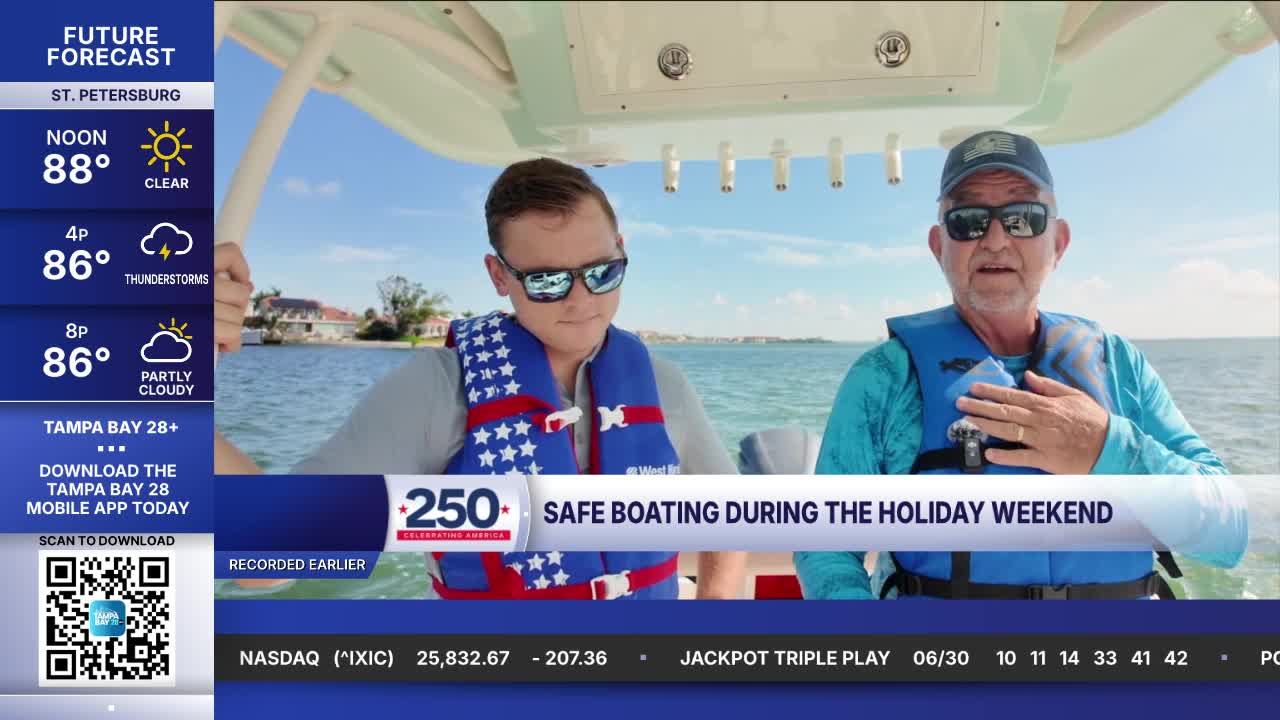


TAMPA, Fla. — With America celebrating its 250th birthday this Fourth of July weekend, Florida's waters are expected to be more crowded than ever. Whether you have plans on the water or know someone who does, a boating safety expert says preparation is key.
Gordon Hornby, an instructor with the Coast Guard Auxiliary, shared with Tampa Bay 28 reporter Blake Phillips the most important safety tips boaters should know before heading out this holiday weekend.
The first step is making sure you have everything legally required on board.
Here is the Florida boat legal requirements checklist:
- Current vessel registration certificate on board
- Registration numbers and validation decal properly displayed
- One USCG-approved wearable life jacket (PFD) for each person on board
- One USCG-approved Type IV throwable flotation device (required on boats 16 feet or longer, except canoes and kayaks)
- USCG-approved fire extinguisher(s), if required for your boat type
- Sound-producing device (horn or whistle)
- Navigation lights (for operation between sunset and sunrise or in reduced visibility)
- Visual distress signals (required when operating on coastal waters and other USCG-designated waters)
- Engine cut-off switch (kill switch) in use, if required (generally on recreational boats under 26 feet equipped with one)
- Proper ventilation and backfire flame arrestor (if required for gasoline-powered inboard or enclosed engine compartments)
- Marine sanitation device (only if the boat has an installed toilet)
- Boating Safety Education ID Card and photo ID (required for operators born on or after January 1, 1988, operating a motorboat with 10 horsepower or more)
Hornby said the list is worth double-checking before you leave the dock.
Once on the water, Hornby said the most important thing a boat operator can do is stay alert and drive defensively.
"As the operator, you've got to have your head on a swivel, be aware of your surroundings, anticipating what everybody else out there on the water is going to do," Hornby said.
If you are unsure what another boater is going to do, Hornby said the safest move is to let them pass.
"Stay within your limits of abilities. Error on the side of slow. And stay alert, stay aware of your surroundings. And operate the vessel defensively," Hornby said.
Hornby also stressed the importance of communicating with passengers before making any sudden moves on the water.
"Anytime they're going to make a radical speed change or change of direction, let your passengers and your guests know you're gonna do it," Hornby said.
Failing to do so, he warns, can have serious consequences.
"Without your guests being aware of it, it can lead to people going overboard," Hornby said.
Hornby said boaters can still have plenty of fun while following safety guidelines — but staying sober is non-negotiable.
"It's hard to be out there and not be celebrating, but somebody's got to take one for the team," Hornby said.
This story was reported on-air by a journalist and has been converted to this platform with the assistance of AI. Our editorial team verifies all reporting on all platforms for fairness and accuracy.

Pasco County mom of 5 takes in 3 children left without food or power whose mother faces neglect charges
Jasmine Young, a mother of 5, opened her home to three neglected girls as their mother faces child neglect charges for leaving them without food, power or water.
