

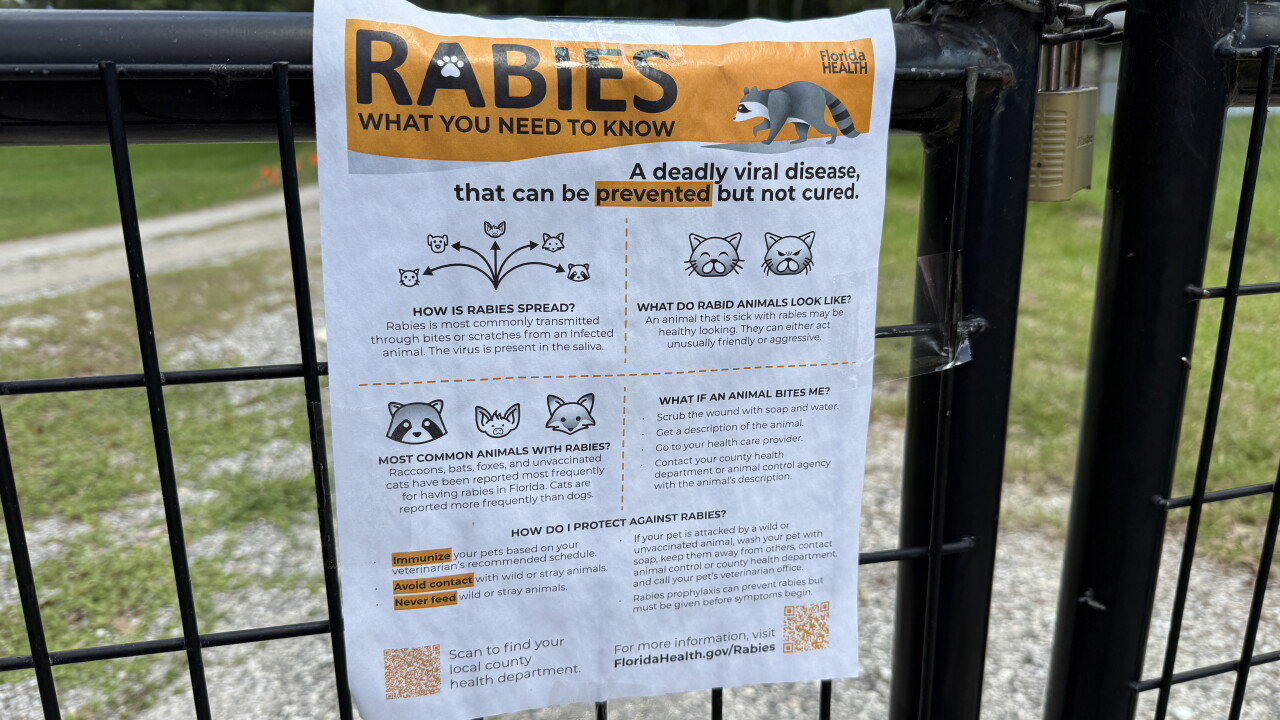


State health officials issued a rabies alert Hillsborough County on Monday after a confirmed case of the virus in a cat that was killed in the Gibsonton area.
Rabies is extremely deadly, with a near 100% fatality rate in humans and other mammals, according to state health officials.
Officials say the cat, which had no known rabies vaccination, was killed in the area of US Highway 41 and Alice Avenue on Friday.
"All residents and visitors should be aware that rabies is currently present in the wild animal population," Florida Department of Health officials in Hillsborough County said in the announcement. Officials said they are monitoring rabies among wild animals in the area.
The alert is in place for 60 days and includes the following area of the county:
- Northern boundary: Alafia River
- Southern boundary: Bullfrog Creek
- Eastern boundary: Alafia Street
- Western boundary: Hillsborough Bay
In Florida, the most common sources of rabies are bats and raccoons, which can then infect people, livestock and pets, according to health officials.
Although rabies can be deadly, receiving the proper treatment in a timely manner can prevent infection in humans. Dogs, cats and ferrets are required by state law to be vaccinated against rabies.
People and pets "should always avoid physical contact with wild animals," health officials said.
Health officials recommended the following precautions to prevent exposure to the deadly virus:
- Immunize your pets and livestock based on your veterinarian's recommended schedule.
- Keep pets under direct supervision and on a leash, and keep livestock secured on your property.
- If an animal bites your pet or livestock, seek veterinary assistance for the animal immediately and contact Hillsborough County Animal Control at 813-744-5660.
- Avoid contact with wild or stray animals. Do not handle, feed, or unintentionally attract them with outdoor pet food, open garbage cans, or other sources of food.
- If you have been bitten or scratched by a wild or domestic animal, seek medical attention, and report the injury to DOH-Hillsborough by calling 813-307-8059.
- Never adopt wild animals or bring them into your home; instead, contact a licensed wildlife rehabilitator.
- Call your local animal control agency to remove any stray animals from your neighborhood.
- Prevent wildlife, including bats, from entering living quarters or occupied spaces in homes, schools, and other similar areas where they might come in contact with people and pets.
Animals that are infected with rabies might show "strange behavior," like attacking for no apparent reason or acting very tame. They may also drool, stagger or become paralyzed.
Health officials recommended the following actions if you believe you have been bitten by an infected animal:
- Immediately scrub the wound with lots of soap and running water for five to ten minutes.
- Try to get a complete description of the animal and determine where it is so that it can be contained by animal control for quarantine or rabies testing.
- Go to your health care provider or the nearest emergency room.
- Call your local county health department or animal control agency with the description and location of the animal. The animal will either be quarantined for ten days (if it is a dog, cat, or ferret) or be tested for rabies.
- If the animal is deceased, be careful not to damage the head, and avoid further contact.
Contact DOH-Hillsborough at 813-307-8059 or visit this website for more rabies information.

Saudi flight from Tampa, secret FBI probe reveal possible Saudi support network for 9/11 hijackers
Twenty years after the Sept. 11 attacks, more than 80,000 records compiled by the Tampa FBI Field Office remain classified. Newly declassified documents are pointing to a possible secret Saudi support network for the hijackers. Soon after the attacks, the FBI uncovered that 15 of the 19 hijackers were from Saudi Arabia.
