



WIMAUMA, Fla. (WFTS) — A piece of land in Wimauma may look empty today, but for Tonya Gay-Jackson, it represents generations of family history, sacrifice and community. And she is determined to make sure that history is never forgotten.
She invited Tampa Bay 28 reporter Jada Williams to learn more about her family's long-standing, trailblazing history in Wimauma.
WATCH: Woman works to restore Black history and family legacy in Wimauma
Gay-Jackson, a community activist, is working to restore the legacy of her great aunt, Willie Mae Lattimore Davis, who owned and operated a store on the property beginning in the early 1950s. The store served as an economic and social lifeline for the surrounding Black community at a time when there was little else in the area.

"This, for me, was an area where we came for the summers, and also where I established my first job," Gay-Jackson said. "The story that you see on the small sign was the first place where I knew that economic diversity was a chance for everybody, where I knew that a woman, an African American woman, could lead in the community with helping folks find jobs, helping folks keep safe and mainly looking out for children and their welfare."
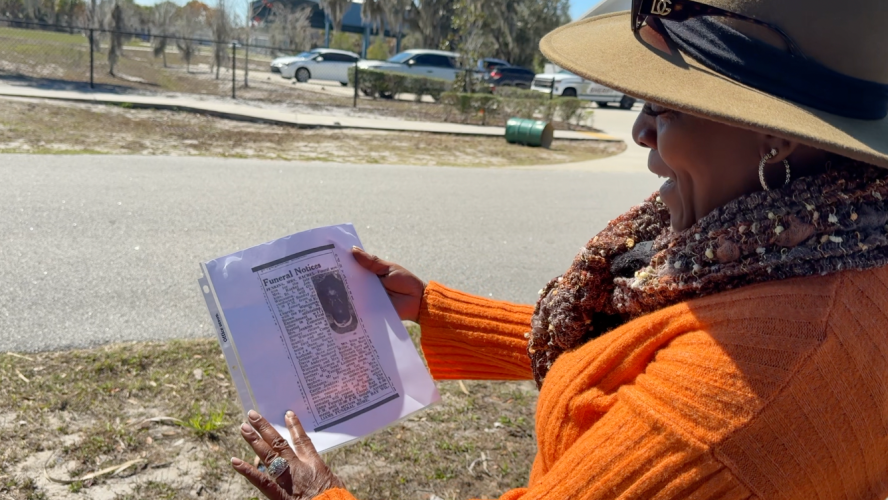
In her hands, Gay-Jackson held an old newspaper clipping of the obituary of another great aunt, Rachel Jenkins. The article identifies her family as among the first African American settlers in Wimauma.

"This newspaper article states that our family is the first settlers here, African American settlers here in Wimauma," Gay-Jackson said. "I was so ecstatic when I found it and it was listed because it does show that we were here. We had ownership of land. We had ownership of businesses."
The store provided more than goods. Community members could get bread, milk and other essential items on credit until they were paid, without judgment.
"They would come and they could get bread, they could get milk, they can get, you know, in kind items until their check, you know, came," Gay-Jackson said. "They got paid on the weekend, and not be looked frowned upon, or looked at as less than because we're all here to help each other."
The store also featured a jukebox, called a piccolo, and a pinball machine, making it a gathering place for children and families. Gay-Jackson recalled traveling to Tampa on Fridays with her aunt to pick up new music records to load into the machine.
Davis was not the only trailblazer in the family. Gay-Jackson said three of her great aunts, Willie Mae, Rachel, and Mary, purchased lots in Wimauma when they arrived and built their lives there. Her grandfather, Harry Anderson Sr., was also a prominent figure in the town's development, working alongside community leaders to secure street lights and roads for the area.
"Finding out my grandfather was a big deal in this town as well, Harry Anderson Senior," Gay-Jackson said. "He was side by side with Mr. Coleman and also Mr. Berry. And they were able to get street lights and roads."
The family's history in Wimauma also includes colorful stories passed down through generations. Gay-Jackson said her great aunt Rachel's husband kept a domesticated alligator on the property that would come around the corner when someone clapped their hands.
"There's at least three, 70 and 80-year-olds that are here in Wimauma that tell that story," Gay-Jackson said. "Who else and how else will we be able to share that unless we got together and shared our stories and told it in our own words."
Gay-Jackson said the family faced significant racial hostility. She recalled watching a delivery driver refuse to serve Davis after realizing she was a Black woman.
"When the gentleman came out to do the delivery, I remember sitting on the stoop out front and him coming to the door and seeing that Willie was actually Willie Mae and an African American woman and turning around and refusing her service," Gay-Jackson said. "That was one of the first times of seeing a time where you weren't appreciated, where you weren't seen as a person."
She also described cross-burnings on family property and other acts of intimidation the family endured.
A historical marker has since been placed at the site. It's the first marker in Wimauma. The marker is recognizing the store and its significance to the community. A second marker has been placed at a nearby cemetery where Gay-Jackson's great-great-grandparents are buried.

Gay-Jackson said her preservation efforts grew out of a community cohort program through Allegheny Ministries, which prompted her to reflect on what she loved about Wimauma. That reflection led her to build a website documenting her family's history and the broader history of Black families who settled in the area.
"Black History Month can't be Black History Month if we don't share our stories in our own words," Gay-Jackson said. "There's so many times that folks want to tell your story or think that they know, but if we don't tell our own stories, in our own words, it just doesn't have the same light and same life."
Now Gay-Jackson is working to take that preservation effort further. She is applying for land use approval from Hillsborough County to restore the property as a community space and plans to open a heritage cafe where visitors can learn about the history of Black families in Wimauma, view historical documents and watch documentary footage.
"There are other folks that are moving here. They'll never know," Gay-Jackson said. "They can come in from wherever they move from. They can come in and taste a bit of history, see different videos that we're going to have, that documentary that could be placed there as well, be able to feel good about themselves in small places, that they can have big dreams."
She is also planning to merge the history of her mother's and father's sides of the family at the site, as the two families have deep, intertwined roots in Wimauma.
On March 7, Gay-Jackson is hosting the first Wimauma documentary screening at First Prospect Missionary Baptist Church, where community families will be invited to share their stories. She said there will also be options for those who cannot attend in person.
"Our generation needs to know how to pass down information," Gay-Jackson said. "If we don't share it, they won't have it."
For Gay-Jackson, the ultimate goal is not just preservation: it is restoration.
"The restoration of dreams, of people, hopes of people," Gay-Jackson said. "For me, the visibility plan, economic development plan, a place where people can dream again and share their history, share their future and share what dreams they have for their generations. Bringing that back will mean the world to me, because it will mean that the legacy of all the families that were here will continue, and the black legacy families won't ever go away."
Gay-Jackson also created a website to share the history she's uncovering in Wimauma.
Share Your Story with Jada

Jada Williams is focused on the issues that matter most to people in who live in Tampa and West Hillsborough County. From downtown Tampa to Town ‘n’ Country and Westchase, Jada works to bring you updates and solutions on everything from crime to infrastructure. Reach out to Jada below with your concerns for your neighborhood.
.

Bradenton community responds after 20-year-old volleyball star dies from disease that affects 2 in a million
The 20-year-old IMG Academy volleyball star and Under Armour All-American died Sept. 16 after a three-month battle with the rare blood disorder — even though doctors had found her a 100% bone marrow match, her mother, Tanya Mack tells Tampa Bay 28 reporter Haley Zarcone.
