

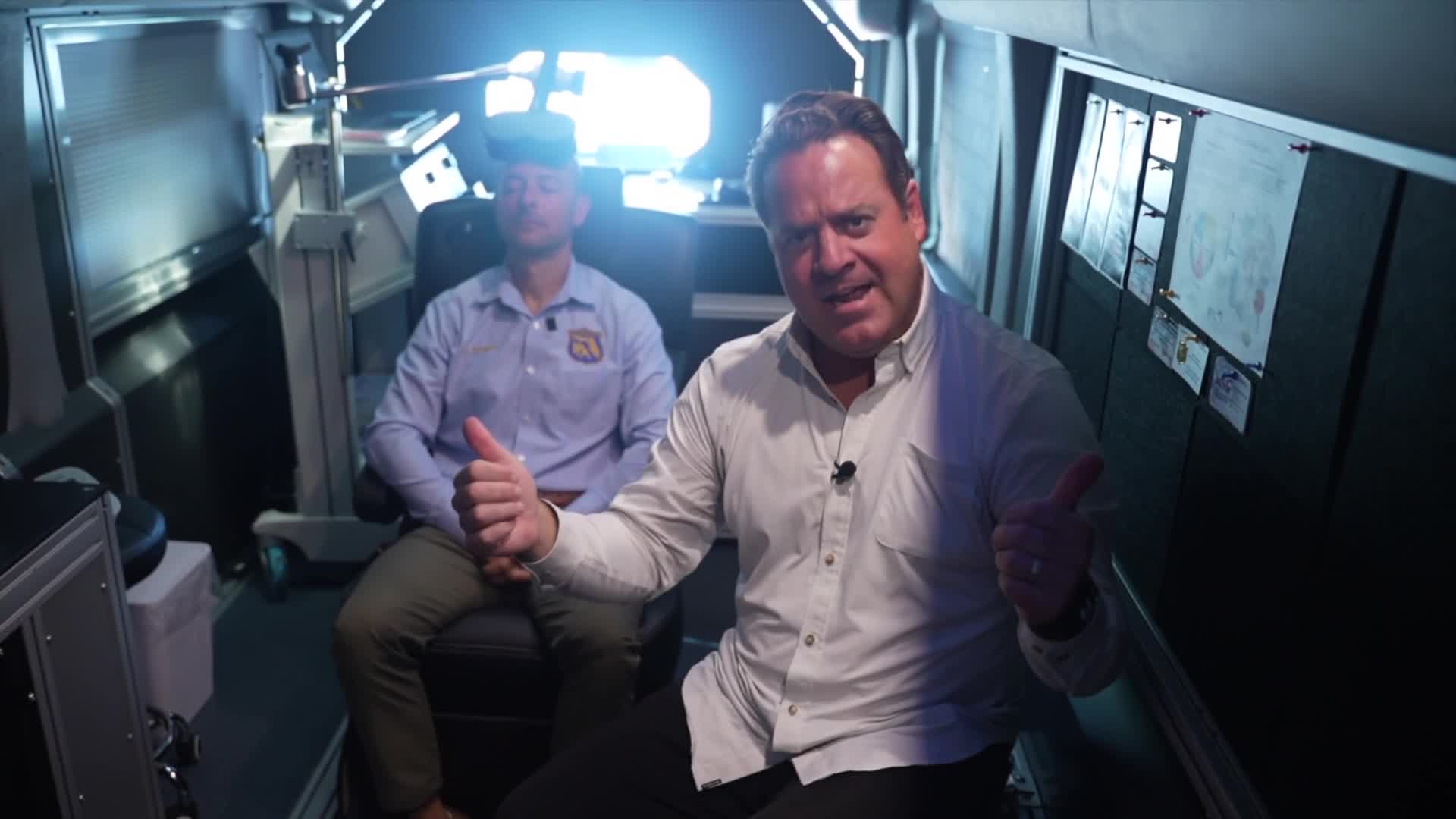


ST. PETERSBURG, Fla. — First responders are trained to help people through some of their worst moments. But across Florida and the Tampa Bay area, concerns about suicide among first responders are putting new attention on those who may be struggling in silence.
A new local program operated by eTMS Florida is working to bring a form of transcranial magnetic stimulation directly to law enforcement agencies, with supporters hoping the treatment can help first responders dealing with depression, sleep problems and other mental health challenges.
Watch report from Michael Paluska
St. Petersburg police K-9 officer Jon Vazquez is among those receiving the treatment.
“You can hear that ding, and then you can hear this clicking. And what Jon Vazquez, a K-9 officer in St. Pete, tells me is this is new therapy, first of its kind to save lives,” Tampa Bay 28 reporter Michael Paluska said while sitting in on one of Vazquez's sessions.
Paluska sat in on two treatments with Vazquez. During one session, Paluska asked him what the treatment felt like.
“You feel anything?” Paluska asked.
“I would equate it to the feeling of being like flicked on your forehead,” Vazquez said.
“No shock?” Paluska asked.
“It doesn’t hurt,” Vazquez said.
The therapy is described as eTMS, a form of transcranial magnetic stimulation. A coil placed against the head delivers focused magnetic pulses that stimulate targeted areas of the brain.
Vazquez said the treatment is individualized using EEG measurements taken during therapy.
“So they get your baseline. Then after 10, they do another EEG to see how it's tracking, and then after your 20th session”… do another EEG,” Vazquez said. “Its individualized because they do the EEG beforehand they see where your brain is lacking the specific hertz and this targets exactly that so its targeted therapy.”
Vazquez said the treatment targets three areas.
“It’s the hertz that are going three spots prefrontal, the top and the back,” he said.
Vazquez said he sought the therapy to improve his sleep and ability to focus.
“It treats depression, it helps with suicidal ideations, it helps with sleep, but for example I am going through this because I want to improve my sleep quality and how I can focus,” Vazquez said.
During one approximately 15-minute session, Vazquez paused the interview while receiving treatment.
“If you talk during it you feel it, it is kind of awkward?” Paluska asked.
“And what they want is to target the alpha brainwaves, and if your like eyes are open and talking, that kind of like changes. So, yeah, they said close your eyes and shut up, basically,” Vazquez said.
Vazquez is also president of the Suncoast Police Benevolent Association. For two years, he pushed state lawmakers to fund a mobile unit that can bring treatment directly to law enforcement agencies. The organization received $10 million this summer.
“So we got this mobile device, and now what we're going to do is we're going to move it from organization to organization, police department to police department to sheriff's department,” Vazquez said.
HOW TMS WORKS
Lena Kuehler, a physician assistant with eTMS Florida, describes the treatment as an effort to help brain cells that may be firing out of sync return to a more coordinated rhythm. She compares that process to a conductor bringing a marching band back together.
“I view us as like a conductor of a marching band, getting back up there and being like, 'Okay, guys, here is the sweet spot? Pick it up. So then your band can play together,'” Kuehler said.
She said the goal is to reinforce rhythms the brain already has.
“I think the most beautiful thing about my job is like we're kind of reinforcing something that you already have innately. We're just strengthening that rhythmically. It's like teaching a kid how to ride a bike, right? Like once they get it, they get it. You don't have to. You're just going to annoy that kid if you keep telling them over and over how to ride a bike,” Kuehler said. “We like to find your brains sweet spot in Alpha so that we know how to help some maybe straggling neurons get back on par with Alpha.”
ST. PETERSBURG OFFICER SHARES HER FAMILY'S LOSS
St. Petersburg police Officer Jessica Bayly knows firsthand the devastating impact of suicide.
Bayly's mother was a sergeant with the Orange City Police Department who died by suicide.
“Nobody knew that she was struggling. Nobody knew it was a battle,” Bayly said.
Bayly said she has PTSD and anxiety and recently finished her treatment sessions.
Paluska asked whether the job's toll had ever made her consider leaving law enforcement.
“I can't imagine being in law enforcement and having those things. Have you ever thought about walking away for your mental health?” Paluska asked.
“100% I mean, I think, I think most of law enforcement has probably asked themselves that question. You know, is this worth it? Is this worth the toll that it takes, not just on my body and the physical aspects, but the mental aspects? But this is my passion. Is what I believe that I was born to do,” Bayly said.
She said she has noticed changes since receiving the therapy.
“Just the day-to-day, I can tell my mood has improved. I can I'm sleeping better. I'm more optimistic. You know, I've never really been a pessimistic person, but I can tell thing. I I don't know how else to explain it,” Bayly said.
BRINGING TREATMENT DIRECTLY TO FIRST RESPONDERS
“The Suncoast PBA was the first union to make it accessible-a mobile device,” said Vazquez, who is also president of the Suncoast Police Benevolent Association. “Firefighters, veterans, if they know that this device is here and we've put it out to the masses on our social media, they can come receive the treatment.”
A waitlist already exists for treatment. Vazquez said convenience for first responders is key.
“There were brick-and-mortar locations. An officer would have to drive an hour to an hour and a half to maybe two hours, depending where they live, just for a 15-minute treatment. A lot of officers were unwilling to do that,” Vazquez said. “It's only 15 minutes long, so you can come in 30 minutes before, get your 15-minute session, and still be 15 minutes early for readoff, or stay 15 minutes after your shift and get your treatment.”
By his second-to-last session, Vazquez told Tampa Bay 28 his sleep was the best it had ever been.
Sleep-tracking information Vazquez shared with Tampa Bay 28 showed scores in the 50s over the summer and scores consistently in the 90s after therapy.
As a K-9 officer and lead K-9 trainer for his agency, Vazquez said focus is critical to his job.
“How is the focus with the therapy?” Paluska asked.
“Fantastic,” Vazquez said.
Paluska asked Vazquez about the importance of staying clear-headed as the department's lead K-9 trainer.
“Dangerous job you need focus for?” Paluska said.
“The dog is always taking you to the fight, the dog doesn’t know fear like we know fear it could be a homicide suspect, a rapist that dog is taking us,” Vazquez said.
Vazquez said the effort extends beyond his own treatment. He wants other first responders to have access to mental health care before they reach a crisis.
“Suicide isn't waiting. Depression isn't waiting. Your sleep issues aren't waiting. So we had to act now. We had to act fast, and we had to make sure that we had this as soon as possible,” Vazquez said.
Share Your Story with Michael

A lot goes into the price of paradise and Michael Paluska focuses on every aspect. From the job market and housing to how Florida’s growth impacts our state’s wildlife. Send Michael tips to keep these important conversations going.
.

Pasco County mom of 5 takes in 3 children left without food or power whose mother faces neglect charges
Jasmine Young, a mother of 5, opened her home to three neglected girls as their mother faces child neglect charges for leaving them without food, power or water.
