

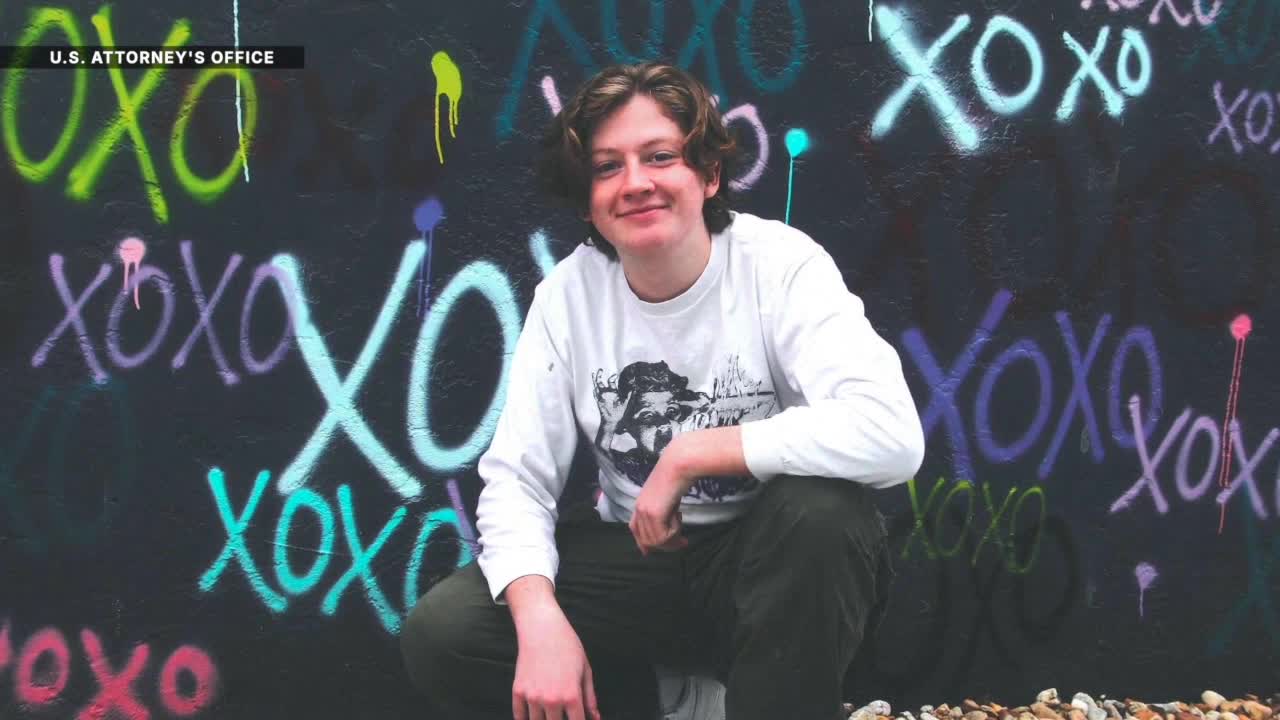


TAMPA, FL (WFTS) — An 18-year-old University of South Florida student bought what he thought were three Percocet pills. He had no idea they were laced with fentanyl. He had no idea they would kill him. And the men who sold them to him kept right on selling after he died.
That is the story of Patrick Connolly, and on Wednesday, it reached its legal conclusion when the final two of the four men responsible were sentenced to federal prison.
Watch report from Jada Williams
U.S. District Judge John Badalamenti sentenced Miguel Cintron, 38, to life in federal prison and Darrius Gustafson, 23, to 21 years and 10 months. A federal jury found both guilty on May 4, 2026, of conspiracy to distribute fentanyl resulting in death. U.S. Attorney Gregory Kehoe announced the sentences at a press conference at USF.
"When he bought the three Percocet pills from these defendants, he had no idea that the purchases would kill him, because they were laced with fentanyl," Kehoe said.
Kehoe described Connolly as a good student with a close family, an Eagle Scout who enjoyed music and was engaged in his studies.
"He was 18 years old, making mistakes that all 18-year-olds might make," Kehoe said.
That mistake cost him his life.
How it happened
Connolly purchased the pills on Feb. 16, 2024. After his death, USF police discovered his body and launched an investigation alongside the Hillsborough County Sheriff's Office. That investigation quickly revealed that Connolly had unknowingly purchased fentanyl from Gustafson.
What investigators uncovered next was bigger than one transaction. Gustafson was not working alone. He was part of a larger drug trafficking organization with Cintron at the top of the supply chain. Cintron never met Connolly. He did not know who he was. But he was running the operation that put the pill in Connolly's hands.
After Connolly died, the defendants did not stop. All four continued to distribute fentanyl, this time to undercover deputies and detectives from the Hillsborough County Sheriff's Office.
On April 10, 2024, all four were arrested. A search warrant executed at Cintron's residence turned up more than 7 kilograms of cocaine, heroin, black tar heroin, fentanyl, firearms and more than $200,000 in cash.
All four defendants were charged with conspiracy to traffic more than 40 grams of fentanyl resulting in death, as well as charges related to continued fentanyl sales after Connolly's death. Cintron faced an additional charge of being a felon in possession of a firearm.
Co-defendants David Chudhabuddhi and Marquis Trant chose a different path than Cintron and Gustafson. Both entered guilty pleas and were sentenced on June 18, 2026. Chudhabuddhi received 8 years and 1 month in federal prison. Trant received 12 years and 7 months.
Cintron and Gustafson took a different approach. Before trial, both entered guilty pleas to the drug distribution charges but stopped short of accepting responsibility for Connolly's death. They admitted to selling the drugs but would not admit that those sales caused his death. A jury disagreed. On May 4, 2026, both were found guilty on all remaining counts, including causing the death of Patrick Connolly.
Kehoe did not hold back in describing what that decision meant.
"They took responsibility for selling the cocaine that had been alleged in the indictment that led to Patrick's death, but they did not plead to the counts that said the sale resulted in his death. In other words, they stopped short of taking responsibility for the death they caused," Kehoe said.
What law enforcement found and what it means
Hillsborough County Sheriff's Office Colonel Nikki Bosley said the scale of what investigators seized during this operation is difficult to overstate.
"Patrick took one pill, and the network responsible for that pill was moving thousands. More than 2,200 pressed fentanyl pills were seized off the streets during this operation. Think about how many different families could have received that same phone call that Patrick's family received," Bosley said.
Bosley said Sheriff Chad Chronister created the Opioid Overdose Investigations Section with a specific commitment to the community: no overdose death would ever be treated as just another statistic.
"Every overdose death is investigated. Every pill is traced, and every dealer in the chain will be a target," Bosley said.
Her message to anyone still selling fentanyl in Hillsborough County was direct.
"If you sell a pill that kills someone in Hillsborough County, we will come for you. We will hold you accountable, and we will charge you with the death of the individual," Bosley said.
FBI Tampa Assistant Special Agent in Charge Michael Donovan echoed that commitment.
"We stand here together today for victims like Patrick. The fight's far from over," Donovan said.
Kehoe made the same point and made clear that distance from the end user is not a defense.
"If you traffic fentanyl in our area, we will come after you. We will come after you with the relentless enthusiasm and zeal of the individuals and the law enforcement agents that stand behind us, and we will find you. It may take some time, but we will find you, and we will hold you responsible, even if your role levels were removed, like Miguel Cintron," Kehoe said.
This case was investigated by the USF Police Department, the Hillsborough County Sheriff's Office, the FBI, the Bureau of Alcohol, Tobacco, Firearms and Explosives, and the Hillsborough County Medical Examiner's Office. It was prosecuted by Assistant U.S. Attorney Candace Garcia Rich.
A national crisis playing out locally
Connolly's death is not an isolated tragedy. It is part of a national fentanyl crisis that continues to claim tens of thousands of lives every year.
In 2024, fentanyl was responsible for approximately 49,000 of the more than 81,000 drug overdose deaths in the United States. Kehoe offered a comparison that puts that number into sharp relief.
"In the year that Patrick Connolly died of this mistaken overdose, more individuals died from fentanyl overdoses than died from car crashes in 50 states," Kehoe said.
There has been some improvement. Overdose deaths dropped to approximately 70,000 in 2025, with fentanyl accounting for more than 38,000 of those deaths. Fentanyl deaths are also down in Hillsborough County this year. But Kehoe cautioned that the underlying supply has not slowed, and new variations of fentanyl have recently appeared on the market that are potentially even more deadly.
State Attorney Suzy Lopez, who spoke about the crisis about a month ago, put it plainly.
"People often ask me what's the scariest things that you as the state attorney face, and fentanyl is certainly in the top two or three of that," Lopez said.
Kehoe said the numbers alone should be enough to make anyone stop and think.
"If we don't get the word out, if we don't begin to tell individuals as to what the dangers are in fentanyl and how that happens, Patrick's life would have been taken in vain," Kehoe said.
What USF is doing about it
Back on campus, USF is not waiting for the next tragedy to act. The university now provides Narcan in every dormitory. Faculty and staff are openly discussing drug overdoses with students. And the university has been distributing fentanyl testing kits directly to students on campus.
USF Police Department Public Information Officer Larry McKinnon said the university's commitment to student safety goes beyond responding to crime.
"It means identifying threats, educating our community, and working to prevent tragedies and building strong partnerships with other law enforcement agencies," McKinnon said.
McKinnon also addressed the specific danger of counterfeit pills, which can look exactly like legitimate prescription medication but contain a potentially lethal dose of fentanyl.
"One pill, one decision, one time can have irreversible consequences. Never take medication that was not prescribed specifically for you and obtained from a trusted, regulated source such as a licensed pharmacy. A pill obtained from a friend, purchased through social media, or acquired from an unregulated source may look legitimate, but you cannot determine what is actually in that pill by simply looking at it," McKinnon said.
USF sophomore Mazin Abdalla said he has noticed the university's efforts firsthand.
"On campus, I remember they were giving out like these fentanyl testing strips, where you could like test some of them out," Abdalla said.
He said the broader awareness campaign on campus matters, even if not every student is paying close attention.
"It's good that there's awareness about it overall, that it's spoken about, that people know what's going on," Abdalla said.
Kehoe said the responsibility does not stop with law enforcement or universities. It belongs to everyone.
"The children in our community need to understand, and college students need to understand that if you take a pill from someone that you don't know, you are risking your life. The message is: Don't do it. Don't do it. The only time you should be taking a pill from anyone is when it is prescribed by a physician," Kehoe said.

Auto glass company salesman pushes questionable windshield replacement at Tampa dealership
A Service Pros Auto Glass salesman said filing an insurance claim would not affect insurance premiums.
