



TAMPA, Fla. — Long before Tanya Lea wore a military uniform, she dreamed of being on stage.
She was 5 years old when her mother took her to New York City to see Sandy Duncan in "Peter Pan."
Watch report from Jada Williams:
"She flew over my head," Lea remembered. "I said, 'I want to be you.'"
"That has always been my goal," she said.
But Broadway wasn't where life took Lea.
She joined the military, starting as a radio operator before moving into cryptologic work.
"In the military, I started as a radio man, and then I cross-rated over to cryptologic," Lea said. "So I worked in the intel field, technology and intelligence."
Her career would eventually take another turn, into mind-body medicine and working with people dealing with trauma.
But she never lost her love for theater.
"I went into technology instead, and then I went into mind-body medicine, and so theater is my passion," Lea said.
Now, those seemingly different chapters of her life are coming together.
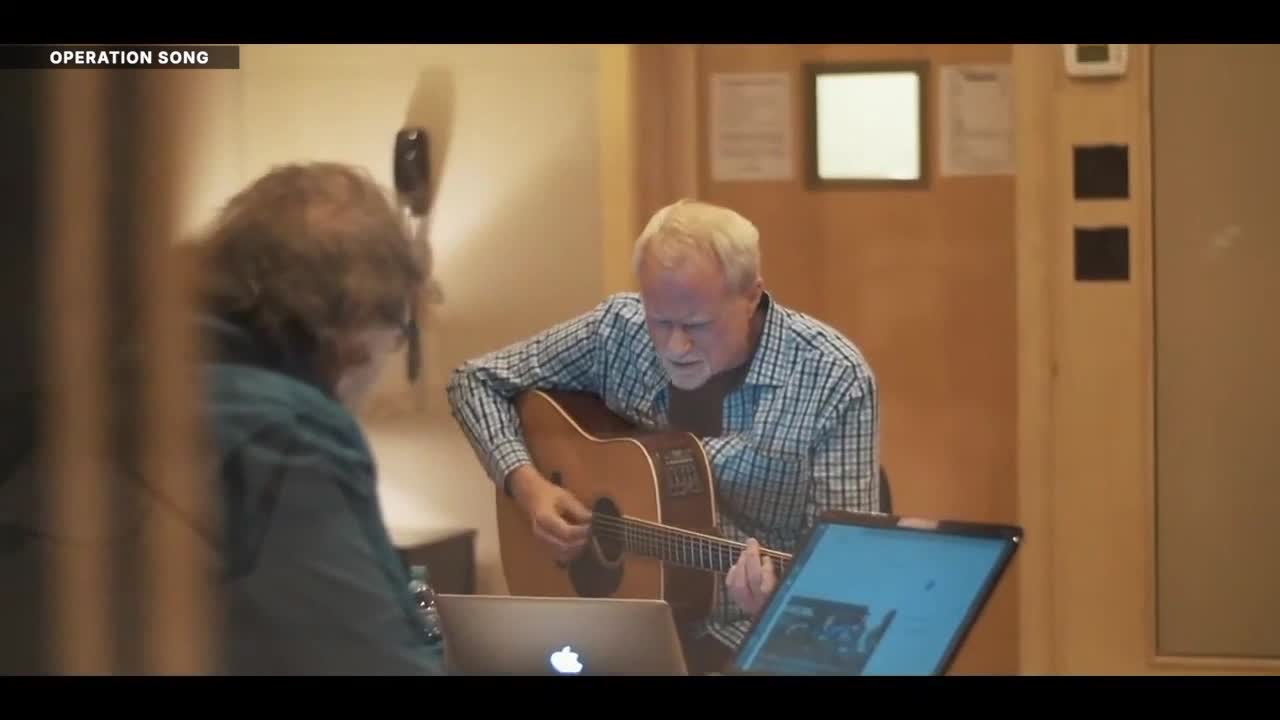
Lea was selected to participate in Operation Song at the Straz Center, where veterans, active-duty service members and military families are working with professional songwriters to turn personal experiences into original music.
"I am beyond excited," Lea said. "I am so grateful that I was selected because I know that there were a lot of applicants."
The songs created through the program will be celebrated during a culminating performance at the Straz Center's TECO Theater on Sunday, Nov. 1 at 2 p.m.
The event will highlight stories of service, sacrifice, family, transition and resilience from members of Tampa Bay's military community.
The performance is free, but registration is required.
For Lea, getting to this point is emotional.
"You feel a little guilty because you wanted the whole world to have this," she said. "But very, very grateful. That's how I feel."
She is especially interested in seeing how the many pieces of her life can come together through music.
"My understanding is they come and they make a song about your life," Lea said. "So for me, there's a lot of aspects of that that I'm looking forward to bringing together and seeing how it'll help others."
That last part, helping someone else, matters deeply to her.
"That's really my heart, is one that gives," Lea said. "So, if it'll help someone else, I love it."
What is Operation Song?
The idea behind Operation Song began with Nashville songwriter Bob Regan.
According to the organization, the Grammy and Dove Award-nominated songwriter was performing on Armed Forces Entertainment tours at military bases in the Middle East in the 2000s when he met service members with compelling stories.
Regan began wondering what could happen if those service members were paired with professional songwriters, people whose careers were built around transforming experiences and emotions into music.
At the same time, he became aware of service members dealing with injuries, illnesses and other issues connected to the wars in Iraq and Afghanistan, including some who were having difficult transitions back to civilian life.
The idea was to use songwriting to help bring some order, perspective and validation to experiences and emotions that could otherwise feel chaotic.
Operation Song began holding weekly sessions in 2012 at the Alvin C. York VA Medical Center in Murfreesboro, Tennessee, under the supervision of a music therapist.
At first, groups of as many as eight veterans would share stories from their military service while professional songwriters turned those experiences into music.
The program eventually shifted from primarily writing group songs to focusing on the experiences of individual veterans and service members.
Operation Song later expanded through weekend retreats in states including Florida, Georgia, Wisconsin, New York, Texas, Washington and North Carolina. The organization says it has written more than 2,000 songs with veterans ranging from those who served in World War II to people currently serving.
Its work has also expanded through on-site retreats, charitable events and virtual retreats.
The organization says veterans and their family members are never charged to participate.
For Lea, however, the concept becomes much more personal when the story being transformed into music is her own.
'They don't really teach us how to ramp down’
There are chapters of Lea's story that are difficult to tell.
She described herself as a military trauma survivor. She said she later relived that trauma and was hospitalized.
It changed the direction of her life.
"I was a military trauma survivor, for lack of a better term, and I relived that trauma and was hospitalized several years later," Lea said. "So it sent me back to school to study mind-body medicine, so I could understand how people get triggered, especially veterans."
She now works with veterans and others struggling with deep-seated trauma.
Her own experiences have helped shape how she understands what can happen after military service.
"We live at such a high state of vigilance," Lea said. "You're always on guard, so you struggle with that high level of anxiety."
Then, she summed up the challenge this way:
"They teach us how to ramp up," Lea said. "They don't really teach us how to ramp down."
For Lea, the path forward isn't the same for everyone.
"We heal in different ways at different points in our life," she said. "Our journeys are all unique and different."
That's also shaped the way she approaches the people she works with today.
"I've just learned to walk with people to meet them where they're at," Lea said.
She believes healing can come through different outlets.
"Healing comes in many different forms," Lea said. "It comes in the form of art. It comes in the form of song. It comes in the form of breath, and it comes in the form of authentic conversations in a safe place."
Creating a place where veterans can open up
Fred Johnson, a community engagement specialist at the Straz Center, said the organization has formally worked to create opportunities for veterans, their families and caregivers to participate in the arts since 2017.
Johnson said that effort was connected to the national Creative Forces initiative, which explored ways the arts could support service members and veterans.
Operation Song is a newer addition locally.
For Johnson, the power isn't simply in creating a piece of music.
It is in what happens when someone feels comfortable enough to tell the story behind it.
"Someone who's an accomplished composer can create a song, and that song is delivered so that that person's story is not just heard, but it's felt in a different way," Johnson said.
He said veterans can sometimes communicate something through a painting or piece of music that they don't feel comfortable saying directly.
But first, they have to be willing to be vulnerable.
Johnson said that can be difficult after military training.
"You ask somebody to step forward and risk their life," Johnson said. "They kind of train that out of you."
Part of the journey, he said, is creating a space where a veteran can realize "it's alright for me to be vulnerable."
Johnson believes that does not take anything away from the strength associated with service.
"There's great power and great dignity in serving," he said.
There can also be a struggle to find balance after someone returns home.
"Veterans, when they come home, we're seeking a sense of balance, a way to be," Johnson said.
'How did you not realize?'
Lea understands how difficult it can be for someone outside the military to grasp what a veteran has experienced.
Sometimes, she said, even the people closest to a veteran may not fully understand.
Lea remembers going to dinner with her mother following another program at the Straz.
Her mother told her something that stopped her.
"She said, 'I didn't realize,’" Lea remembered.
Lea's reaction was almost disbelief.
"Like, how did you not realize? Like, I struggled," she said.
Her mother knew parts of the story.
"She knew I went to, you know, see a therapist," Lea said. "She knew I had eight major surgeries, but she didn't put it together, and that's my own flesh and blood."
For Lea, that moment showed how difficult some experiences can be to communicate, even to someone who loves you.
"It is hard for people to understand that level of intensity," she said.
'You share a bond with people that's almost indescribable'
There are other parts of military service that Lea says can be difficult to put into words.
One is the connection she shares with the people alongside whom she served.
"Veterans coming together is always, we just feel like we're brother and sister," Lea said. "It's that bond that's just formed."
She described what that meant during war.
"The people that I went to war with, I don't know that I'll ever be as close to another human," Lea said.
Then she explained why.
"When you sit in a bunker, and you don't know if you're gonna get out of that bunker, you share a bond with people that's almost indescribable."
Experiences like that are also part of why she believes adjusting afterward can be difficult.
"You have to have a balance," Lea said. "Like I said before, they teach you how to be vigilant. They don't teach you how to come down."
Finding the right community, she said, can be part of that process.
"When you find your tribe, it's impressive to some people," Lea said. "What's not impressive to one group might be impressive to some."
For Lea, that doesn't mean forcing yourself to fit somewhere because you think you're supposed to.
"When you find your tribe that you actually, not who you think you need to put yourself into a crowd, when it flows naturally, it's very, very healing," she said.
Finding a common language through the arts
Johnson has seen the challenge of connecting military culture and the arts firsthand.
One of the Straz Center's earlier efforts involving veterans centered on dance.
Johnson remembered speaking to a group of veterans at the University of South Florida about the program.
Talking about dance and choreography didn't necessarily make an immediate connection.
So Johnson changed the language.
He compared choreography to close-order drill, where service members learn to move together as a unit.
"That’s the military choreography," Johnson said.
Suddenly, he said, the veterans understood the connection.
"They were like, 'Oh yeah, yeah, yeah, I can do that,’" he recalled.
Johnson said people may not naturally associate someone in the military with dancing or songwriting.
"The average military family or the average veteran family or even the average person in the community doesn't like to relate a Marine to dance, right, or a Marine to song," Johnson said.
For him, that is part of what these programs can challenge.
A veteran doesn't have to choose between strength and vulnerability, or military identity and artistic expression.
There can be room for both.
Giving civilians a way into the conversation
Operation Song also reaches beyond the person whose experiences inspire the lyrics.
Eventually, someone else hears the finished song.
Johnson sees that audience as an important part of the process.
"Our goal is to utilize creativity to create a safe space where veterans and civilians have an opportunity to have a conversation, so that they can connect to each other," Johnson said.
He said there can be uncertainty on both sides.
"Veterans are not necessarily sure whether they're going to be fully received," Johnson said. "Civilians are not sure how to start the conversation."
A song can become an opening.
"That's one of the most powerful things about Operation Song," Johnson said.
The veteran can share an experience with someone who has the ability to transform it into music.
"Someone who is versed in making song and composing music can sit with a veteran, hear their story, turn their story into a piece of music that empowers them," Johnson said.
He believes that exchange can also give people who have never served a different understanding of military life.
"It also empowers the general public to hear another side, to feel, you know, what it is to feel the heart energy of what it is to serve," Johnson said.
For Johnson, it's ultimately about getting beyond assumptions people might make when they see a military uniform.
"It puts a heartbeat in an opportunity to see and know someone beyond what your general perceptions are of them, based upon the fact that they wore uniform," he said.
Lea spoke about veterans finding their tribe.
Johnson took the idea further.
"There are tribes, and where we are now is we need to be a tribunal," Johnson said.
For him, that means recognizing the differences between people's experiences while still looking for ways to connect.
"Whether it's a corporal or a lance corporal or a general or it's an architect or it's a journalist, everybody, we have the opportunity to find our place," Johnson said. "And if we focus more on how we can serve each other, then the world can be a better place."
Tanya's story comes full circle
For Lea, this experience brings her back to where her story started — the theater.
She initially connected with the Straz Center's veterans programming because she already loved being there.
She didn't initially show up because she wanted to perform.
"I love the theater," Lea said. "So most people join to want to be in a show. I just wanted to learn."
She said the experience became much more than she anticipated.
"It's a phenomenal program, bringing veterans together for a greater cause, providing a safe space for them," Lea said.
Now, the little girl who dreamed about Broadway, the woman who served in military intelligence and the person who later went back to school to better understand trauma are all parts of the same story.
This time, Lea doesn't have to play a character.
The story being told is her own.
And when it becomes a song, Lea hopes someone listening might recognize a piece of themselves in it.
For her, that's where this experience becomes bigger than one veteran and one song.
"That's really my heart, one that gives," Lea said. "If it'll help someone else, I love it."
Florida brain tumor patient says nearly $1 million in medical bills are now covered after insurance denial
Five months after an insurance fight over brain surgery, Broqsten Bunt says he is medically cleared and has a zero balance on nearly $1 million in billed care.
