

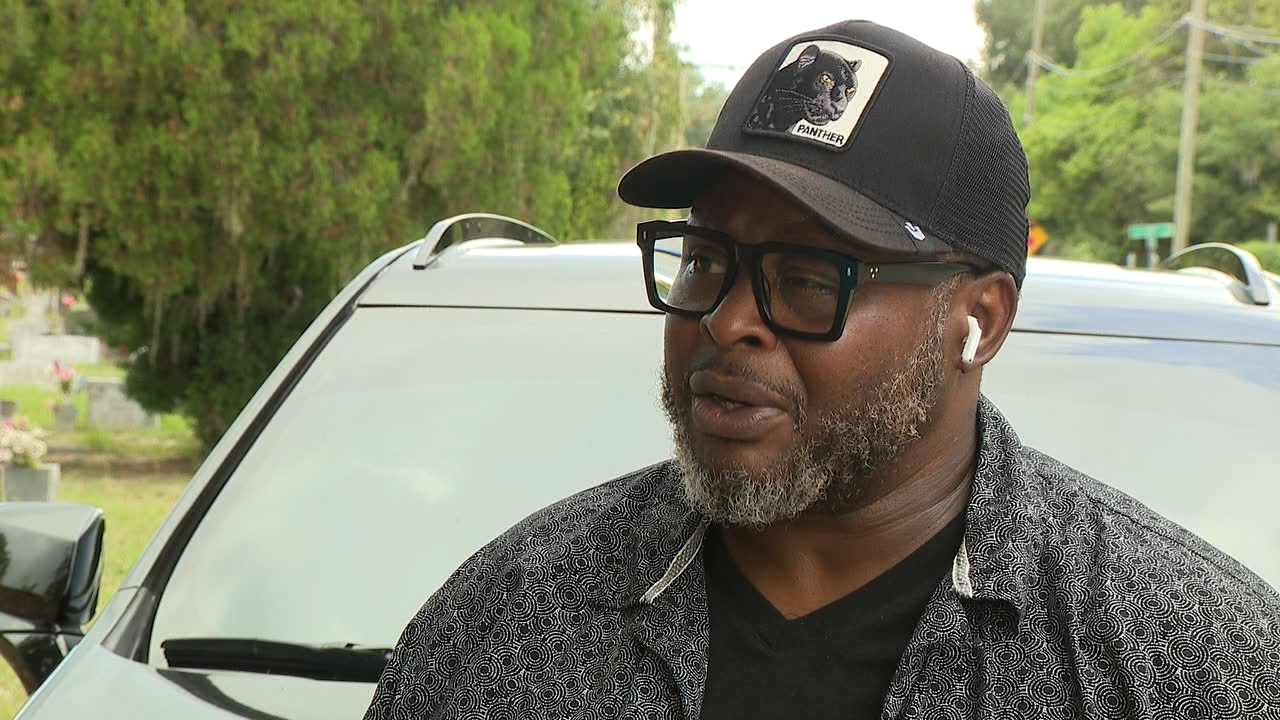


TAMPA, Fla. — A Tampa funeral escort company owner is disputing a citation he received during a funeral procession last month, saying he was operating within Florida law. The statutes at the center of the dispute may leave more questions than answers.
Cedric Weems Sr. has run Men of Valor Funeral Escort and Security Services for 12 years. On June 6, 2026, a Hillsborough County Sheriff's deputy pulled him over mid-procession and issued him a citation.
Weems Sr. recorded a portion of the stop. In the video, the deputy can be heard explaining the reason for the citation.
"The use of sirens is illegal, sir. You are not authorized or permitted to use siren," the deputy said in the video.
WATCH: Funeral escort company owner disputes Hillsborough County deputy citation over siren use
Weems Sr. disagrees.
"I was well aware of what I was doing when I did it, and I was within the law," Weems Sr. said.
Aaron Duncan, one of the drivers present during the stop, said the encounter felt unlike anything they had experienced before.
"We've done this so many times, and we always make sure we're within the primary parameters of what the law says. We've never had that run-in with any officer before, and on this particular day, the officer, it seemed like a personal vendetta," Duncan said.

What the law says about funeral escort vehicles
Both Weems Sr. and the Hillsborough County Sheriff's Office pointed to Florida Statute 316.1974, which governs funeral procession right-of-way and liability. That statute defines a funeral escort vehicle as any motor vehicle that is properly equipped and escorts a funeral procession. It defines a funeral escort as a person or entity that provides escort services for funeral processions, including law enforcement personnel and agencies.
Under that statute, private, non-law enforcement funeral escort vehicles are required to be equipped with at least one lighted circulation lamp exhibiting an amber or purple light or lens, visible under normal atmospheric conditions from a distance of 500 feet from the front of the vehicle. Flashing amber or purple lights may only be used when those vehicles are actively participating in a funeral procession.

The statute also establishes that funeral processions have the right-of-way at intersections regardless of traffic control devices, as long as operators yield to approaching emergency vehicles giving an audible or visible signal, yield when directed by a police officer, and exercise due care.
Notably, Florida Statute 316.1974 addresses lights and right-of-way. But it does not mention sirens or other sound devices at all.
The siren statute
The Hillsborough County Sheriff's Office says the citation was issued under a separate law: Florida Statute 316.271, which governs horns and warning devices. That statute states: "No vehicle shall be equipped with, nor shall any person use upon a vehicle, any siren, whistle, or bell, except as otherwise permitted in this section or s. 316.2397."

The same statute requires that every authorized emergency vehicle be equipped with a siren, whistle, or bell capable of emitting sound audible from at least 500 feet, but specifies that such devices shall not be used except when the vehicle is responding to an emergency call or in the immediate pursuit of an actual or suspected violator of the law.
Weems Sr. says his siren serves a specific and practical purpose during processions.
"My siren, my traffic control device that protects my vehicle and give awareness to the public and the civilians that are on the roads," Weems Sr. said.

Where the law gets complicated
Florida Statute 316.271 directs readers to Florida Statute 316.2397 for exceptions to the siren prohibition. That statute, which governs certain lights and their permitted uses, states that authorized emergency vehicles may operate emergency lights and sirens in an emergency.
However, Florida Statute 316.2397 does not include an explicit definition of what constitutes an authorized emergency vehicle in the context of siren use. The statute's exceptions for lights are detailed, listing police vehicles, fire department vehicles, ambulances, organ transport vehicles, wreckers, mosquito control vehicles, private security vehicles, and others, but no such specific list exists for siren authorization.

The statute does address escort vehicles in one narrow context: it states that escort vehicles may show or display amber lights when in the actual process of escorting overdimensioned equipment, material, or buildings as authorized by law. That provision does not reference funeral escort vehicles or address sound devices.
The result is a gap in the statutory language. Florida Statute 316.1974 governs what lights funeral escort vehicles must have. Florida Statute 316.271 prohibits the use of sirens except as otherwise permitted. Florida Statute 316.2397 permits the use of sirens by authorized emergency vehicles in an emergency, but does not define whether a private funeral escort vehicle qualifies as an authorized emergency vehicle.

A history of mixed signals from law enforcement
Weems Sr. says his past interactions with law enforcement have been largely positive, and that many officers have affirmed his methods over the years.
"I also had law enforcement officers assist me during a funeral, or just assist me just to get extra training, because they say I do it very well," Weems Sr. said.

He says the June 6 encounter stands in sharp contrast to those experiences.
Weems Sr. plans to fight the citation in court.

Share Your Story with Jada
Jada Williams is focused on the issues that matter most to people in who live in Tampa and West Hillsborough County. From downtown Tampa to Town ‘n’ Country and Westchase, Jada works to bring you updates and solutions on everything from crime to infrastructure. Reach out to Jada below with your concerns for your neighborhood.
.

Bradenton community responds after 20-year-old volleyball star dies from disease that affects 2 in a million
The 20-year-old IMG Academy volleyball star and Under Armour All-American died Sept. 16 after a three-month battle with the rare blood disorder — even though doctors had found her a 100% bone marrow match, her mother, Tanya Mack tells Tampa Bay 28 reporter Haley Zarcone.
