

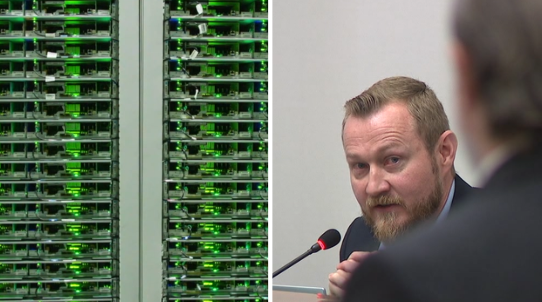


TAMPA, Fla. (WFTS) — Hillsborough County commissioners voted unanimously Wednesday to direct staff to study the impacts of artificial intelligence data centers and ordered the county attorney to draft a moratorium ordinance. The county is acting before any applications have been filed and while the county remains under active water restrictions due to drought.
Watch report from Jada Williams
The board passed two separate motions, both 7-0, that together call for a comprehensive analysis of how the county could regulate data centers and lay the groundwork for a moratorium that would take effect after state restrictions expire in October 2027.
County staff confirmed no data center applications are currently pending and no formal or informal inquiries have been received.
"We do not have any pending applications," said Adam Gormley of the Hillsborough County Development Services Department. "We have had some users who have expressed an interest in potentially developing a data center. We have advised them that data centers are not an approved use currently under the land development code and are not eligible for development at this time."
What the board voted to do
The first motion, brought by Commissioner Chris Boles, directs staff to research water conservation and capacity management tools available under Senate Bills 180 and 484, and to recommend any changes that may be appropriate to the county's land development code, technical manuals, or utility requirements.
Boles framed the effort as broader than just data centers.
"This is bigger than just data centers," Boles said. "Today it's AI. Tomorrow, who knows what's going to be? We have to consider the idea that we have to look at all water-intensive industries."
Boles said the county must evaluate impacts rather than labels when considering any development that places extraordinary demand on water resources.
"If the development places an extraordinary demand on our water resources, we should know how much water it will use, whether our infrastructure can support it, whether there's better conservation measurements, and whether reclaimed water can be used where feasible," Boles said.
The second motion, brought by Commissioner Donna Cameron Cepeda, directs staff to evaluate a framework for land use regulations specific to data centers, including a potential limit or prohibition on the use of county potable water for cooling purposes. It also directs the county attorney's office to draft an ordinance imposing a moratorium on AI data center development in unincorporated Hillsborough County that would take effect after Oct. 1, 2027, or if Senate Bill 180 is struck down by a court.
Cameron Cepeda said her original agenda item called for a five-year moratorium, but the county attorney's office advised that SB 180 prohibits local governments from adopting moratoriums on construction or more restrictive land development regulations through Oct. 1, 2027, and gives affected parties the right to sue.
State law shapes the county's options
SB 180 significantly limits what the county can do right now. Commissioner Joshua Wostal noted, however, that because data centers are not a recognized use under the county's land development code, new restrictions may not be subject to SB 180's preemption.
Gormley confirmed that under the current code, a data center could only be approved as a use through a planned development zoning, a process that would require intentional, case-by-case review.
"We would look at all of those elements to data centers that are particular to data centers, in the context of trying to mitigate any adverse impacts or identify any adverse impacts that would occur and not be mitigatable," Gormley said.
Water restrictions add urgency
The discussion comes as Hillsborough County is under active water restrictions due to drought conditions. Commissioner Harry Cohen noted that the Southwest Florida Water Management District visited his office to discuss its Water Star program, which he said should be analyzed as part of the county's study.
"That might be something that we could institute here that would bring some needed regulation to water usage and would definitely be something that could reduce the potable capacity that's needed for a lot of the lawn irrigation that goes on," Cohen said.
Wostal raised concerns about the building permit and certificate of occupancy process, noting that developers pressurize water lines and irrigate lawns for up to 30 days before a certificate of occupancy is issued.
"I do believe that in a time of drought, this is one of the worst that we've had in a while, that the staff must have the tools to restrict permitting certificates of occupancy that would clearly negatively impact the current residents," Wostal said.
Tampa Bay Water is also exploring a secondary water reserve. The agency currently operates one reserve and is analyzing potential locations for an alternative.
Noise and wildlife concerns raised
Beyond water, commissioners raised concerns about the noise and vibration data centers generate, which can be heard at significant distances, particularly in rural areas.
Wostal said the county's more than 60,000 acres of conserved environmental land must be protected from the acoustic and vibration impacts of data centers, noting that wildlife is more sensitive to sound and vibration than humans.
"I do want to make sure that all of the surrounding area is not impacted, not only to humans but also the natural habitat that already exists around them," Wostal said.
No applications pending, but commissioners say preparation is critical
Cohen said the outcome of Wednesday's vote should reassure residents who have expressed concern that data center projects are already in motion.
"There is nothing in the pipeline at the moment that leads us to think that we're going to be considering a data center authorization anytime soon," Cohen said. "That being said, it certainly is in the interest of the board and the public that we start anticipating that some type of request might come, and that we start analyzing what that might mean in terms of water usage and noise."
Cohen added that the board would consider a moratorium if necessary, but said the immediate priority is study and preparation.
"We are going to assess what the impacts of these centers could be, and we're going to proceed very, very cautiously before we even entertain the idea of allowing anything like this to be built," Cohen said.
Boles said the goal is to build policy that outlasts the current board.
"I would like to see that we have an understanding of our current legal authority, not to pick winners and losers, and about setting consistent rules that protect the public interest and our conservation here," Boles said.
Both motions passed 7-0.
Residents pack chambers in opposition
Ahead of the vote, about a dozen residents urged the board to act, citing water consumption, noise, electricity costs, and environmental damage.
Debbie Holliday warned that communities across the country are already dealing with consequences from data center development that are "difficult, if not impossible to reverse."
"Residents have reported excessive noise, constant humming, ground vibrations, air pollution, excessive energy consumption, concerns about water quality and usage, environmental damage, and increased temperatures resulting in an increase in lawsuits," Holliday said.
Susan Craunis, a lifelong Hillsborough County resident, called for a moratorium on a potential data center at State Route 60 and Dover Road, warning that East Hillsborough County's agricultural economy is at risk. She pointed to the January 2010 freeze in Plant City, when farmers heavily pumped groundwater to protect crops.
"More than 750 residential water wells went dry and approximately 140 sinkholes formed," Craunis said. "There were 750 complaints logged with the Southwest Florida Water Management District, a 60-foot drop in the Florida aquifer, and over 110 official sites documented specifically by the U.S. Geological Survey."
A representative from Food and Water Watch urged the board to place an immediate halt on new data center development, citing national projections.
"By 2028, AI data centers in the U.S. will require as much water as 18.5 million households just for cooling the servers," said Isabella, the group's representative. "When Hillsborough already experiences consistent drought and water shortages, we cannot afford for our water to be pumped into these large data center projects."
Todd Randolph, who said he holds a leadership role in the Sierra Club's local Tampa Bay group, called on commissioners to use the authority granted under Senate Bill 484 to its fullest extent.
"Sierra Club has launched a national campaign against the rampant construction of data centers across the country, which have shown in all cases negative impacts on immediate communities in terms of pollution, energy affordability, and overall quality of life," Randolph said.
Share Your Story with Jada
Jada Williams is focused on the issues that matter most to people in who live in Tampa and West Hillsborough County. From downtown Tampa to Town ‘n’ Country and Westchase, Jada works to bring you updates and solutions on everything from crime to infrastructure. Reach out to Jada below with your concerns for your neighborhood.
.

Saudi flight from Tampa, secret FBI probe reveal possible Saudi support network for 9/11 hijackers
Twenty years after the Sept. 11 attacks, more than 80,000 records compiled by the Tampa FBI Field Office remain classified. Newly declassified documents are pointing to a possible secret Saudi support network for the hijackers. Soon after the attacks, the FBI uncovered that 15 of the 19 hijackers were from Saudi Arabia.
