



TAMPA, Fla. — To most people, the grassy field at College Hill Cemetery in Tampa looks like an empty lot. It's usually where people park to visit other parts of the cemetery.
To Angela Alderman Wynn, it is much more than that.
WATCH: No headstone, no marker, no protection: Advocates say a new Florida law leaves unmarked graves at risk
"The grassy field area is where my uncle would be buried, so I fear they will develop on that, and if that happens, it's going to be a whole new ball game for me."
A new Florida law that took effect July 1 has her worried that grassy area could be developed. Alderman Wynn said development has already encroached on the cemetery once before.
"It's happened already with College Hill, the African American part was where their mausoleum is today, so it's taken place, and I do not want to see that happen again."
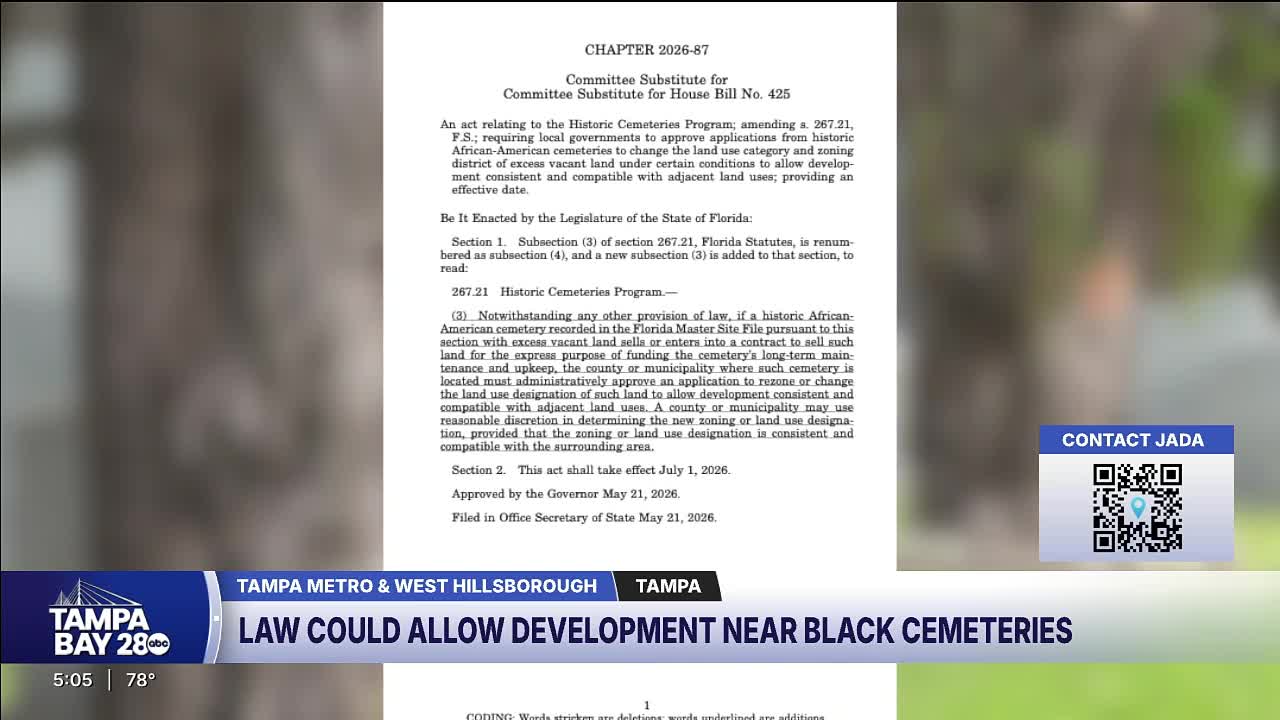
The law, Chapter 2026-87, amends Florida's Historic Cemeteries Program and requires counties and municipalities to administratively approve applications to rezone or change the land use designation of excess vacant land tied to historic African American cemeteries recorded in the Florida Master Site File.
The land must be sold for the express purpose of funding the cemetery's long-term maintenance and upkeep, and any development must be consistent and compatible with adjacent land uses.
Alderman Wynn said the law offers no meaningful protection because it does not require ground-penetrating radar scans or archaeological surveys before development is approved on land a property owner claims is vacant.
The criticism extends beyond College Hill. Aileen Henderson, founder of the Cemetery Society, said she has been raising concerns about the legislation since January.
"Completely opposed to that new state statute. It's something that I rang the bell on back in January, when it was brought to my attention."
Henderson said the law's language is not strong enough to protect land where human remains may be buried. While the bill states that proceeds must fund long-term maintenance and upkeep, Henderson said there is no enforcement mechanism, no required business plan, and no guarantee the funds will actually be used for that purpose.
"They will give you the law, but they don't always tell you how to enforce that law, or who enforces that law, or what do you do if there's a problem?"
She said the law also lacks any requirement for scientific verification before development can proceed.
"I feel the language should have included they must do a GPR, an archaeological study, prior to allowing it to move to the next step in the process."
Without those requirements, Henderson said, a property owner's word alone could be enough to greenlight development.
"It's just handing them that ticket to stand in line to develop on a piece of property that you don't see marked graves. That's all this is. And I'm infuriated by it. It's not okay, and it's wrong."
Henderson pointed to Florida Statute 872, which she said addresses both confirmed human remains and land where remains are believed to exist, a distinction she argues the new law ignores entirely.
"Human remains are believed to exist. And so my fear is, because this language is not strong enough, it doesn't require ground-penetrating radar and an archaeological study, people are gonna say, like they're saying to us, historic context doesn't matter. It's irrelevant. We're telling you no bodies are buried there. That's a problem."
One of Henderson's central concerns involves potter's fields, burial grounds for the poor and marginalized that often have no headstones or visible markers. She described a close call at Woodlawn Cemetery in Tampa, where she said city workers nearly laid manure over nearly an acre of potter's field while preparing to build a garden.
"And one of the biggest challenges we have when we're advocating for those parcels or those properties is the fact that there's no marked graves. Because if they don't see them, the public thinks that they don't exist."
Henderson said a cease-and-desist was issued after she documented the situation and made the appropriate calls.
Henderson said she was caught off guard when she learned the law had already taken effect.
"When I saw your thing, I about had a heart attack. Because I thought, this can't be."
Henderson, who works in the Parks Department and lives three blocks from Woodlawn Cemetery, said she fears the long-term consequences extend beyond individual burial sites.
"If we don't protect these historic cemeteries, mark my words, 10, 15 years down the road, they may be the only green space we have left. And now you have a state statute in place that isn't going to protect them."
Share Your Story with Jada
Jada Williams is focused on the issues that matter most to people in who live in Tampa and West Hillsborough County. From downtown Tampa to Town ‘n’ Country and Westchase, Jada works to bring you updates and solutions on everything from crime to infrastructure. Reach out to Jada below with your concerns for your neighborhood.
.

Bradenton community responds after 20-year-old volleyball star dies from disease that affects 2 in a million
The 20-year-old IMG Academy volleyball star and Under Armour All-American died Sept. 16 after a three-month battle with the rare blood disorder — even though doctors had found her a 100% bone marrow match, her mother, Tanya Mack tells Tampa Bay 28 reporter Haley Zarcone.
