

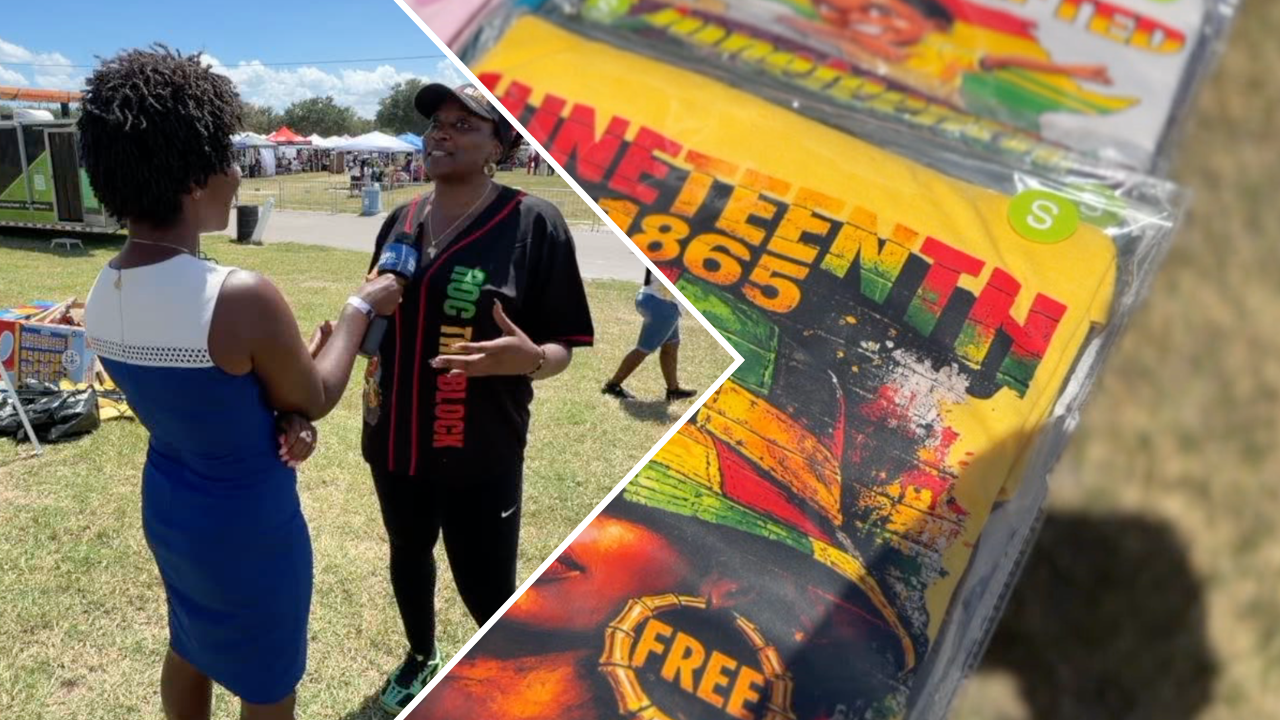


TAMPA, Fla. — The sun was blazing over Raymond James Stadium, but that did not stop thousands of families from showing up. Some nearly 2 hours before the gates even opened.
They came for the food, the music, the bounce houses, and the vendors. But they also came for something deeper: a celebration of freedom, community, and the Black-owned businesses that are too often overlooked.
WATCH: She saw Tampa's Black businesses being overlooked. Now thousands show up every Juneteenth for her
This was the sixth annual Roc the Block festival, and by every measure, it was exactly what its founder intended.
Bolaji Ajike, president of Roc the Block Inc., built this event from the ground up with a singular mission.
"We are reconditioning our communities by hosting community events, festivals, conferences, everything to support and to uplift the cultural and the community altogether," Ajike said.
A holiday rooted in a delayed message of freedom
Roc the Block is intentionally held on Juneteenth weekend, and for Ajike, that timing is everything.
Juneteenth marks June 19, 1865 — the day enslaved people in Galveston, Texas, finally learned they had been free for more than two years. President Abraham Lincoln had signed the Emancipation Proclamation in 1863, but the news did not reach Galveston until Union soldiers arrived more than two and a half years later. They were the last to find out.
For Ajike, the history is not a footnote. It is the foundation.
"That message of freedom took years to get to them, and also that message has gone across the world," Ajike said. "It has also emancipated so many other countries, and as an immigrant to this country, I know of the impact that black Americans have had on my life, and I just want to make sure that I keep up with it."
Ajike said education is central to what Roc the Block does every year.
"The history is so important, so crucial," Ajike said.
From Super Bowl disparity to community movement
Roc the Block did not start as a Juneteenth festival. It started as a response to what Ajike saw, and did not see, when Tampa hosted the Super Bowl.
"I realized the disparity between who was being highlighted, shown, the businesses, and I didn't think that it was really showing black-owned businesses. I didn't think it was showing the true colors of Tampa," Ajike said.
Ajike said she is the kind of person who acts when she sees a problem.
"If I see something, I'm gonna do something about it," Ajike said.
So she organized a Black pop-up event in downtown Tampa during the Super Bowl, keeping it safe during the pandemic while the rest of the city buzzed around the stadium. The turnout was strong, and the momentum carried forward.
When Juneteenth came around, Ajike set her sights on Raymond James Stadium itself.
Then, just two days before the first festival, President Biden signed legislation making Juneteenth a federal holiday. Ajike's phone lit up with calls, direct messages, and screenshots of the breaking news.
"Everyone's calling my phone, sending me DMs, sending me snapshots of the breaking news that he just signed a proclamation," Ajike said. "That just really amped up the whole city, the whole community, and everyone just showed up."
What started as a small, intimate gathering has grown into one of Tampa's signature Juneteenth celebrations. Since year four, the festival has drawn more than 15,000 people each year.
"Over 15k. We have literally, from year four, it's been over 15 each year," Ajike said.
A platform that draws businesses from across the country
The reach of Roc the Block extends well beyond Tampa. This year, it brought Danie Spikes all the way from Miami.
Spikes is the principal founder of BeLoved Box, a luxury niche fragrance house she describes as the only one in the United States focused on sensitive skin. She said she made the trip because opportunities like this one are rare.
"We came all the way from Miami, Florida, because these opportunities are so far and few in between. Especially now," Spikes said.
Spikes said the experience at Roc the Block was unlike anything she had encountered at other events.
"As someone who is a black-owned business, a woman black-owned business, the support, the admiration, the upliftment that I received here today is like nothing I have ever experienced," Spikes said.
She said the festival gave her business a chance to show that Black entrepreneurs exist in every corner of the business world.
"We're not a monolith, that we have food, that we have drinks, that we have bounce houses, but we're also perfumers, we also are in any sector of the business world," Spikes said.
For Spikes, the challenge facing Black-owned businesses is not just visibility. It is the structural disadvantage that comes with having less access to capital and marketing resources.
"You're last considered. You're last seen, because we don't get as much funding dollars, so marketing is very strategic and oftentimes not as robust as other businesses. To have someone that walks into the room and says, I'm thinking of black-owned businesses, I'm thinking of minority-owned businesses first. It changes the entire dynamic," Spikes said.
That dynamic shift, Spikes said, is exactly what Roc the Block delivers. Attendees do not arrive feeling like they are doing vendors a favor. They arrive genuinely invested.
"When you're here, people don't feel that they're doing you a courtesy. It's like, no, I want to support you. I'm here," Spikes said.
And the support from Roc the Block itself went beyond simply offering a vendor space. Ajike's team made a decision that left Spikes overwhelmed.
"She took the steps further and said, you know what, we're going to actually purchase, so that everyone can take something with them. We were overwhelmed, because those opportunities don't come, because when the Super Bowl comes, or FIFA comes, or any of these major events come, it usually goes to the people who are always on the top of mind, which usually have larger marketing budgets, larger business, larger access to capital," Spikes said.
Spikes said she hopes Roc the Block grows far beyond Tampa.
"Every city needs to see this. Every city needs to have an opportunity to come out and see all of the black-owned businesses that are regional, local, or even national," Spikes said. "I need her to come to Miami. I need her to be in Jacksonville. I need her to be in DC, Chicago. I want to see this festival flourish in ways that we can't imagine, so that now, instead of us going to the Super Bowl, the Super Bowl was coming to us."
A nonprofit that needs the community's support
Roc the Block Inc. is a nonprofit, and Ajike said the work of putting on an event of this scale falls largely on the organization itself.
"It takes money to make this happen, and we have been taking care of this on our own," Ajike said. "We would hope people would donate, share, let them know what good things we're doing."
Community members can donate or learn more by clicking here.
Share Your Story with Jada
Jada Williams is focused on the issues that matter most to people in who live in Tampa and West Hillsborough County. From downtown Tampa to Town ‘n’ Country and Westchase, Jada works to bring you updates and solutions on everything from crime to infrastructure. Reach out to Jada below with your concerns for your neighborhood.
.
Bradenton community responds after 20-year-old volleyball star dies from disease that affects 2 in a million
The 20-year-old IMG Academy volleyball star and Under Armour All-American died Sept. 16 after a three-month battle with the rare blood disorder — even though doctors had found her a 100% bone marrow match, her mother, Tanya Mack tells Tampa Bay 28 reporter Haley Zarcone.
