



TAMPA, Fla. (WFTS) — Day in and day out, Aileen Henderson fights for the voiceless.
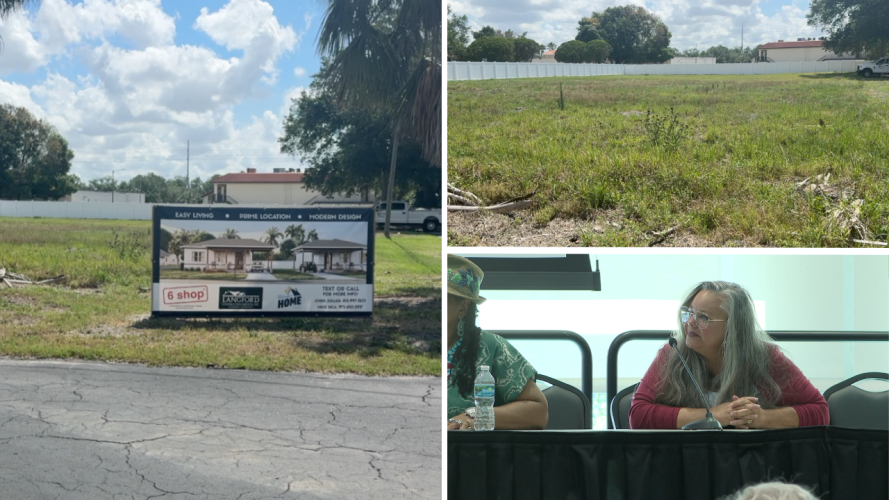
On Thursday, she stood before the Tampa City Council. On Friday, she was in St. Petersburg as a panelist at the 2026 Black Cemetery Network Conference. In both places, her message was the same: development must stop on a West Tampa parcel she says is built on erased graves.
WATCH: Tampa approved permit to develop on land activist says is erased grave site, now she fights to stop it
"Here we go again," Henderson said.
Henderson is the founder of The Cemetery Society, a Tampa-based preservation organization she started roughly 5 years ago after realizing no one was systematically protecting the city's historic cemeteries. What began as a plan to organize monthly cleanups quickly became something far larger.
"I thought I was just going to do monthly cleanups at the cemetery, right, get some volunteers, and we'll clean up the historic cemeteries," Henderson said at the conference. "That's not what it turned into. It quickly became apparent that advocacy was needed."
Her current fight centers on 3203 W. St. John Street in West Tampa, a parcel adjacent to the historic Martí-Colón Cemetery. A building permit for the site was signed on May 11, 2026. A sign advertising homes coming to the land now stands at the edge of the cemetery, visible from the public portion of the grounds. Henderson said she has heard the development may include not just two homes but as many as four.
"I'm asking you to do your due diligence," Henderson told the city council.
A Promise Made, Then Broken
Henderson said the parcel has been threatened before and that the community believed it had been protected.
In 2018, property owner Patrick Thorpe purchased the parcel. Henderson said Thorpe knew it was a cemetery at the time of purchase, told the community it was a cemetery, and publicly promised West Tampa residents he would never develop it.
"We have the video of him saying that," Henderson said. "We have community members in West Tampa where he stood before them and promised them that he would never develop on that property. So the cemetery was saved in 2018 from development."
The parcel was threatened again in 2024 when a Jewish organization considered purchasing it. After a ground-penetrating radar survey was suggested by the city council, the organization quickly withdrew from the deal after reviewing the results. Tampa Bay 28 reporter Jada Williams reported on that story.
The parcel split was denied in 2021 over concerns related to potential human remains and applicable state statutes. It was approved in 2025. Henderson said the city has not explained what changed between those two decisions.
"The land did not change," Henderson said. "The cemetery history did not change. The tax-treatment history did not change. The burial-risk concern did not disappear. The applicable state statutes did not disappear."
A 1989 Tax Record Says It Was a Cemetery
At the center of Henderson's documentation is a 1989 Hillsborough County tax record, covering GHIRA Lots 13 and 14, Block 8. The record specifically states: "USED AS CEMETERY."
Henderson said that designation is not a matter of interpretation. It is a government record stating plainly what the land was used for.
"The City now has direct government tax-record evidence stating the parcel was used as a cemetery," Henderson said in a May 13, 2026, letter to Tampa City Attorney Scott Steady, Mayor Jane Castor, and members of Tampa City Council. "This is significant historical evidence. The City cannot responsibly treat this parcel as ordinary vacant land."
Henderson said the parcel appears to have been treated as cemetery land for property and tax purposes for years, with no taxes paid during that period. She said the city's 2025 approval of the parcel split appears to have administratively removed that cemetery-use classification without first resolving the burial-risk, archaeological, and state-law questions attached to the land.
"The City and the property owner cannot use an administrative parcel split to make decades of cemetery history disappear," Henderson said.
16 GPR Anomalies and a State Expert's Written Warning
A ground-penetrating radar survey conducted by Precision GPR LLC on March 15, 2024, identified 16 subsurface anomaly locations on the parcel.
Henderson submitted the report to the Florida Division of Historical Resources. In a March 3, 2026, written response, Patrisha L. Meyers-Gidusko, Historic Cemeteries Program Supervisor for the Division of Historical Resources, said the GPR report was "not comprehensive from an unmarked historic burials perspective." Meyers-Gidusko said the survey appeared to have been conducted by a company specializing in construction locates rather than unmarked burial location, and that it lacked a research design, equipment and survey strategies, and a field methods section defining the extent of the survey.
"The anomalies shown warrant further investigation by a professional archaeologist experienced in conducting GPR and analyzing data for unmarked burials," Meyers-Gidusko said.
Henderson said that written guidance from a state expert directly undermines the city's position.
"I went to the Florida Division of Historical Resources, and I have an email from a woman who does this for a living, who looked at this GPR that they don't want to substantiate, and she said based on this GPR, an archaeological study needs to be done," Henderson said. "She said it. An expert in the field. So the hang-up with the GPR, I'm not understanding it, because I gave you the expert opinion that said what I'm looking at warrants further study."
Henderson also noted that Meyers-Gidusko attached records from the Florida Master Site File for the cemetery and directed her to state statutes governing burials and cemeteries, including Chapter 872, which protects both marked and unmarked burials, and Section 497.284, which gives counties and municipalities the option to maintain abandoned and neglected cemeteries.
The City Attorney's Response
In a March 25, 2026, letter to State Representative Fentrice Driskell, Tampa City Attorney Scott Steady acknowledged receipt of the 2024 GPR study and noted the anomalies but wrote that "there is no clear evidence showing these anomalies are grave or cemetery related." Steady said the city was legally required to approve the lot split and building permits because the applications were consistent with local zoning regulations and the Florida Building Code.
Steady wrote that the city added a condition to the construction permits stating that if human remains are discovered during any site work, the applicant must immediately stop all activity and comply with Florida Statute 872.05, which governs unmarked human burials.
Henderson said that the condition gets the law exactly backward.
"It doesn't say dig till you hit bones," Henderson said. "That's not how the statute is written. It is written in a way so that people understand that if there's the possibility, we do our homework first."
Henderson also pushed back on the city's reliance on local zoning authority, citing Chapter 166 of the Florida Statutes, which governs municipal self-governance but also establishes that state law takes precedence when the two conflict.
"Just because you have private property doesn't mean you get to skirt the law," Henderson said. "We have very strict laws when it comes to human remains. The fact that it's private property does not exempt you from following state statutes."
Henderson said she has faced the private property argument before and prevailed.
"I've been here, done that," she said. "Let's face it. Showman's property back in 2021, private property. We won. It's irrelevant because there's human remains there."
In formal correspondence to city officials, Henderson requested written explanations of how the 2025 approval reconciles with prior city determinations, why the 2025 approval did not meaningfully analyze the 2024 GPR anomalies, how the city will respond to the Division of Historical Resources guidance, and how the city determined that the development complies with Florida Statutes 872.02, 872.05, 497.284, 166.033, and 267.061. She also asked the city to confirm whether it consulted the Division of Historical Resources, the State Archaeologist, the District Medical Examiner, law enforcement, Historic Preservation staff, or the Historic Preservation Commission before allowing development to proceed.
Driskell Steps In
On March 13, 2026, Driskell wrote to Tampa's Director of Development and Growth Management, Abbye Feeley, requesting a review and urging the city to stop further disturbance to the site until the burial-risk concerns were resolved. Driskell said she did not act on Henderson's word alone.
"She didn't take me at face value," Henderson said. "She made me give her all of the supporting documentation. Based on that, she felt compelled. Because I got to tell you, how many state reps do you know do that kind of work? She felt compelled enough to say, 'Hey, City of Tampa, give this a go, you need to look at this. Let's stop and let's evaluate to make sure.' That's what she did."
Henderson said the city's response to Driskell failed to answer the specific questions the representative asked.
"All they come back and say is, well, we told them if he hits bodies, he's got to stop," Henderson said. "They have refused to answer any of my emails, not even an acknowledgment of receipt. They have refused to answer any of my questions. I can't even counter because I'm not even given an explanation as to why these decisions are being made."
Henderson said the city also blocked her attempt to appeal the permit decision, telling her to pay a nonrefundable $2,000 fee before they would consider the appeal, while also telling her she probably would not qualify.
Driskell's Legislation and the Broader Fight
At the 2026 Black Cemetery Network Conference, Driskell described legislation she introduced this session that would directly impact cases like Henderson's.
"Just this legislative session, we introduced legislation that would balance the needs of private property owners along with the descendant community by granting conservation easements to the private land owners and granting the state the opportunity to go onto the land and investigate using non-invasive means, whether or not there's a cemetery," Driskell said. "All of that is to say it compensates the landowner while also giving the descendant communities closure."
The bill passed through committee unanimously but ran out of time before a full floor vote. Driskell said she intends to see it reintroduced.
"This legislation is so important," Driskell said. "I want to make sure that we continue fighting for it until it ultimately is passed."
She said the key to building bipartisan support for cemetery protection legislation has been telling the human stories behind the cemeteries.
"Everybody understands heritage," Driskell said. "When you can sit across from a lawmaker, regardless of their party, and have that conversation one-on-one about some of the things that happened to these cemeteries, they are moved. Nobody's heart is that hardened that they can't understand heritage."
Driskell said the work is urgent because efforts to protect civil rights-era gains are being rolled back nationally, and abandoned cemeteries represent an opportunity to build bridges across political divides.
"We are living in a time where a lot of those efforts, unfortunately, are being rolled back," Driskell said. "Perhaps abandoned cemeteries are a way for us to build more bridges and to connect."
More Than 1,000 Unaccounted Burials
Historical burial research compiled by associate researcher Erica Trowell documents at least 1,072 individuals believed to have been buried at Martí-Colón Cemetery whose remains are not accounted for in the city's own cemetery database. The research draws on Tampa and Florida burial and transport permits, Florida Department of Vital Statistics death certificates, Tampa Times and Tampa Tribune obituaries, and funeral home records from J.L. Reed & Son, Lord & Fernandez, and other undertakers. The records span 1895 to 1939.
The individuals documented include cigarmakers, laborers, infants, sailors, county hospital patients, county jail inmates, and people buried in pauper and Potter's Field sections. Many were immigrants from Cuba, Spain, Italy, Puerto Rico, the Bahamas, and other countries. The records also include Black residents buried at the cemetery during a period of racially segregated burial practices.
Tampa historian Ray Reed spoke before the city council. He said that the cemetery received county indigent burials under a contract held by undertaker J.L. Reed beginning in 1906, meaning the cemetery contains remains of people from across Hillsborough County, not only West Tampa residents.
"Anybody dying at the poor farm, as well as any unclaimed body, anywhere in Hillsborough County, that Martí Cemetery is full of his commercial contract burials," Reed said. "Not just Cubans, and not just Afro-Cubans, or West Tampans. People from all over Hillsborough County are there."
Reed also testified about a section referenced in historical death certificates as "Lafaye," whose location has never been confirmed, and about a 1984 Tampa Tribune article describing the sale of cemetery land north of Columbus Drive for commercial development after Black headstones were found there.
"Shoot me dead, God, if I am wrong; that's the Black cemetery, and the bodies are still there," Reed said.
The South Side, the Black Section, and the Disputed Parcel
Henderson said the cemetery's history makes the location of the disputed parcel especially significant. During the construction of Columbus Drive through cemetery land, documentation shows reinterments were directed to the south side of the cemetery, the same side where the parcel sits.
"The uniqueness about Martí-Colón Cemetery is we've already done this once before," Henderson said. "We built over human remains. It's very well documented with Columbus Drive and the plaza. Here we go again."
Henderson said the Black section of the cemetery presents a particular concern.
"We have the section that was the Black section. They were reinterred because the public didn't want them buried in their cemetery," Henderson said. "Where are they?"
Henderson also pointed to the unconfirmed "Lafaye" section referenced in historical death certificates.
"Where is it?" Henderson said. "They could be anywhere on that property, including that parcel. But they are there because we have the documentation."
Henderson's Plea
Henderson said she is running out of time and resources. She said more than 80 community members have voiced opposition or concern, and that a recent social media post generated 78 shares.
"Time is of the essence," Henderson said. "I don't have any time. I'm desperate. I'm really desperate."
Henderson said she may need to retain legal counsel, but does not have the funds as a 501(c)(3) charitable organization.
"It looks like they're going to put my back against the wall," she said. "And it shouldn't be that way. Not when we have everything on our side."
Henderson said the stakes extend beyond this single parcel and connect to Tampa's larger identity and future.
"These are Black and brown bodies," she said. "These are the people of Tampa that made Tampa what it is today. These were the workers. What are we going to do about our history? What are we going to do for those voiceless people who built Tampa to bring us to where we are today?"
Henderson said she believes she can stop this development just as she has stopped others before.
"I stand before you representing all of those community members who can't make the time to be here," Henderson said before the city council. "Make no mistake, just because they're not here doesn't mean that they're not here. They're here."
The Cemetery Society's Facebook page is at Facebook.com/TheCemeterySociety.
Share Your Story with Jada
Jada Williams is focused on the issues that matter most to people in who live in Tampa and West Hillsborough County. From downtown Tampa to Town ‘n’ Country and Westchase, Jada works to bring you updates and solutions on everything from crime to infrastructure. Reach out to Jada below with your concerns for your neighborhood.
.

Pasco County mom of 5 takes in 3 children left without food or power whose mother faces neglect charges
Jasmine Young, a mother of 5, opened her home to three neglected girls as their mother faces child neglect charges for leaving them without food, power or water.
