



TAMPA, Fla. (WFTS) — A $100 million-plus stormwater project aimed at relieving chronic flooding in South Tampa's Parkland Estates and Palma Ceia Pines neighborhoods is heading toward a pivotal Tampa City Council vote, but sharp disagreements over its design, cost, and effectiveness are threatening its future.
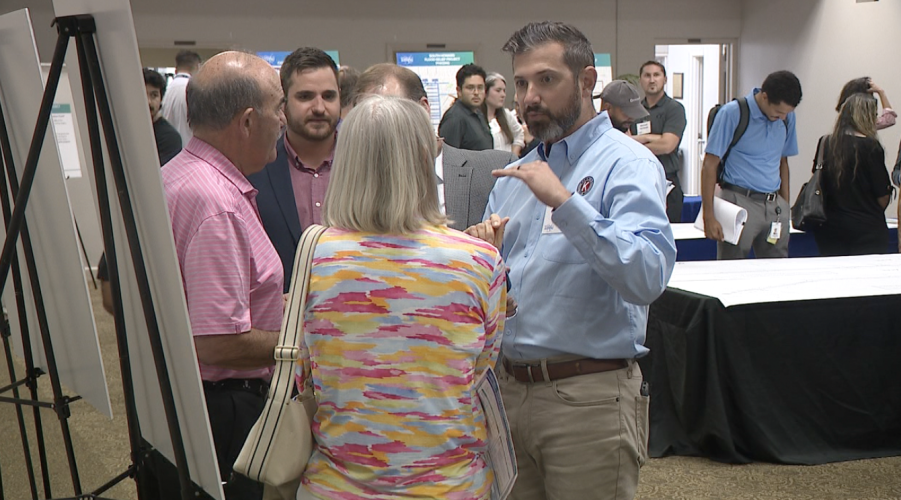
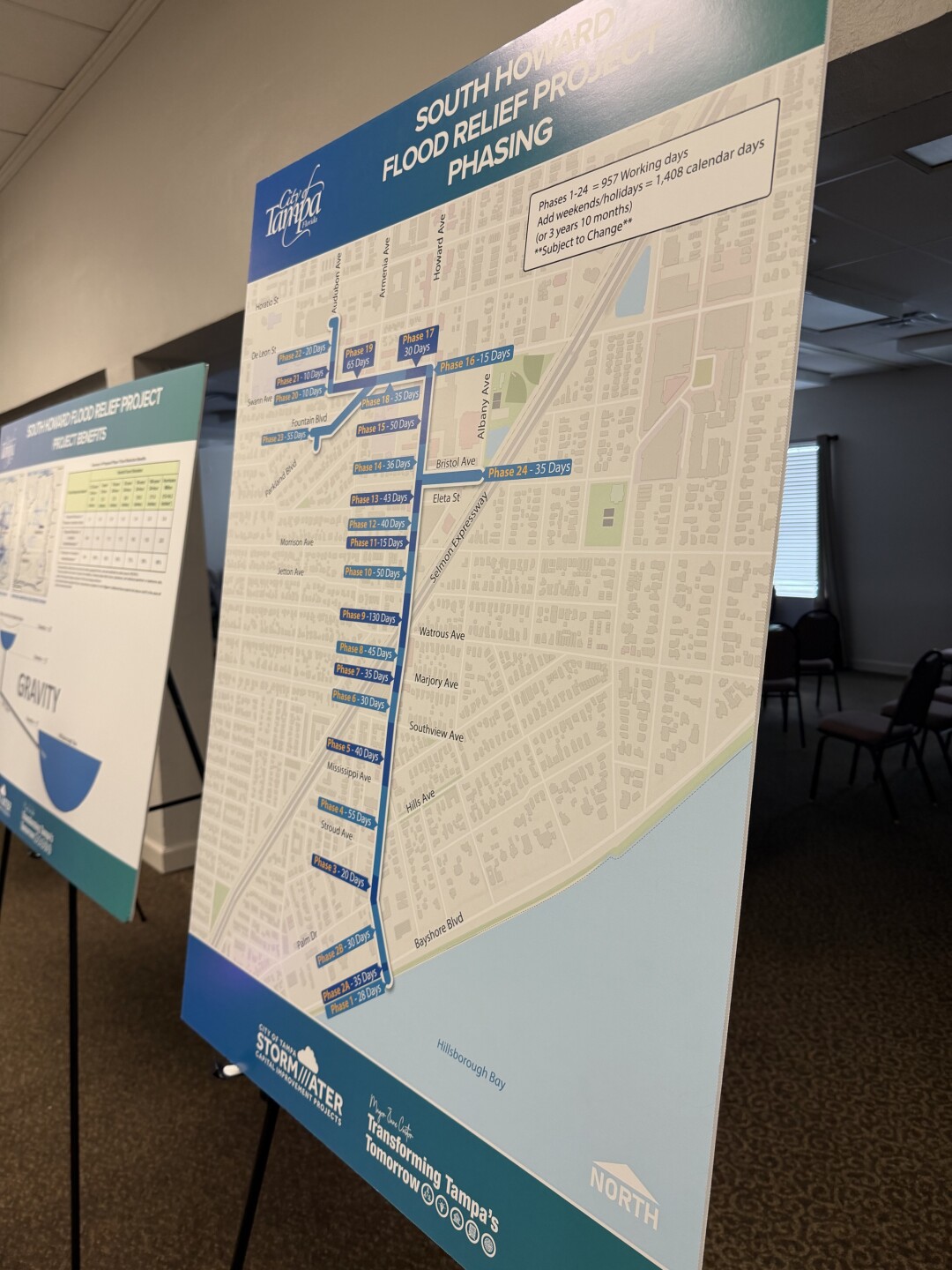
Tampa's mobility department presented a 60% design review of the South Howard Storm Relief Project at a community open house, outlining plans for a 6,000-plus-foot box culvert along Howard Avenue. The project has been years in the making. Tuesday's open house drew residents, business owners, and community advocates who hold deeply opposing views on whether the city is pursuing the right solution to a flooding problem that has plagued South Tampa for decades.
WATCH: Tampa's South Howard flood relief project nears critical council vote amid debate
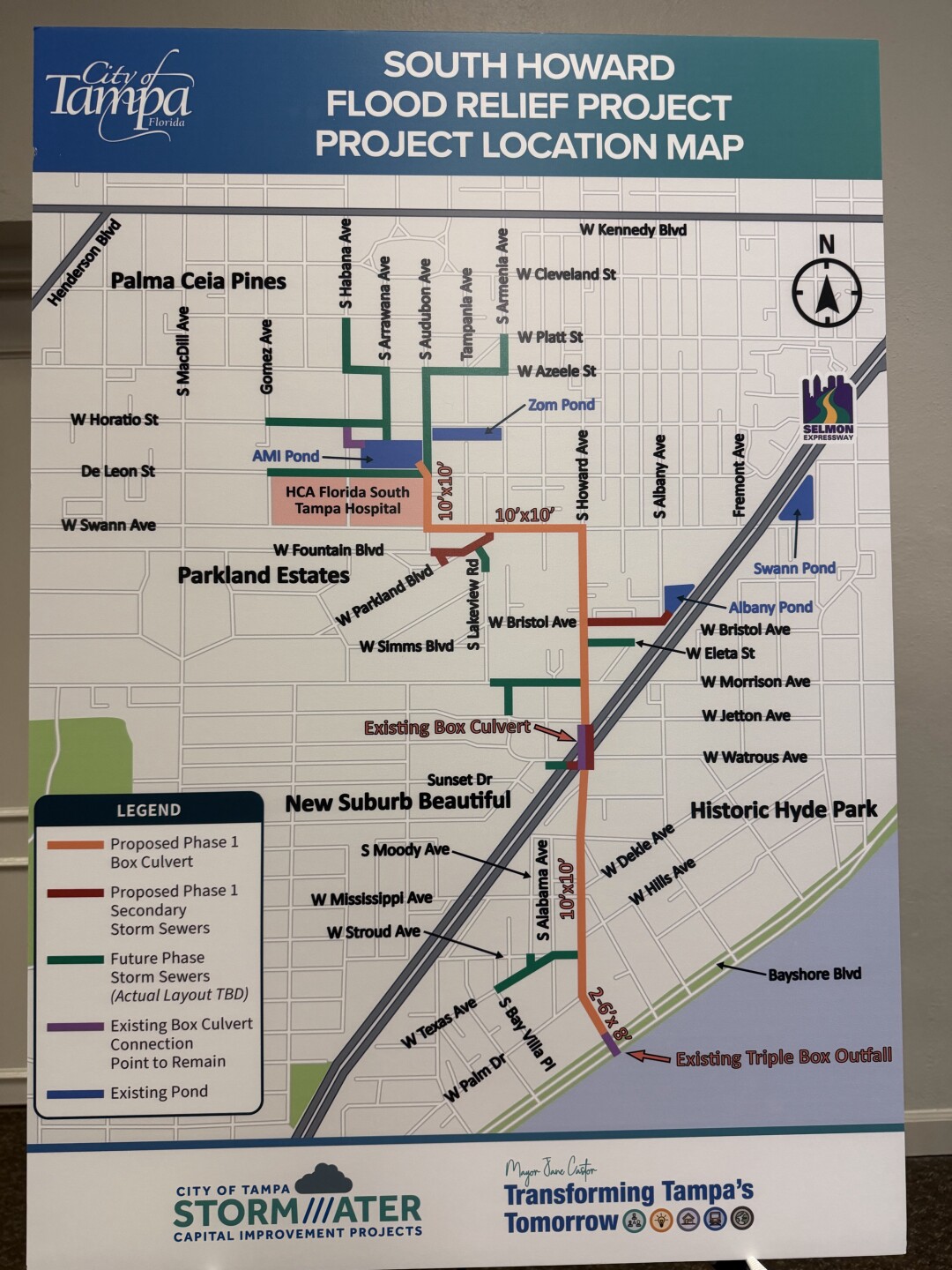
The culvert would run from Bayshore Boulevard north to Swan Avenue, then turn west to an AMI pond, which would serve as a large stormwater inlet. Brandon Campbell, Director of the City of Tampa's Mobility Department, said the design is built around a five-year, eight-hour storm, roughly 5 inches of rain over eight hours, but has also been modeled for larger events, including Hurricane Milton, which struck approximately 2 years ago.
"We will see significant flood reduction in both of those neighborhoods," Campbell said. "A significant number of homes and businesses that, under existing conditions, were flooded would not be flooded with the proposed project in place."
The project is funded in part through Tampa's 2016 Stormwater Improvement Assessment, which covers the area from Fowler Avenue South. Campbell said the project is one of several funded citywide through that source, with money distributed across the lower portion of the city to provide flood relief.
Tampa City Council is scheduled to discuss the guaranteed maximum price for the construction phase on Aug. 27, with a final vote anticipated Sept. 17.

Decades of flooding, and a neighborhood that has been waiting for answers
For residents of Parkland Estates and Palma Ceia Pines, the flooding is not a new problem. It is a generational one.
Greg Tambo, who lives at the corner of Fountain and Audubon Boulevards in Parkland Estates, said his home sits near the center of the flooding problem. Fountain Park, directly across from his house, is where stormwater collects and sits during heavy rain events and hurricanes.
"It can be really quite bad," Tambo said. "We are pretty much in ground zero where our house is."
Tambo has deep roots in the neighborhood. His parents purchased property there, and after spending most of his adult life in the Midwest, he retired and returned to Tampa with his wife, rebuilding on the same lot where he grew up.
"I know the property in the area since 1953," Tambo said.
He said he has attended multiple City Council hearings on the project and has spoken in support of it on several occasions. He described the flooding as a problem rooted in infrastructure that never kept pace with the rapid development of Palma Ceia Pines.
"When I was a boy, the area was mostly small frame houses set on concrete blocks with big yards," Tambo said. "That meant there was a lot of land to absorb the water. Now, because it's a very attractive location, a mile and a half from downtown, a mile and a half from Dale Mabry, in the middle of everything, it has been an area that people have developed and built townhomes and apartments and condos and what have you."
Tambo said the problem is compounded by infrastructure that was inadequate from the start.
"There are no curbs, no sidewalks up there to speak of, and I suspect, and what I can see of the intakes for the sewer system, it isn't all that great and never was," Tambo said.
He said the city has attempted to address flooding in the area since the 1950s, but those efforts have only provided temporary relief because the core infrastructure problem in Palma Ceia Pines was never resolved.
"The real problem is that the infrastructure north of us in Palma Ceia Pines has not kept pace with the development of that area," Tambo said.
Tambo compared the proposed box culvert system to building an underground river, one that would carry stormwater from Palma Ceia Pines all the way south to Bayshore Boulevard and out to the bay.
"Just as the Mississippi drains the state of Minnesota as well as it drains the state of Louisiana, that's what rivers do," Tambo said. "An underground river will do that for Palma Ceia Pines all the way to Bayshore, and that has to be done first before they can start collecting water there, because they have no place to send it until they get this project."
Ted Kelly, another Parkland Estates resident, said the flooding is not just an inconvenience. It is a public safety issue.
"There's a hospital right down here on Swan that we just had a big rain a couple weeks ago," Kelly said. "Swan is not drivable at that point."
Kelly said the lack of a passable road near HCA South Tampa Hospital during heavy rain events is unacceptable, and he expressed frustration with council members who have voted against the project without offering an alternative solution.
"They're not proposing anything other than to just let the flooding continue," Kelly said. "That's not acceptable."
Kelly also raised concerns about long-term property values if the flooding problem is left unaddressed, pointing to what has happened in Shore Acres in St. Petersburg as a cautionary example.
"Are our council members trying to turn us into Shore Acres over here?" Kelly said.
What the city is proposing and how it would work
The South Howard Storm Relief Project centers on a box culvert that would run more than 6,000 feet along Howard Avenue, starting at Bayshore Boulevard and moving north to Swan Avenue before turning west toward the AMI pond near HCA South Tampa Hospital. The pond would serve as a large inlet, collecting stormwater from the surrounding area and channeling it through the culvert and out to the bay.
Campbell said the system relies on gravity to move water, using the natural elevation difference between the flooded neighborhoods and the bay outfall.
"We have a 15-foot elevation difference between the areas that are being flooded and the outlet, the outfall in the bay," Campbell said. "We know that even if the tide is high, if it's at 8 feet, but if the area that's being drained is at 15 feet, that elevation difference is still plenty to push that water out into the bay."
Campbell used a simple analogy to explain how gravity drainage works even when the outfall is partially submerged.
"If you put a garden hose at the bottom of the pool and turn on a spigot, you'll feel that water still flowing, even though it's submerged in the pool," Campbell said.
City officials acknowledged that the current phase of the project primarily addresses flooding outside the roadway in Palma Ceia Pines, with additional phases needed to address roadway flooding within that neighborhood. Campbell said the Howard Avenue spine must be built first to create the downstream capacity needed before additional pipes can be connected into the neighborhood.
"We have to build the capacity downstream, which is this Howard Avenue spine, so that if and when we decide to put in additional pipes connecting into the neighborhood, we can manage that stormwater flow that comes into the trunk, the main line that we're building with this project," Campbell said.
Campbell said one significant design change has already been made in response to public input: extending the box culvert to the AMI pond to improve flood relief specifically for Palma Ceia Pines.
"One of the major changes that we've made with this project is the extension of the culvert up to that AMI pond to provide better flood relief, particularly to that Palma Ceia Pines area," Campbell said.
On the question of cost, Campbell said the South Howard project is one of many funded through the 2016 Stormwater Improvement Assessment, and that the target beneficiary is the entire community, not just the immediately affected neighborhoods.
"We are talking about access, emergency access to a hospital, access throughout the neighborhood," Campbell said. "Our intent is to make sure that the roadway remains safe, clear, passable for all users, and that includes anybody in the city."
On the timeline for finalizing the design, Campbell said the contract structure allows city teams to review and approve final design decisions as the contractor prepares to implement each phase.
"There will be final design decisions that are finalized as they get ready to implement them," Campbell said. "Those will be reviewed by our city teams across the board, whether it's our stormwater engineering division or our Transportation Division, looking at their specific areas of focus."

Business owners along Howard Avenue brace for construction
One of the most contentious aspects of the project is its potential impact on businesses along South Howard Avenue, a commercial corridor with restaurants, shops, and other small businesses that depend on foot traffic and vehicle access.
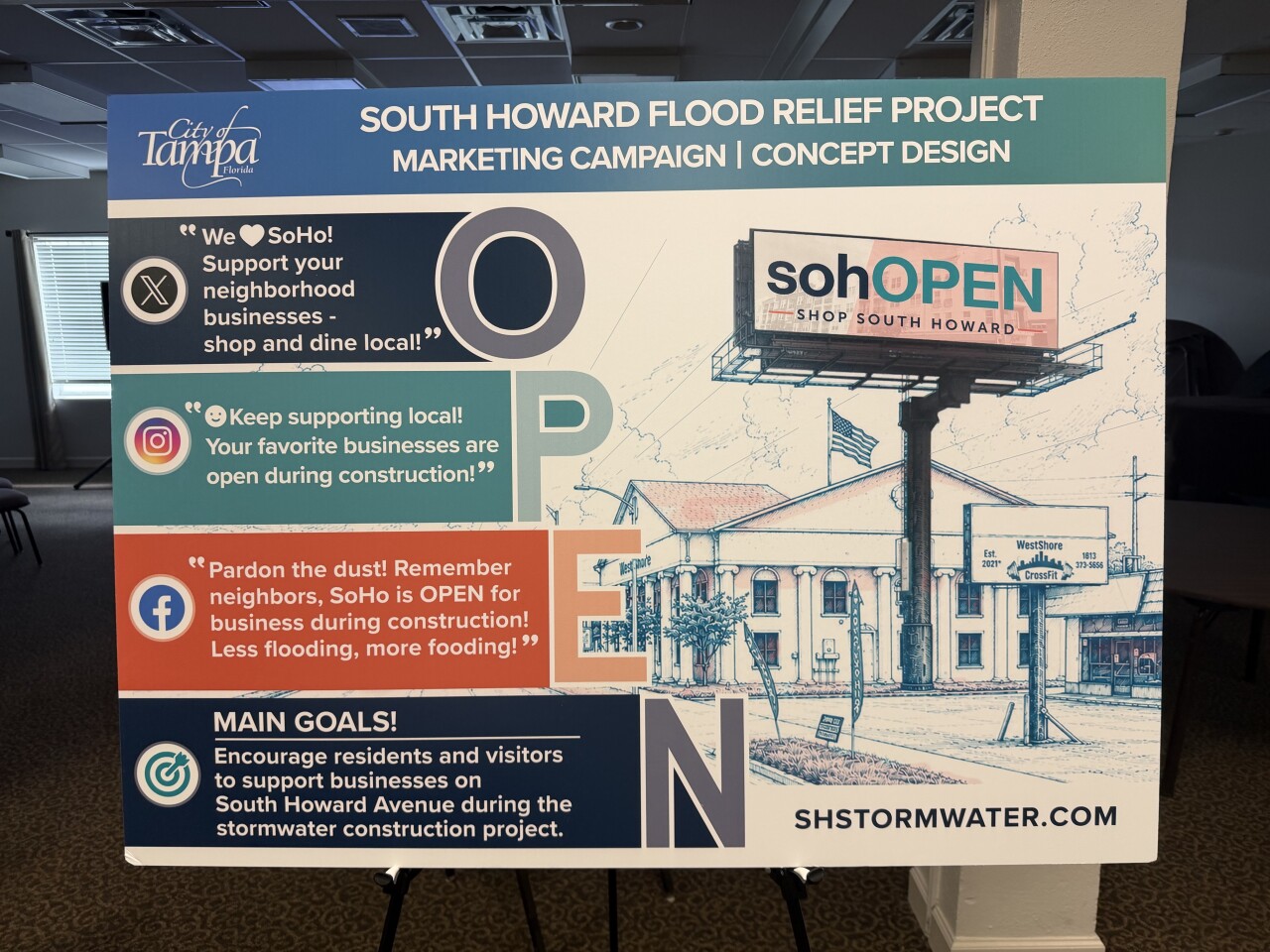
Campbell said the construction contractor will use a "restore as you go" phasing method, completing and restoring each section of roadway before moving on to the next. The city also announced a marketing campaign called "SoHOpen" designed to remind the broader community that businesses along the corridor remain open during construction.
The design-build contractor has also committed to maintaining access to each business throughout the duration of the project, including assistance with deliveries and logistics for businesses whose entrances may be temporarily adjacent to active construction.
"We will make sure that customers can get into those businesses," Campbell said. "We will keep sidewalk access open at all times on at least one side or the other."
However, at least one business owner told me the city had not yet reached out to her directly. Campbell said the design-build contractor is responsible for those outreach efforts and that representatives at the open house could set up consultations for anyone not yet contacted.
"Our design-build contractor is reaching out to those individual business owners," Campbell said. "In fact, the last time we were in council chambers, I saw him passing out business cards to people who came to provide public comment."
One business owner also objected to the open house format itself, saying the lack of a formal public presentation and open comment period made it difficult for the public to engage with the city's plans collectively. Campbell defended the format, saying it allows for closer, one-on-one review of design details.
"This is truly a design review workshop," Campbell said. "It's a common method for us to lay out those road plots, get people gathered around the table, and point out what we're doing in specific spots where they may have concerns."
Campbell added that written public comment is being collected and will receive responses.
Opponents say the project is flawed, over budget, and built on biased engineering
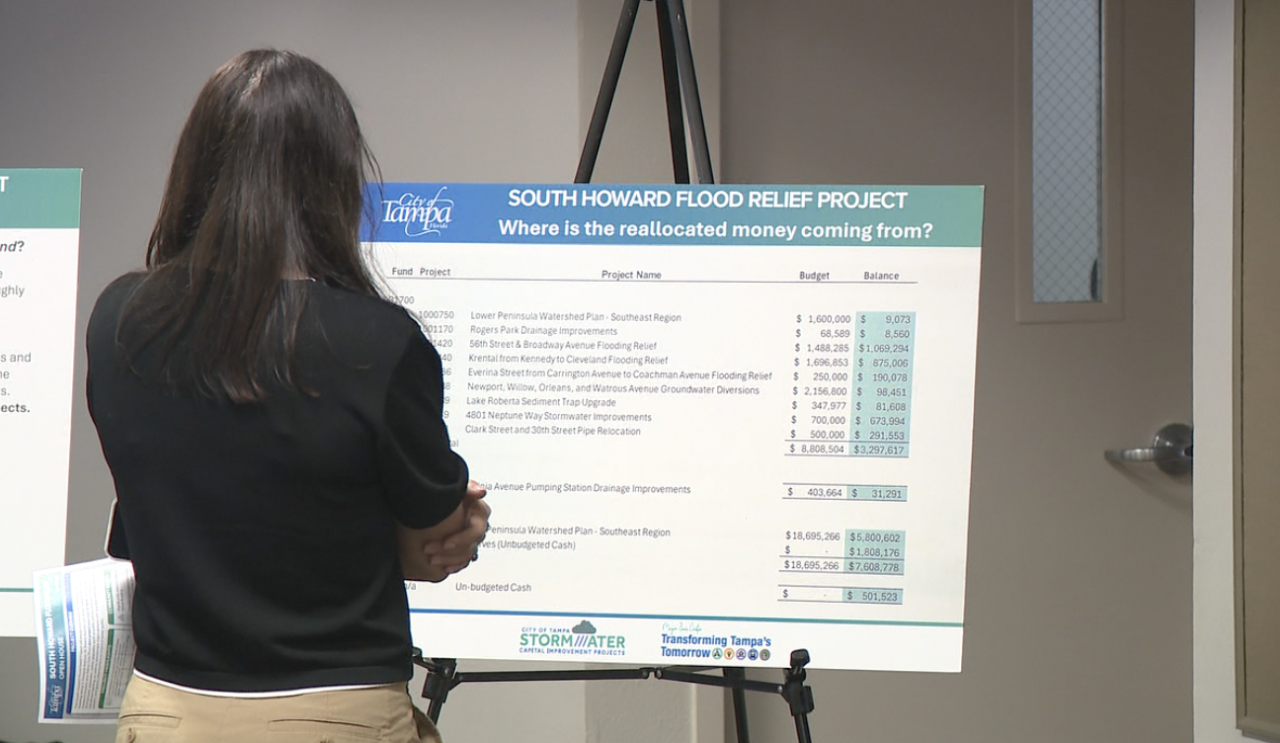
Steve Michelini, who represents business interests along South Howard Avenue, said the project has fundamental problems that go beyond construction inconvenience. He said the city's own disclosures at a recent budget workshop revealed that it currently has approximately $40 million available, with the remainder of the funding still unresolved.
"They really have 40 million dollars, and they're trying to find out where they're going to get the rest of the money," Michelini said.
Michelini said the finance department told community members the project would consume all of the city's stormwater funding, approximately $5 million per year, for at least the next 5 years.
"A singular project should not use up all the money," Michelini said.
He also questioned the city's accounting of specific funding sources, including $1.5 million vetoed by the governor and $11 million from the Tampa Hillsborough Expressway Authority, known as THEA, noting that the contractor said he only needs $2.2 million of that THEA allocation.
"Are they messing with THEA on how much money they want?" Michelini said. "They can't keep track of where all these different things are. Statements from different departments, different individuals contradict what they've made public statements about."

Michelini said the project's scope and cost have changed significantly since early community meetings, when city officials told business owners construction would maintain one open lane of traffic at all times.
"That all is gone," Michelini said. "The project changed, the scope changed, the cost changed. Now we're at somewhere in the neighborhood of 160 million dollars plus, if they include Palma Ceia Pines, with no plans, and they don't have the money."
Michelini also raised concerns about the AMI pond that would serve as the project's stormwater outlet, saying it contains contaminated water, medical waste, and an estimated 2 to 3 feet of sludge.
"We have photographs of medical waste bags floating down in that mess underneath the pond," Michelini said.
He said the city should go back to the original JMT engineering report, which he said called for retention ponds and pump stations rather than the box culvert approach now being pursued.
"Redesign it," Michelini said. "Listen to what the original JMT report said. Create the retention ponds and pump stations that were called for."
Michelini said he was encouraged that council members asked pointed questions at the budget workshop, but remained skeptical about the project's path forward.
"It makes us feel better that they're asking probative questions, questions that really get to the meat of the problem," Michelini said. "It's a very expensive project, and they don't have the money."
Council member calls project a 'terrible idea' and questions the engineering
Council Member Bill Carlson, who represents District 4, has been one of the most vocal opponents of the project on the council. He said he has yet to speak with an engineer not paid by the city who supports the plan.
"Every engineer I've spoken to, who's not getting paid by the city of Tampa, thinks that this is a terrible idea and it's not the right solution," Carlson said. "I even met with engineers overseas on my recent vacation, and I showed them, and they looked at it and said, 'Why would you do it that way?'"
Carlson said the project has gone double or possibly triple over its original budget, not including interest, and still does not fully protect Palma Ceia Pines. He said residents in that neighborhood would not be protected for at least 4 years after the first phase is complete, and that the city's own maps show their homes would still flood even after the project is finished.
"They're giving false hope to people in the community, making them think that this is going to protect them," Carlson said. "I don't think it's acceptable to spend $100 million and still have people's houses flood."

Carlson said historical documents dating to the 1980s and 1990s pointed to a different solution entirely, one that would have placed a retention pond at the lowest point in the area, where the city has since permitted multifamily housing.
"Up until 3 years ago, there was a different solution, and suddenly this hair-brained idea came out of somewhere, and I don't understand why the administration keeps pushing it," Carlson said.
He argued that the engineering analysis used to justify the project was shaped by the parameters the city gave its engineers from the start.
"If you tell the engineers, 'I want a project that goes down Howard Avenue,' they're going to come back with a solution with Howard Avenue, and that's what they were told," Carlson said. "The math might be correct, and an engineer can sign off on it, saying that the math is correct. But if the model is biased, then you can't do it that way."
Carlson said the city conducted an alternatives analysis after council pressure, but he questioned how it was structured.
"They came back with four alternatives that I pointed out, not the engineers, and it turned out that the one that made the most sense was the most expensive," Carlson said. "It's all about the model you put together."
He also accused the mayor's office of framing the debate as a conflict between businesses and neighborhoods, which he called unethical.
"It's really about how do we best protect the neighbors," Carlson said. "If you can protect the neighbors and prevent their houses from being flooded and spend less money and take less time, why would you not do it?"
Carlson warned that if the project moves forward and takes 4 years to complete, residents will still be flooding in the meantime, and the city will have no stormwater funding left for the roughly 20 other South Tampa neighborhoods that also experience chronic flooding.
"In four years, when this project is done, I'm going to be the one sitting there explaining to people that had we had a different project, had this mayor not pushed for a bad project, their houses wouldn't have flooded," Carlson said.
He also accused the administration of a lack of transparency, pointing to documents that were not provided to council members until the morning of the budget workshop.
"We saw that some of what they were presenting was not true," Carlson said. "They need to step back and do a reset, but then move quickly to find better solutions to prevent flooding in these neighborhoods."
Carlson said the city's communication and political departments work for the mayor, and he questioned whether the way the project is being presented to the public crosses an ethical or legal line.
"You're not allowed to use city or government resources for political purposes," Carlson said. "This project just doesn't make sense. It doesn't make sense from a financial point of view or an engineering point of view. But they've convinced people that it is, and they're trying for political reasons to whip people up against me, but it's not going to work ultimately," Carlson said.

Council vote is close, and the outcome is uncertain
The project has survived previous council votes, but only narrowly. Supporters acknowledge that the margin leaves little room for any shift in position before the final vote.
Tambo said he is hopeful that the neighborhoods most affected by flooding will continue to have enough support on the council to push the project through.
"The people who are for the project have prevailed in each case so far, and we very much hope all the neighbors, people in Parkland Estates, and not only Parkland Estates, but the area just north of us, Palma Ceia Pines, the area around HCA South Tampa Hospital, the people there also are very much for this project because the flooding really starts up there, and they get flooded there," Tambo said.
Tambo said younger residents in newer developments in Palma Ceia Pines are among those most affected by the flooding and most in need of the relief the project would provide.
"The younger people living up there, typically in the newer development places, in the condos and the apartments and the townhouses, they get flooded because the infrastructure is not what it should be and never has been up there," Tambo said.
Kelly said he would be willing to push for new council representation if the project fails.
"I want a new council then," Kelly said. "Let's hope they're term-limited."
Campbell said the city remains committed to moving the project forward and is focused on delivering flood relief to the community.
"The current plan is for council to have this in front of them for discussion on August 27th," Campbell said. "We anticipate the final vote happening September 17th."
Campbell also hinted at what happens if the council votes against the project.
"If it fails, the project doesn't move forward," Campbell said. "There's no plan B. This project is the plan."
Share Your Story with Jada
Jada Williams is focused on the issues that matter most to people in who live in Tampa and West Hillsborough County. From downtown Tampa to Town ‘n’ Country and Westchase, Jada works to bring you updates and solutions on everything from crime to infrastructure. Reach out to Jada below with your concerns for your neighborhood.
.

Bradenton community responds after 20-year-old volleyball star dies from disease that affects 2 in a million
The 20-year-old IMG Academy volleyball star and Under Armour All-American died Sept. 16 after a three-month battle with the rare blood disorder — even though doctors had found her a 100% bone marrow match, her mother, Tanya Mack tells Tampa Bay 28 reporter Haley Zarcone.
