

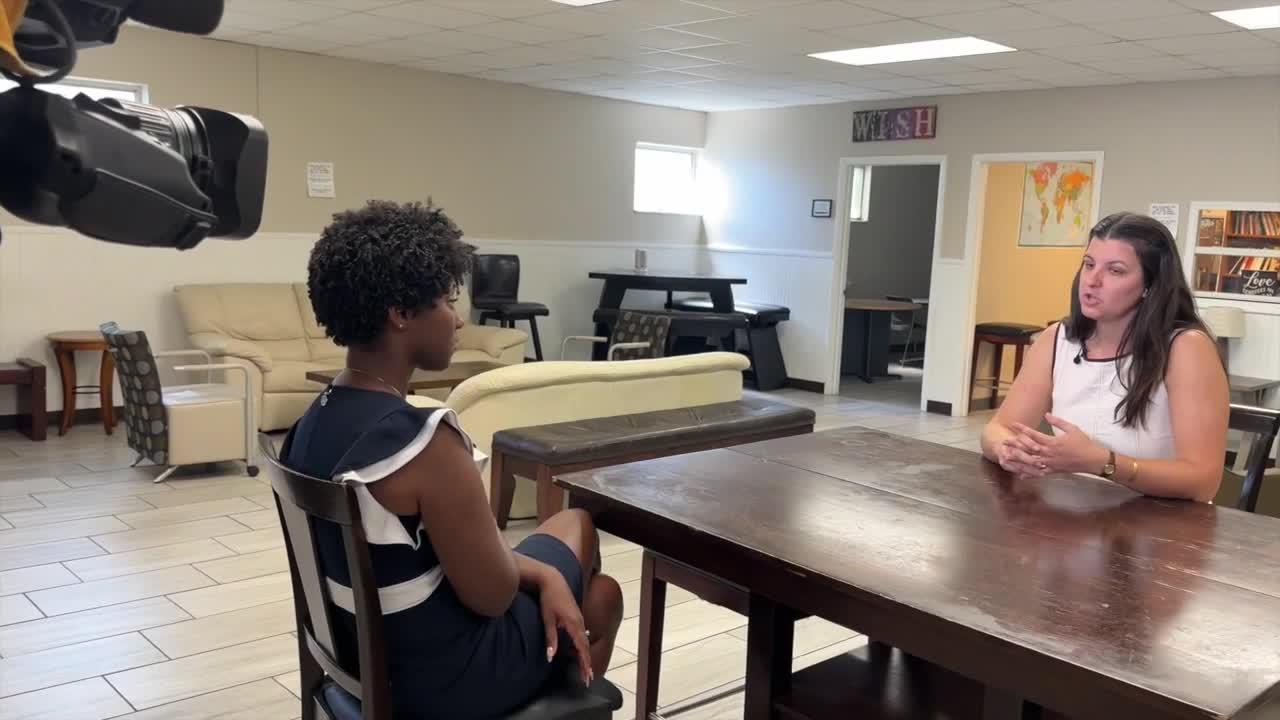


TAMPA, Fla. (WFTS) — A loss in grant funding is threatening the Kinship Free Market's ability to serve roughly 12,000 people annually across 11 locations in the Tampa Bay area.
Six days a week, a refrigerated trailer pulls up to neighborhoods across Tampa. Volunteers unload hundreds of pounds of fresh produce, meat, dairy and bakery items. People line up, pick out what they can use and head home with groceries they could not otherwise afford.
Watch report from Jada Williams
It is a simple idea, but it has been running since around 2008. Now, it is in jeopardy.
The Kinship Free Market, a mobile food distribution program operated by Well Built Cities, is facing a significant loss in recurring grant funding. Without a solution, the organization may have to cut two of its regular weekly distributions just to keep the rest of the program afloat.
Well Built Cities was incorporated in 2014, but the Kinship Free Market is one of its oldest programs, with roots going back to around 2008. Dhalia Bumbaca, Chief Operating Officer of Well Built Cities, said the math is straightforward and the stakes are real.
"Something that we do entirely for free for the benefit of the community, and therefore it's largely grant funded, and then partially donor funded," Bumbaca said.
The program costs about $10,000 a month to operate. Over the course of a year, that adds up to roughly $100,000 the organization now needs to raise through private giving while it works to rebuild its grant funding pipeline.
"We've lost some of those recurring grants that have supported the Kinship Free Market, and so as a result, we're in need of more ongoing support to sustain that," Bumbaca said.
What the Kinship Free Market actually does
Annually, the Kinship Free Market serves about 12,000 individuals and distributes between 250,000 and 300,000 pounds of food. Each distribution event puts roughly 800 to 1,000 pounds of food on the table, sourced directly from grocery stores including Whole Foods, Sprouts Farmers Market and Abby's Health and Nutrition.
That sourcing matters. The food is not purchased wholesale or donated through traditional food bank channels. It is diverted directly from grocery store supply chains, food that would otherwise be considered waste. Bumbaca said the organization takes the position that food is only waste if you waste it, and by redirecting it to community members, each participant walks away with about 50 pounds of food, enough to serve as their groceries for the week.
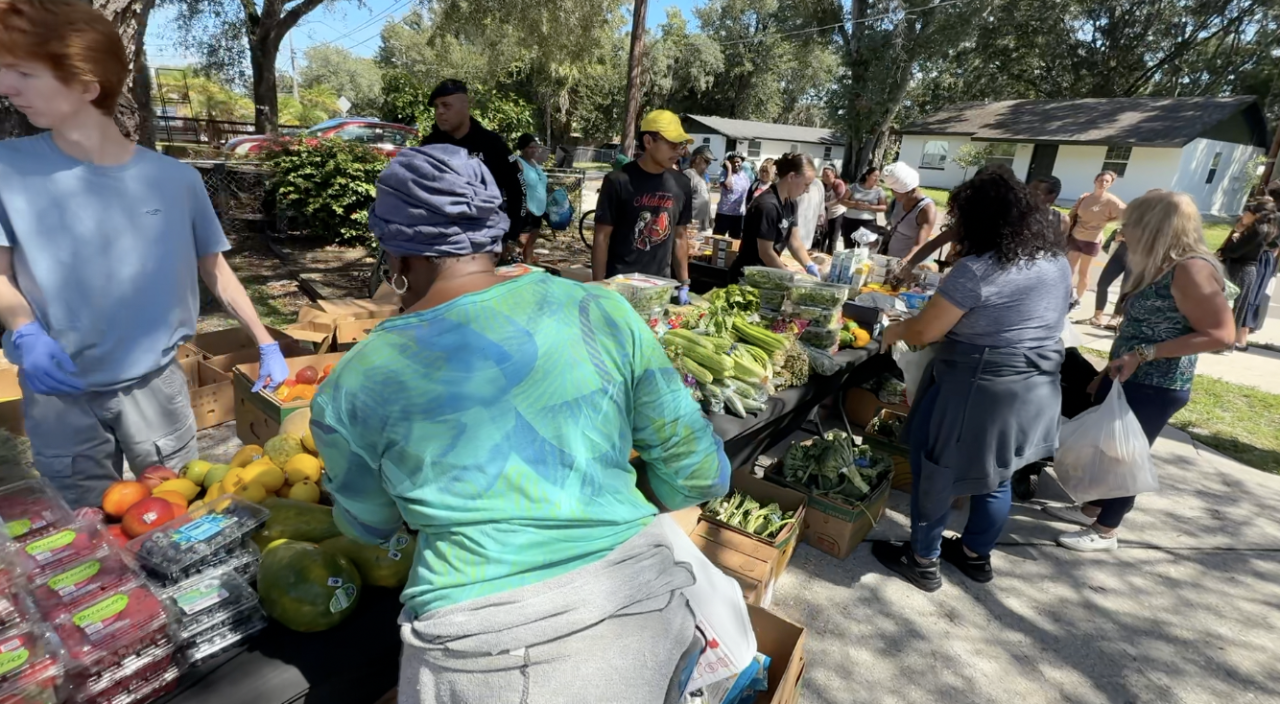
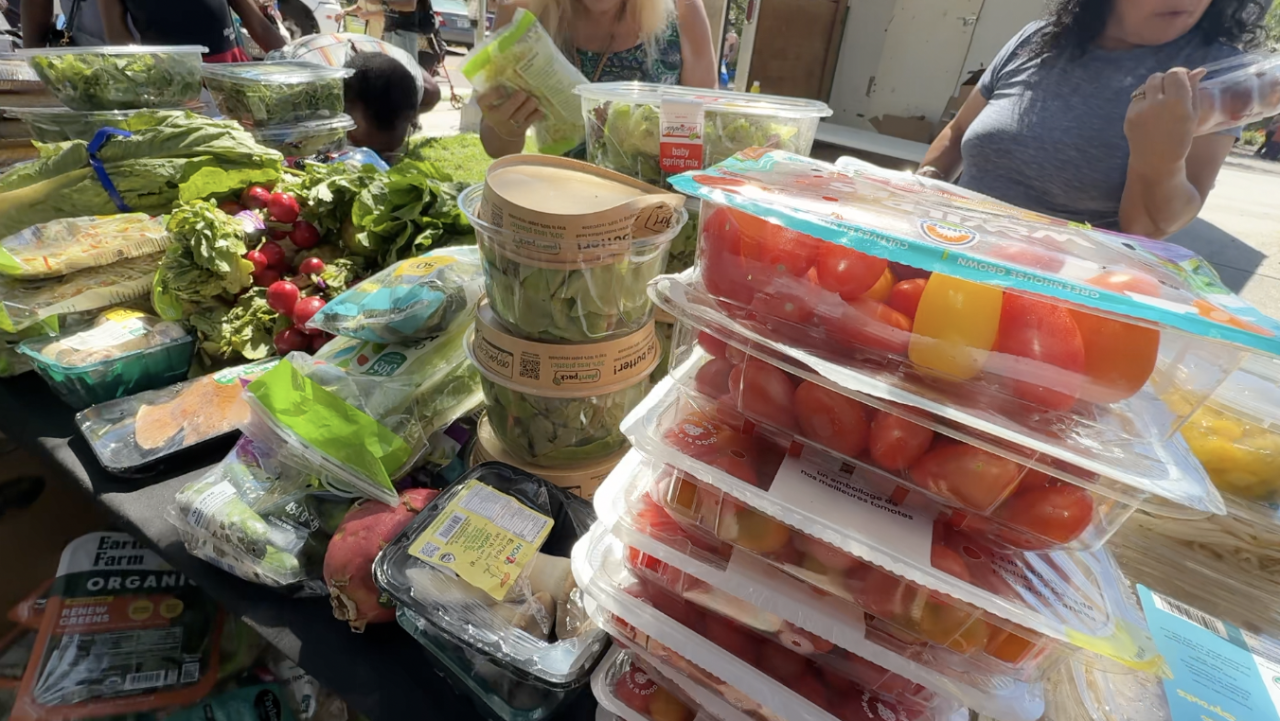
The food is fresh, not canned. Participants walk through tables of produce, dairy, meat and pre-made meals and choose what works for their household and their diet, rather than receiving a pre-packed box of items they may not be able to use.
John Davis, who sets up the distributions each week, said that approach makes a real difference for the people who show up.
"We let them actually go through and pick out what they can eat instead of us giving them a box of food. That way, it doesn't get thrown away. They're going to take what they need. They know their diet better than we will ever know it," Davis said.
Davis also described the variety of food available at a typical distribution.
"We get stuff that a lot of pantries don't get," Davis said.
That includes items like fresh basil, specialty coffees and produce from health-focused grocery retailers. The goal is to keep the food as nutritious as possible.
The people who show up
Rita Mack, a retired woman, was number 72 in line at a recent distribution just outside Harvest Hope Park in the University area.
"I don't have a car, but I have this scooter and another scooter," Mack said.
But Mack is not just there for herself. She said she takes food home and shares it with neighbors who have children and cannot always make ends meet.
"I don't work and I'm retired, but when I get food, I help other people in my neighborhood that may need help that have a lot of kids, because God say help people," Mack said.
She did not hesitate when asked how she feels about the program.
"I'm very thankful," Mack said.
Stories like hers are exactly why Davis keeps showing up, even on the hard days. And there are hard days. A recent distribution started more than an hour late after a trailer hitch failed and both back tires on the replacement trailer were flat. Davis had to run to five different locations to pick up food before he could even get to the site.
He still came.
Davis said his commitment to the work is rooted in his own experience.
"I've been through it. Me and my family, we were homeless for three years, living in motels, trying to keep our stuff in a storage unit. So I know what it's like," Davis said.
He also talked about how he was raised, and why that shapes the way he shows up for others.
"Growing up, when I was a kid, there was four kids in my family, my mom and dad. And no matter how hard it got for us, we always had a couch for somebody to sleep on, a place for them to take a shower and wash their clothes, and food for somebody else to eat. So I was raised that we're here to help each other out," Davis said.
More than a meal
Bumbaca is clear that the Kinship Free Market is not just a food pantry. It is a front door.
"Without that basic need, that's our excuse to have the conversation, right? That's how we bring them into the ecosystem, into the fold," Bumbaca said.
Well Built Cities runs cooking demonstrations alongside its distributions, showing participants how to prepare the produce they are taking home. It operates community gardens open to the public. It has a Community Food Ambassador program that provides formal workplace training to participants who want to get more involved, eventually bringing them on as paid food educators.
The results of that pipeline are visible within the organization itself. Some current staff members were once standing in the distribution line.
"A couple of our employees that they were first on the other side of our free market, and because of their engagement, their intentional engagement is how we converted them really to being staff," Bumbaca said.
One employee was homeless when they first lined up for food. Their willingness to engage with the program eventually led to a role helping run the organization. Bumbaca said that person is also the one who feels the potential cuts most deeply, because they know firsthand what it means to count on the Kinship Free Market.
Another participant started attending cooking demonstrations, then began volunteering at them, and is now a paid food educator running those same demonstrations for others in the distribution line. Along the way, she lost 50 pounds and saw improvement in an autoimmune condition through changes in her diet.
Bumbaca described the organization's philosophy this way: give a person a fish through the free market, teach them how to fish through food education and community gardens, and then make sure they have access to the pond through a mobile, community-based model that meets people where they are.
"Access to the pond is things like being a mobile free market, and that we're coming to you so that you can access those opportunities," Bumbaca said.
What happens if the cuts go through
If Well Built Cities cannot close the funding gap, the plan is to eliminate two weekly distributions to preserve the rest of the program. Bumbaca said the organization has already committed to keeping its Friday distribution running no matter what, even at its own cost.
But losing two distributions is not a small thing. Each event serves hundreds of people and puts roughly 800 to 1,000 pounds of fresh food into the community. Across a month, that could mean nearly 10,000 pounds of food no longer reaching the people who need it most. Across a month, that could mean roughly 4,000 to 5,000 pounds of food per distribution no longer reaching the people who need it most. When you consider that each participant typically walks away with about 50 pounds of food, enough to cover groceries for the week, the impact of those cuts adds up quickly.
For someone like Mack, who rides a scooter to get there and shares what she brings home with neighbors who have children, fewer distribution days means fewer options and more gaps.
Bumbaca said the timing could not be worse.
"This can potentially, unfortunately, line up with the holiday season and this reduction in distribution at that time, which is not ideal," Bumbaca said.
How to help
Well Built Cities is asking the community to step up in three ways: donate financially, volunteer or partner as an organization.
Bumbaca said even a small recurring monthly donation makes a meaningful difference because the organization can plan around it.
For organizations like church groups that want to do more, there is another option.
"If they're part of a community that needs a food distribution and has an organization or institution that's willing to support that. So, for example, we've seen this with church groups in the past, where they have the interest in doing a distribution at their church, and they'll contribute financially as an organization to bringing that food distribution out there," Bumbaca said.
To donate, visit donate.wellbuilt.city. To ask about volunteer opportunities or organizational partnerships, email info@wellbuilt.city.
Share Your Story with Jada
Jada Williams is focused on the issues that matter most to people in who live in Tampa and West Hillsborough County. From downtown Tampa to Town ‘n’ Country and Westchase, Jada works to bring you updates and solutions on everything from crime to infrastructure. Reach out to Jada below with your concerns for your neighborhood.
.
Bradenton community responds after 20-year-old volleyball star dies from disease that affects 2 in a million
The 20-year-old IMG Academy volleyball star and Under Armour All-American died Sept. 16 after a three-month battle with the rare blood disorder — even though doctors had found her a 100% bone marrow match, her mother, Tanya Mack tells Tampa Bay 28 reporter Haley Zarcone.
