

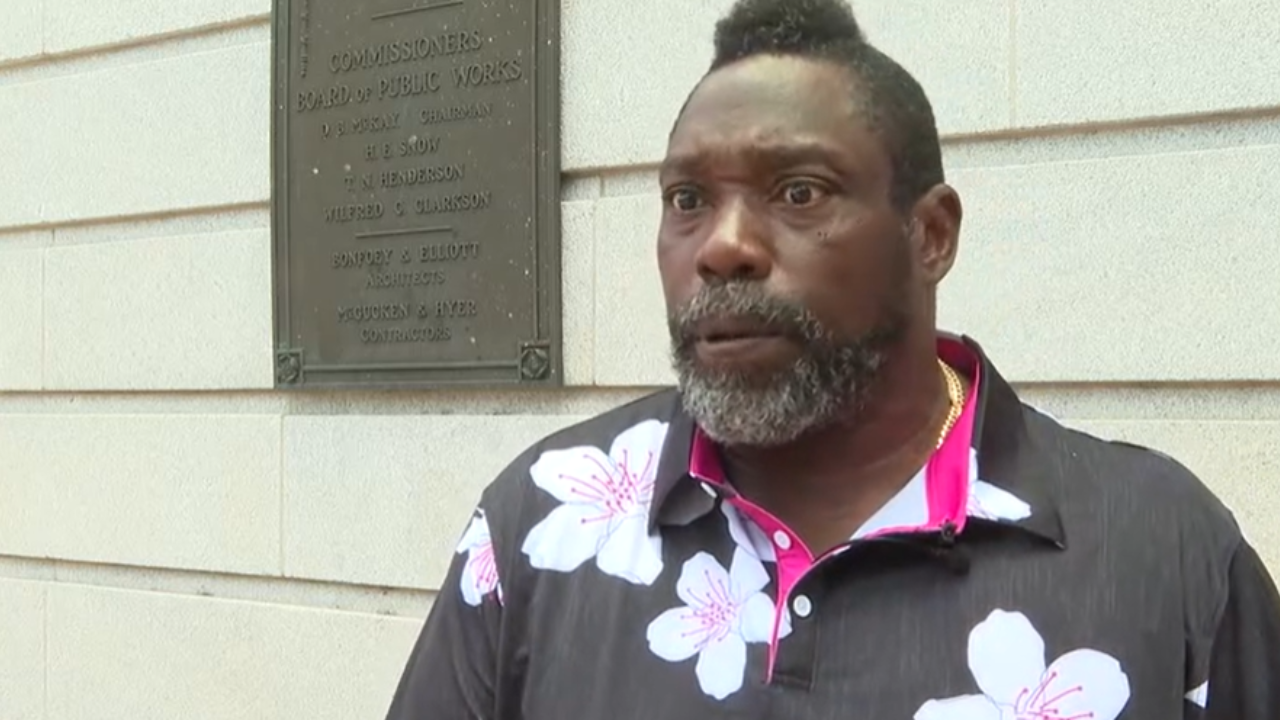


TAMPA, Fla. — Former NFL star Warren Sapp and two other men failed to overturn trespass warnings issued by the City of Tampa on Wednesday, with a hearing officer upholding the notices after a nearly two-hour proceeding that raised questions about First Amendment rights, proper legal authority, and errors on the trespass forms themselves, including whether the city followed its own written guidelines.
Sapp, Bryan Wilkins of the Chuck Bronson Media Group, and William Palmer were trespassed from the Tampa City Center on Hanna Avenue on Feb. 25. On Wednesday, a hearing officer upheld all three trespass warnings following an appeal hearing at Tampa City Hall.
WATCH: Warren Sapp loses Tampa trespass appeal amid questions about First Amendment rights and legal errors
The three men had gone to the city center that day to submit public records requests. They were accompanied by recording devices, which became a central point of contention throughout the hearing and which the city's own First Amendment guidelines suggest should not, on their own, be cause for removal.
What happened on Feb. 25
Corporal Jessica Hollis, a 10-year veteran of the Tampa Police Department who also has 15 years of experience at the Pasco County Sheriff's Office and four years as a military police officer in the U.S. Army, testified about the events that led to the trespass warnings.
Hollis said she was acting as a sergeant that day and responded to the city center after two of her subordinates called her to the scene. When she arrived, security told her the three men had refused to sign in, were filming inside the building, and were making employees uncomfortable.
The Hanna City Center, located at 2555 E. Hanna Ave., is a three-story city office building that houses between 500 and 570 employees. Not all areas of the building are open to the public. Visitors are required to sign in upon entry, and signs throughout the building identify restricted areas. The men were not wearing visitor badges when Hollis arrived.
Hollis testified that she spent at least 45 minutes with the men, working to address their concerns. She said their stated purpose was to visit code enforcement and obtain a copy of a book kept behind the security desk. That book is a log of individuals who had previously been trespassed from the building and also contained photos of people who had conducted First Amendment audits there.
Hollis said she reviewed the book before agreeing to release it, checking for personally identifying information that would need to be redacted. She collected an email address from one of the men and said she forwarded the records request to the city's legal department. She testified she does not know whether the legal department ever responded.
After she determined their official business was complete, the men exited the building. Hollis testified that before they re-entered, she convened a discussion with security officer Lawrence Kraft, a building manager, her captain, and city attorney Megan Newcomb. The group agreed that if the men came back inside, they would be trespassing.
The men returned within approximately five minutes, according to Hollis. Hollis said she then informed them that they were being trespassed.
Errors on the trespass forms
Attorney Brandon Meeks, who represented Sapp, focused significant attention on the trespass warning issued to his client. That is TPD Form 709, completed by Officer Michael Flemmi.
Meeks pointed out that two boxes in the middle of the form, designating whether the trespass applied to city parks or other public property, were both left unchecked. Hollis acknowledged an error on the officer's part and said the box for "city parks or other public property" should have been checked.
Meeks also noted that the authority listed on the form was security officer Lawrence Kraft, not an owner, manager, or agent of the property. Hollis confirmed that Kraft was the listed complainant and that she had contacted security rather than building management directly.
Body camera footage, very briefly played during the hearing, showed Officers Bell and Flemmi discussing the justification for the trespass before completing the forms. Officer Bell was heard saying that she left a section blank because she did not want to be vague and that she planned to bring it to Hollis for guidance.
Palmer's trespass form listed his name as Joseph Palmer. Palmer told the hearing officer his legal first name is William and that he never provided the name Joseph to officers at the scene.
The sign that wasn't there
One of the more pointed exchanges of the hearing involved a retirement party being held in a second-floor conference room on the day of the incident.
Hollis testified that a sign restricting access to that area had not been properly positioned when the men were in the building. Security told her the sign had been off to the side rather than blocking the entrance to the conference room. By the time Hollis arrived, the sign had been moved to the center.
Meeks argued that the men could not have known the area was restricted if the sign was not properly posted. Hollis said she could not confirm the sign's position before her arrival because she was not there at that time, but acknowledged security had been forthcoming about the discrepancy.
Wilkins pressed Hollis on the same point during his own cross-examination, saying the sign was positioned 30 to 40 feet from the conference room and against the wall when the group was on that floor. Hollis said security told her it was off to the side, not blocking the area.
The city's own guidelines
At the center of the First Amendment argument is a document obtained from Tampa City Hall: a city-issued leaflet titled "First Amendment Guidelines for Public Spaces," distributed to Tampa Police officers assigned to Sector D.
The document, which Hollis confirmed she had previously read and which body camera footage showed officers reviewing at the scene on Feb. 25, draws a clear distinction between areas of city property that are open to First Amendment activity and those that are not.
According to the guidelines, parks, parking lots, green spaces outside city facilities, and sidewalks are open to First Amendment activity with only limited restrictions. Lobbies, offices, waiting rooms, and workspaces are listed as "generally NOT open for First Amendment activity."

The document also includes a companion page titled "City of Tampa Public Forum Designation of Locations," which further defines those distinctions. Under that designation, all lobbies and waiting rooms are classified as "limited public forums" where First Amendment activity may be limited only under a rational basis standard, meaning any restriction must be rationally related to a legitimate government interest. All offices and workspaces are classified as "non-public forums" where the public has no protected right to enter without authorization.
Critically, the guidelines specifically address video recording. Under a section titled "Videotaping Do's and Don'ts," the document instructs city staff: "DON'T forbid video recording or taking photos in public spaces Open To First Amendment Activity." It also states that "generally, videotaping should not cause disruption."
The guidelines further instruct staff to warn an individual if their actions are disrupting business operations before taking further action, and to "talk to the person creating the disruption first before taking any further action."
The document also states that failure to comply with staff requests "may result in the issuance of a trespass warning", but only after those steps have been followed.
Hollis testified that she had read the leaflet when she first transferred to Sector D because similar situations had occurred at the city center before. She said she did not fully understand its contents and therefore consulted the city attorney. She could not confirm whether she had reviewed it on Feb. 25 or directed her subordinates to review it before responding to the call. She said she did not believe her subordinates had read it before arriving at the scene, because neither they nor she knew what they were responding to before they got there.
First Amendment concerns
A recurring theme throughout the hearing was whether the men's presence and recording activity inside the building constituted a protected exercise of First Amendment rights or a disruption of city business.
Hollis testified that employees appeared to be in a state similar to a school lockdown while the men were in the building. Offices were empty, phones went unanswered, and staff were not visible in areas that are normally active. She said no employee verbally told her they were afraid while the men were present, but that fear was expressed physically through their behavior.
She also testified that since the incident, multiple city employees had reached out to personally thank her. She said Kraft told her his personal phone number had been posted online by people associated with the group, causing significant distress in his personal life.
The men disputed that characterization. Sapp said he does not have a YouTube channel focused on Tampa and has not posted any videos about the city center or doxxed anyone connected to it.
Wilkins argued during the hearing that his actions were protected and that the city's response amounted to retaliation for constitutionally protected activity.
"I had every legal right to be in that building. I was there to submit a public records request. What happened on that day was not a mistake, it was retaliation and I'm here to make that record. Their own recision of the prior trespass proves it was unlawful. I was there exercising constitutional rights both times," Wilkins said.
Wilkins also noted that a prior trespass warning against him had been rescinded eight days before the Feb. 25 incident, on Feb. 17, before any hearing had been held, which he said was itself evidence that the original warning had been improperly issued.
The legal argument
In his closing argument, Meeks argued that the city lacked proper authority under Tampa's municipal code to allow a security officer to issue a trespass warning. He cited Catron v. City of St. Petersburg, a case he said stands for the proposition that a city ordinance, not just a state statute, is required to grant that authority. He argued Tampa does not have the proper ordinance in place.
Meeks also argued that even if the authority question were set aside, no actual disturbance occurred. He said Hollis' testimony amounted to an acknowledgment that the men were calm, conducted official business, and were trespassed based on the subjective fear of employees and the prior activities of people associated with the group, which he characterized as retaliation for protected First Amendment activity.
City attorney Ian McAllister argued in response that security personnel were acting on behalf of the city and were therefore authorized under Florida's trespass statute as agents of the property. He said the evidence showed the men had concluded or never had legitimate official business, re-entered the building after being asked to leave, and created a disturbance through their presence and recording activity.
The hearing officer upheld all three trespass warnings without issuing a written ruling.
After the hearing
Sapp did not hold back in his assessment of the outcome.
"I learned today that when there's an ordinance in the Tampa code that says you're not allowed to trespass me, I can write it up as an officer saying you trespassed me and then get in here and say, well, it doesn't matter that I did it and I issued it improperly. That's how we're doing it," Sapp said.
He said the hearing officer's decision to walk out without issuing a written ruling left him without answers on even the most basic terms of his trespass.
"I didn't hear what disturbance I caused," Sapp said.
Sapp pushed back on the claim made during the hearing that employees at the city center were afraid of him and the people he was with. He said he does not have a YouTube channel focused on Tampa, has not posted any videos about the city center, and has not doxxed anyone connected to it. He said the security officer's claim that his phone number was released by someone in the group was not something he had any part in.
He also took aim at the body camera footage that was discussed during the hearing. Footage that showed officers reading the city's First Amendment guidelines leaflet at the scene on Feb. 25.
"There's a part where they actually read the leaflet and said the corporal told us to read the leaflet," Sapp said. "Get that leaflet. It's in this building."
Sapp said the footage showed officers being instructed on what not to do, and then doing it anyway.
He was also critical of how his own legal representation handled the hearing, saying key evidence, including body camera footage he had provided, was not fully presented.
"I definitely sent the body cam. I definitely transferred this over to somebody that I paid a nice piece of change," Sapp said. "You can't do that bad of work when I'm giving you the layup."
He said the network of people who have supported him through a previous encounter in Okeechobee helped shape his understanding of how to engage with government.
"I thought my calling was teaching kids my craft for going to get the quarterback," Sapp said. "Nah."
Sapp connected the broader fight to his own name and said he sees no coincidence in his involvement.
"For those freedoms in the First Amendment spell my name: S-A-P-P — speech, assembly, press, and petition," Sapp said.
He cited the 11th U.S. Circuit Court of Appeals and Smith v. Cummings as the governing legal standard for Florida, Georgia, and Alabama, and said the group intends to take the fight to that level.
"We're gonna have some fun with them," Sapp said.
Wilkins said the public records requests that brought the group to the city center on Feb. 25 have still produced zero responsive documents and that the fight is not just about the trespass.
"I had every legal right to be in that building. I was there to submit a public records request. What happened on that day was not a mistake, it was retaliation and I'm here to make that record. Their own recision of the prior trespass proves it was unlawful. I was there exercising constitutional rights both times," Wilkins said.
Share Your Story with Jada

Jada Williams is focused on the issues that matter most to people in who live in Tampa and West Hillsborough County. From downtown Tampa to Town ‘n’ Country and Westchase, Jada works to bring you updates and solutions on everything from crime to infrastructure. Reach out to Jada below with your concerns for your neighborhood.
.

Pasco County mom of 5 takes in 3 children left without food or power whose mother faces neglect charges
Jasmine Young, a mother of 5, opened her home to three neglected girls as their mother faces child neglect charges for leaving them without food, power or water.
