



FT. PIERCE, Fla. — During the segregated Jim Crow South — a time of lynchings, racial terror, and systemic violence — a group of Black Florida men and women turned Florida landscape art into survival.
They were called the Highwaymen — selling landscapes door-to-door, along roadsides, and really anywhere they could make a sale. During one of the darkest moments of American history, the Highwaymen, self-taught painters, risked their lives to feed their families. Their paintings, once sold for $25 to $30, now fetch thousands — a powerful legacy of talent, faith, and resilience.
WATCH full report by Michael Paluska
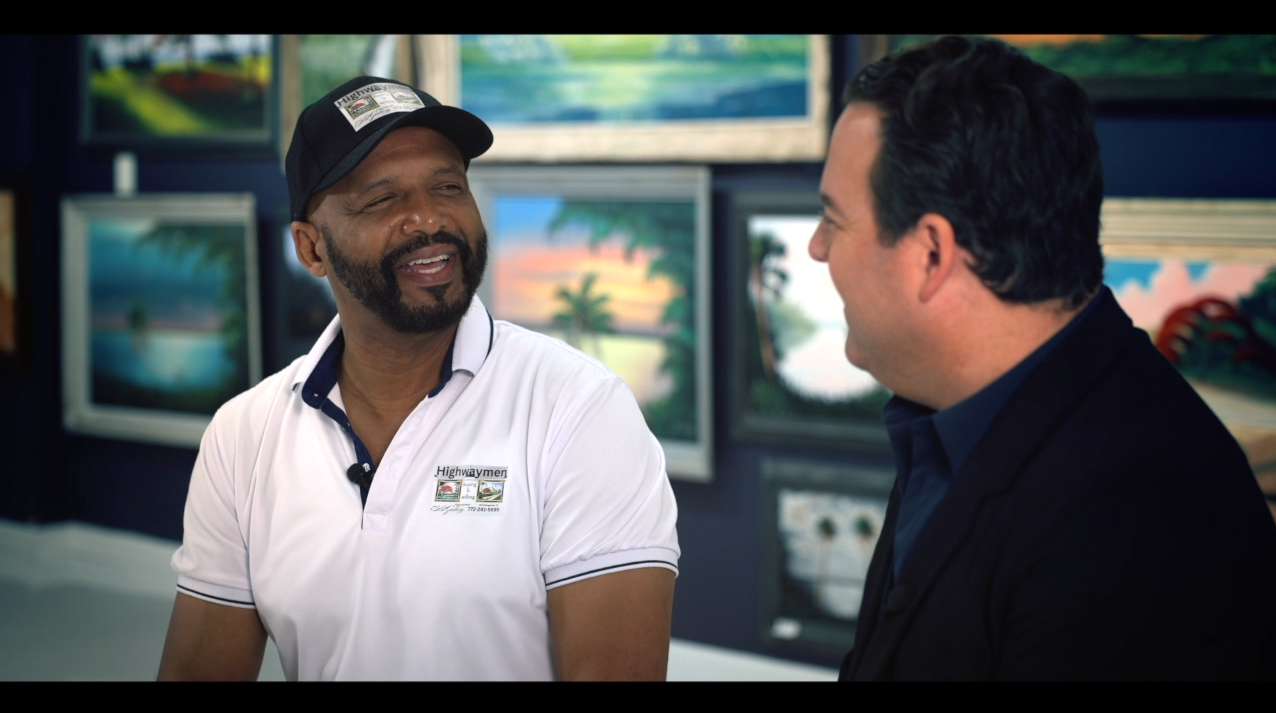
Tampa Bay 28 reporter Michael Paluska and photojournalist Reed Moeller traveled to the heart of where the movement began, Ft Pierce, Florida. It’s where we sat down with Kelvin Hair at his Highwaymen Art Gallery. His father, Albert, was one of the 26 original artists.
"I'm considered a second-generation highwayman, but as long as you buy my painting, whatever you want to call me is cool," Hair said.
Their story begins in the 1950s — 25 men and one woman, Mary Ann Carroll, painting in Florida's Jim Crow South—a time marked by racial violence and segregation. Amid the chaos, they carved out their place in history.
For years, Paluska has reported on Black History Month, recently sitting down with two photographers using their cameras to inspire diversity, equity, and inclusion. That report was called “Behind the Lens of Black Excellence: The journey of two photographers.”
Hair tells Paluska no one sold better than Al Black, an original Highwayman who never backed down to the racism that hung like a thick fog of darkness over communities.
"Al would say, 'tell them a little lie to excite their mind. Tell them a little truth to make it shine,'" Hair said.
Selling was never easy. Hair shared a story about Black's persistence in the face of racism.
"So Al went and knocked on the guy's door with the paint as a sale. And the guy came to the door and said, (expletive), if you don't get off my porch, he called him the "N" word. And Al, instead of just getting mad, walking away, Al said, 'Sir, see that young man out in the car. That's my nephew. We're trying to get money to take him to his mom's funeral, and we tried to get gas money.' And the guy bought three paintings from him. He let nothing discourage him," Hair said.
Those paintings that sold for $25 to $30 now command much higher prices.
"Anywhere from $2,000 to $4,000," Hair said about what an Al Black original would sell for today.
Gary Monroe is the author of "The Highwaymen: Florida's African American Landscape Painters," the definitive work on the subject.
"It's just that the confluence of events you couldn't make up,” Monroe said.
“Magic in a bottle,” Paluska said.
“It's like magic in a bottle. Yeah, they captured it... spontaneous combustion," Monroe said.
Monroe found it remarkable that the very people who were oppressing the Highwaymen were often the ones buying their paintings.
"Mary Ann Carroll said it to me most eloquently. She simply said, white people are great one-on-one. She's been invited to people's homes, and everybody treated her with respect. And I think these paintings were calling cards," Monroe said.
Stephanie Denmark-Black is Al Black's daughter. In the years before he passed, she finally picked up a brush.
"And one particular day, he told me to clean off the place he was painting at. So I'm like, Daddy, you want to put in the trash? He said, No, put it on the board. So I scribbled and put the paint on the board, and it started from there," Denmark-Black said.
Black's nephew, Michael Love, also took up the craft.
"Definitely, these paintings, they break many barriers in obstacles that you know we face on a daily basis," Love said. "Like you said, it crosses across many lines, and it's a good thing, you know, because otherwise, you know, people can't seem to come together, but these seem to bring us together a lot."
In St. Pete, West Evans was also trained under Black. Evans called Black a father figure and an artist who saw humanity first — not the color of one's skin — and gave him advice that forever changed his life.
Black told Evans to work toward something bigger than just paying bills. When Evans said he wanted a 1963 Mercury Comet convertible with a bench seat, Black told him to paint and sell paintings until he had enough money to buy it.
"I found the car, got it," Evans said. "I didn't tell him cause I was going to surprise him. Woke up in the morning with a call from his daughter telling me that Al's in the hospital and it's not good, and he passed away before he got to see the car."
Black’s passing continues to send shock waves throughout the lives of his friends and family.
"I miss him," Denmark-Black said. "He was a good man."
Hair remembers Black's unique ability to connect with people.
"The guy was phenomenal. I've never seen anyone who can sell and make someone be attracted to him the way he did," Hair said. "He had an uncanny ability to connect with the people."
A good man who didn't use his feet to march, but his hands and the subtle strokes of a brush.
"So a landscape can speak to anyone. You could be white, black, short, or tall. You could be Jewish or Protestant. You could not believe in God at all. You could do whatever. Anyone can relate to the landscape. And that's what I love about it, it's not only beautiful, but the audience is wide open," Hair said.
This story was reported on-air by Michael Paluska and converted to this platform with the assistance of AI. Paluska and our editorial team verify all reporting on all platforms for fairness and accuracy.
Share Your Story with Michael

A lot goes into the price of paradise and Michael Paluska focuses on every aspect. From the job market and housing to how Florida’s growth impacts our state’s wildlife. Send Michael tips to keep these important conversations going.
.

'My heart breaks': Woman describes helping injured students after deadly school bus crash in Polk County
A woman on her way to work Monday morning found herself helping injured Winter Haven High School students after a school bus crash that killed two people.
