

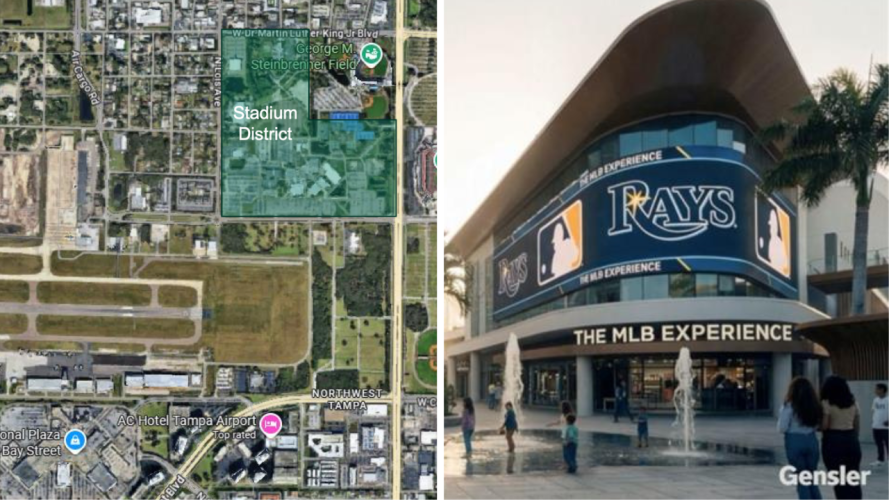


TAMPA, Fla. — The Tampa Bay Rays are proposing a $2.3 billion, 31,000-seat ballpark as the centerpiece of a massive 130-acre stadium district, but the deal requires $1 billion in local public funding from Hillsborough County and the City of Tampa.
According to documents prepared for an April 16 Hillsborough County Board of County Commissioners workshop, the proposed development would be located at the existing Hillsborough College Dale Mabry Campus.
WATCH: Rays' $2.3 billion stadium pitch demands $1 billion in public funds, sparking property tax concerns
The project requires the $1 billion in local public funding to be paid during the construction period, with a Phase 1 ballpark construction deadline set for April 2029. Because the site is currently home to the college, the campus would need to be reconstructed. The governor has pledged $150 million in state funding for new campus buildings, and no local public funds are planned for that specific purpose.
Here is an in-depth breakdown of the proposal, the economic impact, the venues, and how local government could fund the project based on the newly released documents.
The Ballpark and Event Projections
The proposed 31,000-seat stadium would host far more than just baseball games. According to an independent analysis conducted by AECOM for the Tampa Sports Authority, the venue is projected to host the following events annually:
- 81 Rays Regular Season Games: Average attendance is estimated at 20,500 for the first three years, which represents a 20 to 25 percent increase over the team's 2023 and 2024 attendance.
- 8 Concerts: Projected to draw 25,000 attendees per event with an average ticket price of $100.
- 30 Festival Days: This includes events like Enchant Christmas, which most recently took place at Tropicana Field, drawing an estimated 10,000 attendees per day.
- 10 Other Sporting Events: This includes soccer friendlies and college football games, such as an HBCU spotlight, drawing an estimated 20,000 attendees per event.
- 5 Community Events: This includes performances by The Florida Orchestra, drawing an estimated 10,000 attendees per event.
For the Rays, AECOM projects a 20 to 25 percent increase over recent years, noting the Tampa location should attract more fans than St. Petersburg. However, the report notes that even with 20,500 fans per game, the Rays would still rank in the bottom third of MLB attendance.
Furthermore, AECOM warns this attendance spike will likely be short-lived. Hypothesis testing and linear regression models showed that after an initial three-year "honeymoon period," attendance tends to revert to pre-stadium levels unless the team experiences an extended period of winning.
For ticket pricing, AECOM conducted a regression analysis utilizing public MLB data from Statista, factoring in median household income and stadium age. The firm estimates general tickets will cost $32.70 by the 2030 opening. However, because premium seating (which makes up 15 percent of the stadium) typically costs 400 percent more than general tickets, the overall average ticket price inflates to $47.27.
To round out the projections, AECOM contacted vendors for concession data and assessed current parking prices at Tropicana Field and Raymond James Stadium. Fans are expected to spend an average of $28 on concessions and $5.30 on merchandise per game, with parking fees ranging from $21.20 to $26.50 per vehicle.
The Stadium District Development
Beyond the ballpark, AECOM estimates the district will support 7.6 million square feet of total development over 30 years.
There is a notable discrepancy in the documents regarding the size of the project. The county's presentation states the district is 130 acres, while AECOM's economic analysis states the district covers approximately 113 acres.
Furthermore, the report explicitly notes that actual site plans for the Stadium District were not provided by the developers. Because detailed plans were missing, AECOM stated it had to make its own assumptions regarding the type and intensity of the development to conduct its analysis.
Based on those assumptions, AECOM projected the following build-out:
Market-Driven Ancillary Development (5.9 million square feet):
- 4,750 market-rate rental apartment units. Despite the massive scale of the residential development, the model assumes zero affordable housing. The report states that "all multifamily residential is assumed to be market-rate rental apartments, based on input from the developer."
- 690,000 square feet of multi-tenant office space.
- 300,000 square feet of destination retail and dining.
- 860 hotel rooms.
Build-to-Suit and Revenue-Generating Venues (1.7 million square feet):
- Lifestyle Fitness Center: A 430,000-square-foot premium health club featuring four hardwood basketball courts, a FIFA-regulation indoor turf field, an Olympic pool, two ice sheets, gymnastics facilities, and a spa. It is projected to draw 1.2 million visits annually.
- Immersive Sports Venue: A 65,000-square-foot entertainment venue with a 2,000-person capacity, featuring upscale dining, a large sports bar, and tiered ticketing.
- Live Entertainment Venue: An 80,000-square-foot flexible concert hall with a 6,000-person capacity, featuring a standing-room floor and tiered balconies. It is projected to host 120 events per year.
- Parking Garages: 3,400 spaces intended to be publicly owned, with paid parking enforced on event days.
- Other Anchors: This includes the reconstructed Hillsborough Community College, corporate relocations, and sports medicine facilities.
Economic and Fiscal Impact
To calculate the economic impact of this assumed development, AECOM utilized an Input-Output (IO) model via a software called Lightcast. The firm projects massive economic output for Hillsborough County over a 30-year period (2029-2058):
- Total Economic Output: $75.5 billion ($63.1 billion direct, $12.4 billion indirect).
- Job Creation: 9,760 average annual jobs supported (7,420 on-site, 2,340 across the county).
- Wage Earnings: $24.7 billion.
By 2058, the total assessed property value for the stadium district is estimated to reach $4.8 billion. This figure excludes the ballpark and the community college, which would be immune from property taxes assuming the county owns the stadium.
The analysis estimates $2.24 billion in gross tax collections from confirmed available sources over 30 years. This includes ad valorem taxes, state and county sales taxes, the Tourist Development Tax, and a proposed 8 percent admissions surcharge on ticket sales within the district.
To calculate the property tax distribution, AECOM had to make assumptions about future political actions. The proposed district sits inside the Drew Park Commercial Redevelopment Area (CRA), which expires in 2034. AECOM's model assumes politicians will vote to create a new CRA to replace it through 2058; otherwise, the tax distribution model used in the report would change.
The report also factors in $543 million from what it explicitly labels "Speculative Additional Funding Sources." AECOM notes that these taxes "do not currently exist" and would require new legislation to be enacted. They include a 2 percent Community Development District (CDD) tax on food, beverage, retail, and parking (which requires city approval) and a 1 percent Special Assessment tax on tickets and district sales (which requires state legislation).
Finally, the report notes that this fiscal impact analysis focuses strictly on on-site development and activity. It calculates the taxes generated within the district itself based on the assumed build-out, rather than analyzing if that spending is simply shifting from other parts of Tampa.
Discrepancies in Economic Projections
The documents, however, show a massive discrepancy between AECOM's independent analysis and a previous study conducted by RCLCO on behalf of the Rays.
While AECOM actually projected a higher total economic output ($75.5 billion compared to RCLCO's $55.5 billion), RCLCO estimated vastly higher tax collections. RCLCO projected $6.05 billion in tax collections, compared to AECOM's $2.24 billion.
AECOM noted that 30-year taxable sales were the greatest source of variance. RCLCO's state sales tax estimates implied $38.9 billion in taxable sales, compared to AECOM's estimate of $12.5 billion.
AECOM pointed out that RCLCO's implied taxable sales ($38.9 billion) actually exceeded RCLCO's own estimate for total direct output ($34 billion) for the entire 30-year period. AECOM stated this is "mathematically impossible" unless RCLCO included tax collections from indirect, off-site activity in their fiscal impacts.
The documents also attribute the disparities to the two firms using different economic multipliers (RCLCO used RIMS II, while AECOM used Lightcast), different development timelines, and different tax rates applied, such as full versus select millage rates.
How the County Could Fund the $1 Billion
To meet the Rays' requirement of $1 billion in local public funding, county staff outlined several potential funding options.
Community Investment Tax (CIT) Voters renewed the CIT in November 2024, but county documents note that paying for the stadium will be harder than originally thought. After the renewal, the state eliminated the sales tax on commercial leases in July 2025, reducing CIT revenue by 8 percent. Furthermore, staff estimate 2026 CIT revenue will be weaker due to a slowed economy.
The 15-year renewal was configured based on an anticipated 3 percent average annual revenue growth. Staff calculated that a 3.7 percent annual growth rate would allow for tax-exempt bonds, though it still reduces proceeds by $50 million. If the board implements this 3.7 percent option, the county would require a "make whole" guarantee from the Rays to protect eligible CIT projects if the tax revenue underperforms.
Tourist Development Tax (TDT) The county could utilize a TDT option totaling $268 million. This includes $228 million in proceeds from 35-year bonds repaid with the TDT 6th Cent, and $40 million drawn from existing cash reserves. However, using the 6th Cent comes with trade-offs, as it currently funds the county's Cultural Assets Program and provides $2 million a year to the Tampa Convention Center through 2031.
County Cash Reserves The county could drain up to $132 million from various unrestricted cash reserves to help fund the stadium. However, staff warned that using these reserves reduces budget flexibility. The available funds include:
- $24 million from Economic Development Reserves.
- $20 million from Catastrophic/Disaster Reserves.
- $20 million from State Shared Revenue/Half-Cent Sales Tax Reserves.
- $20 million from Capital Project Reallocations.
- $30 million by pre-funding a new Pet Resources Facility with the current CIT.
- $10 million from R3M Appropriations.
- $10 million from estimated one-time funds in the 2027 budget.
Other Potential Funding Sources The county is also exploring Opportunity Zone Tax Credits, New Market Tax Credits, impact fee waivers, Special Assessment Districts, Community Development Districts, state transportation improvements, and public-private partnerships to offset local public funding.
Legal Hurdles and Open Deal Points
A legal opinion provided by county bond counsel Bryant Miller Olive P.A. confirmed that the county can legally expend CIT proceeds to fund a publicly-owned ballpark, even though the word "stadium" was not on the ballot when voters renewed the tax.
The counsel determined that a stadium qualifies as a "recreational facility," which falls within the statutory definition of a "public facility" approved by voters. To use the money, the county must hold a noticed public hearing to officially amend the Infrastructure Projects List to add the ballpark. The counsel also noted that a previously withdrawn motion by board members to prohibit stadium funding does not legally bind the county.
Despite the legal clearance, county staff established strict guiding principles for the negotiations. The county will not jeopardize its AAA credit rating and will not provide public funding for items lacking a public benefit. Furthermore, the county insists that no local public funds will be released until private financing is secured, public bonds are validated, and all legal issues are resolved.
Several deal points remain open for negotiation, including:
- Determining whether bonds are taxable or tax-exempt.
- The form and surety for funding backstops (the "make whole" provision).
- Land ownership and its impact on ad valorem tax revenue.
- Verification of the financial capacity of the Rays' ownership group.
- Value engineering of the ballpark to lower the overall cost.
- Ownership of the stadium after the lease term ends.
- Responsibility for stadium capital expenditures and maintenance.
- Parking facilities and the allocation of revenue.
- Relocation of the Tax Collector facility.
- Negotiating Community Benefits Agreements.
Commissioner Backlash and Property Tax Concerns
The massive public funding request is already drawing sharp criticism from local leaders. Hillsborough County Commissioner Joshua Wostal posted a scathing statement on Facebook regarding the proposal and the team's ownership.
"At this point I have to rescind all of the positive things I've said about the new Rays Ownership," Wostal said. "They have outright lied not only to my face but also the public at multiple meetings. This is them now asking literally for your property taxes. May God have mercy on the soul of anyone that supports this."
Wostal's claim that the team is asking for property taxes is supported by the county's documents. The AECOM fiscal impact analysis lists "Real Estate Tax" (ad valorem property taxes) as a "Confirmed Available Funding Source" to help pay for the district. The report projects $907 million in gross real estate tax collections over 30 years, drawn directly from the county and city operating millage rates applied to the new development.
Regarding Wostal's claims of shifting narratives, the documents reveal that the Rays have changed how they categorize the money they are asking for. According to a county presentation slide, the Rays previously requested $1.15 billion in local public funding. That number was recently reduced to $1.001 billion, but not because the overall cost went down. Instead, the documents state the reduction occurred because the Rays are now "recharacterizing" certain funding sources—such as ticket surcharges and construction fund interest—from "public to private funding."
The documents also show the Rays asked the county to use aggressive financial assumptions to generate more upfront cash. The team requested the county calculate its Community Investment Tax (CIT) bond proceeds using a 4 percent annual growth rate. County staff rejected that request, determining that doing so would force the county to issue taxable bonds, which would actually reduce the county's bond proceeds by over $100 million.
Share Your Story with Jada
Jada Williams is focused on the issues that matter most to people in who live in Tampa and West Hillsborough County. From downtown Tampa to Town ‘n’ Country and Westchase, Jada works to bring you updates and solutions on everything from crime to infrastructure. Reach out to Jada below with your concerns for your neighborhood.
.

Saudi flight from Tampa, secret FBI probe reveal possible Saudi support network for 9/11 hijackers
Twenty years after the Sept. 11 attacks, more than 80,000 records compiled by the Tampa FBI Field Office remain classified. Newly declassified documents are pointing to a possible secret Saudi support network for the hijackers. Soon after the attacks, the FBI uncovered that 15 of the 19 hijackers were from Saudi Arabia.
