



TAMPA, Fla. — When Americans picture the year 1776, they usually imagine Philadelphia, New York, or Boston.
They think of the Declaration of Independence, powdered wigs, and the birth of a new nation.
But while the Founding Fathers debated liberty, the place we now know as Tampa Bay was a world apart.
There was no Tampa. No St. Petersburg. No Clearwater.
Instead, the region was a remote frontier of mangrove islands, sprawling estuaries, and scattered settlements along one of the world's great natural harbors.
"Tampa Bay specifically in 1776 was very, very different than today,” said Rodney Kite-Powell, director of the Touchton Map Library at the Tampa Bay History Center.
WATCH: Tampa Bay in 1776: A wild frontier few of us would recognize today
A place of mangroves, marshes, and extraordinary abundance
Dutch explorer Bernard Romans left behind one of the most detailed firsthand accounts of the Tampa Bay region during the Revolutionary era. In his 1776 book, A Concise Natural History of East and West Florida, he referred to the body of water we now call Tampa Bay as "the Bay of Tampe, or harbour of Spirito Santo."
Romans also praised Florida's climate. He wrote that "from the end of September to the end of June, there is perhaps not anywhere a more delightful climate to be found.” But, he acknowledged that July, August and most of September were "excessively hot."
Another account from the era, penned by British physician and naturalist William Stork, described "low sandy islands and marshes, covered with mangrove bushes," along with "plenty of deer, and some wild cattle."

Stork marveled at "the greatest quantity of fish...I ever saw," and he noted that enough could be caught "to load a ship."
Kite-Powell says those descriptions weren't exaggerations.
"Just the amount of game that was here. Deer and turkeys and all kinds of other things. The amount of fish," he said. "The oysters that used to be in Tampa Bay apparently rivaled oysters anywhere else in the country."
The landscape, he says, was "a very bucolic setting" that attracted both seasonal and Indigenous settlement.

A frontier, but not an empty one
It's easy to imagine 18th-century Tampa Bay as empty wilderness.
Kite-Powell cautions against that.
"I don't want to say it was unpopulated," he said. "There certainly were likely people here, and actually, it was an interesting mix of people."

Indigenous communities lived throughout the region. Spanish and Cuban fishermen operated seasonal fishing ranchos along the Gulf Coast. During the Revolutionary era, formerly enslaved people also escaped into parts of Florida seeking freedom.
Still, development was minimal.
"Florida was very much a frontier during the Revolutionary era," Kite-Powell said. "We were so far in the frontier, there really wasn't a whole lot going on here.”
In many places beyond St. Augustine and Pensacola, settlements amounted to little more than large land grants with a small village nearby.
"It was just wild nature," he said.

Why Florida's Revolutionary story is so different
Florida's role in the American Revolution often surprises people because it doesn't fit the familiar narrative.
"Tampa and Florida were British colonies at that time, and that is one thing that I think is often forgotten," Kite-Powell said.
After more than two centuries under Spanish rule, Florida became British in 1763 following the Seven Years' War. The British divided the territory into East Florida, which covered the peninsula, and West Florida, which stretched from the Panhandle west to the Mississippi River.
While the original 13 colonies rebelled against Britain, Florida did not. Instead, it remained loyal to the Crown.
"Florida's story during the revolution is really one of being a safe haven for loyalists," Kite-Powell said.
Loyalist refugees from colonies like South Carolina and Georgia fled to places like St. Augustine.
"A lot of people who signed the Declaration and who are part of this patriotic movement in the 13 colonies were actually burned in effigy in St. Augustine," Kite-Powell noted.
Florida's path to statehood would not be straightforward, either. Spain regained the territory after the Revolution under the 1783 Treaty of Paris, and the United States would not acquire Florida until 1821.

Florida's quiet but important role in the war
Although Florida never joined the Patriot cause, it still played an understated role in the conflict.
Spanish forces under Bernardo de Gálvez captured Mobile and Pensacola (both part of West Florida at the time) in campaigns that forced Britain to defend another front late in the war.
"Florida played a pretty important role in the end game of the American Revolution," Kite-Powell said.

A story that defies easy labels
For Kite-Powell, the history of Revolutionary-era Florida resists simple narratives.
"Florida is kind of a tricky story," he said. "History isn't always black and white. History isn't always just this clean thing."
The region that would one day become Tampa Bay was already a crossroads of cultures, languages, and loyalties.
"Florida has always reflected a broader sense of what the United States was or could be," he said. "Always a mix of people, and it's how those people get along or don't get along that really shows that American spirit."

Want to learn more?
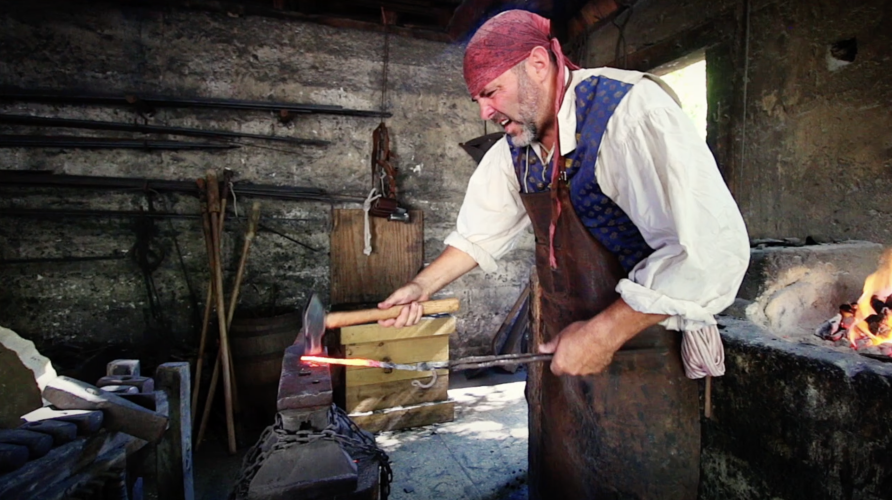
The Tampa Bay History Center is marking America's 250th anniversary with "Mapping the 14th Colony," a special exhibition exploring British Florida during the Revolutionary era through original maps, charts, and historical documents. The exhibit opens July 3.
Or, for an immersive look at colonial life, consider a trip to St. Augustine's Colonial Quarter, a living history museum where visitors can explore recreated buildings, demonstrations, and exhibits that bring British Florida to life and offer a glimpse of what the colony looked like 250 years ago.
Share Your Story with Chad
Chad Mills calls Polk County home and has witnessed the area’s growth firsthand. He is focused on sharing stories from his neighbors in Lakeland. You can use the form below to connect with Chad.
.

Saudi flight from Tampa, secret FBI probe reveal possible Saudi support network for 9/11 hijackers
Twenty years after the Sept. 11 attacks, more than 80,000 records compiled by the Tampa FBI Field Office remain classified. Newly declassified documents are pointing to a possible secret Saudi support network for the hijackers. Soon after the attacks, the FBI uncovered that 15 of the 19 hijackers were from Saudi Arabia.
