



TAMPA, Fla. (WFTS) — The City of Tampa says its South Howard Flood Relief Project will move forward despite a legal challenge from SoHo business owners who have hired an attorney and are raising questions about the project's funding, cost and the number of properties it would actually protect.
Watch report from Jada Williams
The Soho Business Alliance has retained the law firm de la Parte, Gilbert, McNamara & Caldevilla, P.A. Attorney Edward de la Parte Jr. sent letters on February 18, 2026, to all members of the Tampa City Council and to City Infrastructure & Mobility Administrator Jean Duncan and Chief Financial Officer Dennis Rogero, outlining the alliance's concerns.
Read letter
26-02-18 DG-COT Letter (WExhs) by Tampa Bay 28
At the center of the dispute is a $25 million grant the City of Tampa applied for through the Florida Department of Environmental Protection's Resilient Florida program. The city's CFO, Dennis Rogero, told City Council at a January 29, 2026, workshop that the grant had been applied for and had not been denied. But on January 21, 2026, 8 days before that workshop, Alex Reed, director of the FDEP Office of Resilience and Coastal Protection, sent an email to Soho Business Alliance representative Steve Michelini stating the 2025 application for additional funds was not approved for inclusion on the fiscal year 2026-2027 Statewide Flooding and Sea Level Rise Resilience Plan.
De la Parte's letter to Duncan and Rogero states that a public records request to FDEP confirmed the city does not currently have any grant applications pending before the agency for this project.
"On the face of these documents, it appears you provided incorrect information to the City Council and the public at large concerning the status of the FDEP grant," de la Parte wrote.
Michelini, who represents the Soho Business Alliance, said the documents his group obtained tell a clear story.
"The city keeps saying that they have this money, and we now have the documents in hand that shows that they have applied for two grants, $25 million each, and both of them have been denied," Michelini said.
The city is responding directly to those concerns. Josh Cascio, Communications and Public Outreach Coordinator for the City of Tampa, said the funding picture is more complex than critics suggest.
"The city has identified numerous potential funding sources for the South Howard flood relief project, including current and potential grants, potentially additional legislative funding, as well as other sources," Cascio said.
Cascio said the city's CFO laid out the full funding picture during the January 29 workshop, which is available to watch on YouTube (It starts about 18 minutes in). He also pushed back on claims that the project would drain the city's stormwater improvement fund.
"Only $8.4 million from the stormwater fund will go to this project, leaving plenty more for future projects as well," Cascio said. He added there will not be a tax increase because of this project.
PREVIOUS COVERAGE
MORE: Tampa City Council passes funding vote on South Howard flood project
MORE: City council approves $20 million in South Howard Flood Relief Project funding
At the January 29 workshop, Rogero presented a funding plan totaling just over $98 million. That plan includes approximately $29 million already approved and appropriated by City Council, $8.4 million from the storm water improvement assessment, two previously issued storm water bond series totaling approximately $10 million, a $10 million FDEP Resilient Florida grant already in the budget, and nearly $21 million in already-issued debt transferred from a completed project: the MacDill 48 project, which came in under budget.
The plan also identifies approximately $40 million in potential funding, including the disputed $25 million FDEP grant, $11 million from the Tampa-Hillsborough Expressway Authority, and nearly $4 million in hazard mitigation grant funding tied to Hurricane Ian. A $9 million backstop from the Community Investment Tax renewal rounds out the plan.
The legal letters also challenge the city's claims about how many properties the project would protect. De la Parte's letter to City Council cites a February 2022 email from City Engineer Ben Allushuski to the Southwest Florida Water Management District, in which Allushuski wrote that the project appeared to remove only 15 structures from the 100-year floodplain; a number he described as "low." The letter also cites a 2022 SWFWMD analysis that found the project would remove only 3 homes from the 100-year floodplain and gave it a benefit-cost score of 0.77, below the threshold for fundable projects. The district's analysis found that the project would have no impact on structural flooding during storms up to a 50-year storm, and would reduce the number of flooded structures from 5 to 2 only during a 100-year storm.
Read letter
26 02 18 DG Letter Duncan,Rogero (WExhs) by Tampa Bay 28
De la Parte's letter argues those findings are "completely at odds" with what city staff presented at the January 29 workshop, where a slide claimed the project would deliver a 95% flood reduction during a 5-year storm and a 70% structural flood reduction during a Milton-type event, saving more than 220 homes and businesses.
The city's presentation at the January 29 workshop also noted the project has grown in scale since 2022, with an expanded route into Palma Ceia Pines and a new connection through a pond beneath a hospital parking deck that would serve as a large inlet to drain floodwater from the neighborhood. The city's August 2025 grant application to FDEP cited a benefit-cost ratio of 1.01, compared to the 0.77 calculated by the district in 2022.
Cascio said the project's scope has grown significantly since the 2022 analysis.
"In a strong summer storm, this project eliminates structural flooding in Palma Ceia Pines and in Parkland Estates. What about a hurricane Milton? If hurricane Milton hit and this project were in place, we would expect to see up to 70% less structural flooding in those neighborhoods. That means we're protecting more than 220 homes and businesses," Cascio said.
He also pushed back on a 2022 email circulated by the Soho Business Alliance suggesting only 3 to 15 homes would be impacted, calling it "wildly out of date" and not reflective of the current project design.
One of the visuals from the city's January 29, 2026, workshop presentation shows two side-by-side maps of the South Howard area comparing current flooding conditions to projected flooding conditions after the project is completed, both measured against a 5-year, 8-hour storm event. The red shows structural damage. The city's map shows that after Phase 1 is completed, the structural damage would be repaired, leaving only some road flooding. That flooding would then be addressed in Phase 2.

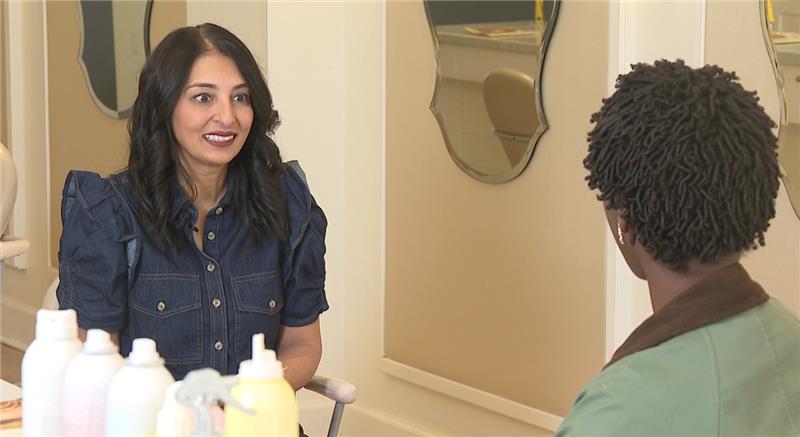
Ami Govindaraju, owner and operator of Dry Bar Tampa, which has operated on South Howard Avenue for 9 years, said she is worried about what the construction project could mean for her business and others like it.
"I think the biggest concern is, is this really going to be feasible and possible for small businesses to thrive, but really small businesses to survive after all this construction? Is it going to take another three to five years to rebuild again? And can businesses afford that? I don't think so," Govindaraju said.

Govindaraju said foot traffic is essential to her business model and that road closures during construction could be devastating. She also questioned whether the project would actually solve the flooding problem it is designed to address, noting that her side of Howard Avenue does not experience flooding.
"It's not helping a whole lot of but it's going to impact the business on the entire street, and to shutter that many businesses, to put that many people out of employment, and to impact the economy of this road is huge for we're talking 15 to 20 structures," Govindaraju said.
Cascio said the city does not want to hurt businesses and is working on a promotional campaign. He described it as a "shop Howard" type effort to help keep customers coming to South Howard during construction. He said the project will be built block by block, with restoration happening as crews move forward.
"Kimmons, the contractor here, has basically said they're going to build one block, they finish that, they restore it, then they move to the next block. And it kind of goes like that, usually between five to seven weeks per area. That's the general idea," Cascio said.
The city's presentation also noted that construction would pause during the business district's busy season and that sidewalks would remain open at all times. When the project is complete, Cascio said the streetscape will include 10-foot-wide sidewalks, new trees, new landscaping and new lighting.
"It will be a very inviting destination for people to come to, and that is really good for businesses," Cascio said.
Michelini said the alliance's attorney has been funded by the businesses along South Howard and will pursue the matter on every available front.
"The attorney's been turned loose and being funded by all these businesses, and they'll be pursuing it very actively on every level," Michelini said.
The project is not yet finalized. A guaranteed maximum price vote by the Tampa City Council is expected around October 2026, according to the city's project timeline. Construction is currently scheduled to begin in January 2027, with substantial completion projected for August 2030.
Residents and business owners who want to learn more can attend a public open house on March 5 at Bayshore Baptist Church from 6 to 8 p.m.
Share Your Story with Jada
Jada Williams is focused on the issues that matter most to people in who live in Tampa and West Hillsborough County. From downtown Tampa to Town ‘n’ Country and Westchase, Jada works to bring you updates and solutions on everything from crime to infrastructure. Reach out to Jada below with your concerns for your neighborhood.
.
Bradenton community responds after 20-year-old volleyball star dies from disease that affects 2 in a million
The 20-year-old IMG Academy volleyball star and Under Armour All-American died Sept. 16 after a three-month battle with the rare blood disorder — even though doctors had found her a 100% bone marrow match, her mother, Tanya Mack tells Tampa Bay 28 reporter Haley Zarcone.
