

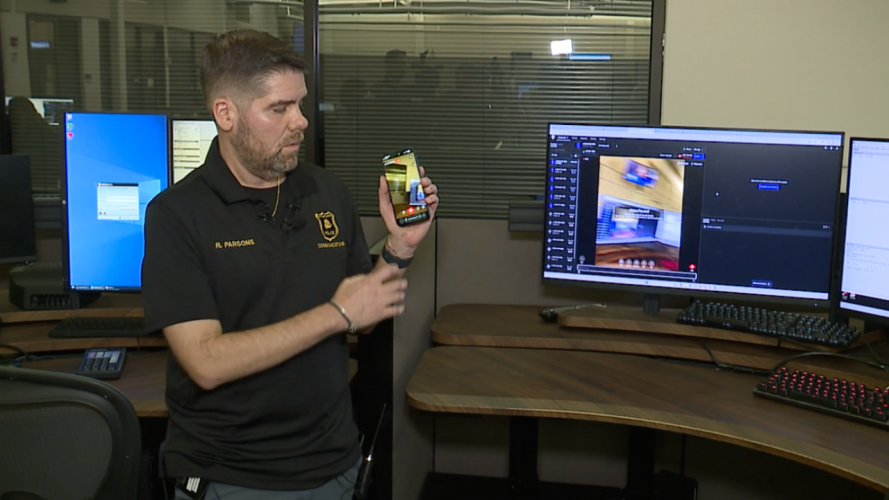


TAMPA, Fla. — Since the age of dialing 911, all of your needs are met based on what you can tell the person on the other end of the call.
Tampa Police Department is now allowing callers to show as well as tell through a partnership with Prepared 911. And that's just one of many new technology advancements happening this year.
Watch report from Jada Williams
Here's what you can expect. Prepared 911 allows text-based emergency communication with live video streaming, real-time translation through body-worn cameras supporting 54 languages and an AI-powered policy assistance system for officers in the field.
"The goals of this technology is not to replace officers. It is actually to help our officers in their safety, ensuring that they can go home safe at night," said Tampa Police Chief Lee Bercaw during Monday's demonstration.
Tampa Bay 28 reporter Jada Williams went inside the dispatch center to see firsthand how these revolutionary tools are changing emergency response in the city.
Revolutionary 911 video capabilities
The Prepared 911 system represents the most significant advancement in emergency communication technology for the department. When residents call 911, dispatchers can now send a text link allowing callers to share live video and photos of ongoing situations directly with responding officers.
"You dial 911, dispatchers are typically trained to listen to everything, so they're really relying on their ears. Today we get to go live and see things that callers are calling in about," said Communications Supervisor Richard Parsons.
During the demonstration, Williams experienced the technology herself, receiving a text message from dispatchers and streaming live video directly to the 911 center. The process was seamless. After dialing 911 and speaking with dispatchers, she received a text link, tapped to begin live streaming, and granted camera permissions. Within seconds, dispatchers could see everything through her phone's camera in real-time.
The video feed provides officers with crucial real-time intelligence about what they're responding to, including details about weapons, suspect descriptions and scene conditions that could affect their safety and response strategy.

"If somebody's on the phone saying someone's with a gun, and we can't get that type of information, now we can see it. What type of gun is it? Is it an automatic weapon? So all of that could change our response," Chief Bercaw explained.
"It happens instantly, with no regard to drive time, no regard to, 'hey, what's your phone number?' It's on everyone's phone," Parsons said.
Breaking language barriers instantly
The body-worn camera translation feature addresses a critical need in Tampa, where approximately 25% of the population speaks a language other than English at home, according to Census data.
The system can translate conversations in real-time across 54 different languages without requiring backup officers or phone-based translation services.
Our cameras also watched as officers demonstrated the technology's capabilities. An officer presses a button with two protruding dots on their body-worn camera.
"Translation, press and hold button, then say translate to x or auto detect," the system announces. "Auto detect. Automatic detection enabled."
The person in need of help can then start talking. The system will immediately identify the language and provide English translation.
"Time is of the essence. If somebody was just a victim of a crime and they have a suspect description, we need to get that information out so we can get that person off the street and keep our community safe," said Jaclyn Douillard, a field training officer.
The technology proves particularly valuable in downtown Tampa and the Ybor area, where tourists and cruise ship passengers frequently need police assistance but may not speak English. Officer Douillard said Russian speakers have been particularly common among cruise ship passengers recently.
"It's just something that really bridges that gap where they're able to trust the Tampa Police Department to help them, and they're comfortable coming here," she said.
The hands-free design addresses a critical safety concern for officers. Unlike using Google Translate on a phone, which requires officers to hold a device and look down at screens, the body camera system allows officers to maintain their defensive stance and situational awareness.
"Officers don't like things in their hands, and you'll see a lot of officers stand in this manner, and having a phone in your hand with Google Translate is very detrimental. Dropping a phone is a lot harder than just releasing a button, so it does help with the safety," officials explained.
AI-powered policy assistance
The third technology introduces an internal AI chatbot system that allows officers to quickly access department policies and procedures through a mobile app. Officers can type questions like "I'm on a domestic violence call, what are some things I need to know?" and receive immediate responses.
Think of it like having a Google search specifically designed for police policies and procedures, officials explained. The system provides instant access to the department's vast collection of policies without officers having to search through lengthy manuals or wait for supervisory guidance.
Future versions will integrate this capability directly into body-worn cameras, enabling voice-activated conversations with the AI system while officers remain hands-free in the field.
Privacy and safety protections
The video streaming system includes multiple safeguards to protect caller privacy and ensure public safety. Callers must explicitly grant permission through phone prompts before video access is enabled. Once calls conclude, the chat session automatically closes and callers receive notification that monitoring has ended.
"The caller has to give permission to the 911 dispatcher," Parsons said. "Once the call is finished, then the entire chat will kind of go away, and basically, we will send you an updated chat that this call is closed."
He adds that dispatchers would never direct callers to put themselves in danger for better video footage.
"We want to make sure that the caller is in a safe spot. We're going to make sure that you aren't going out to try to apprehend a suspect or make the suspect, 'Hey, turn around so I can get you on camera.' We want to make sure that everyone is safe," Parsons explained.
All video and photo evidence collected through the system becomes part of the official case record and can be used in court proceedings.
The Prepared 911 system receives funding through Hillsborough County 911 services, while the translation and AI policy features are included in Tampa Police Department's updated contract with Axon as part of an enhanced technology package.
Share Your Story with Jada
Jada Williams is focused on the issues that matter most to people in who live in Tampa and West Hillsborough County. From downtown Tampa to Town ‘n’ Country and Westchase, Jada works to bring you updates and solutions on everything from crime to infrastructure. Reach out to Jada below with your concerns for your neighborhood.
.

Pasco County mom of 5 takes in 3 children left without food or power whose mother faces neglect charges
Jasmine Young, a mother of 5, opened her home to three neglected girls as their mother faces child neglect charges for leaving them without food, power or water.
