



TAMPA, Fla. — Tampa is in the middle of a severe drought, one city leader says is the worst in 50 years, and the drinking water supply is at risk as some residents continue to overuse water despite restrictions meant to protect it.
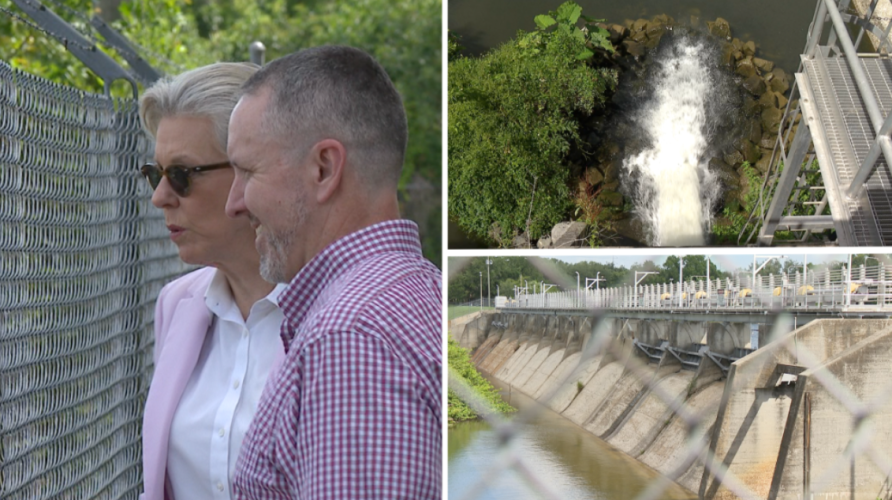
Mayor Jane Castor and Rory Jones, the city's water department director, gathered at the Hillsborough River Dam to sound the alarm. The dam itself tells the story more plainly than any statistic.
WATCH: 17% of Tampa residents are using 40% of the water during the worst drought in half a century
"There is no water going over that dam right now. The releases you see are for those minimum flows and levels downstream," Jones said.
The city holds a permit to pull 82 million gallons from the Hillsborough River each day, treating it into drinking water for Tampa and a third of Hillsborough County. When the river cannot meet demand, the city must purchase supplemental water from Tampa Bay Water, an agency whose own customers are also feeling the strain of the drought.
Even as afternoon rains have begun returning to the Tampa Bay area, Castor said that does not mean the crisis is over.
"We are still in a severe drought," Castor said. "Even if it starts raining in the afternoon, it's been so long since we've had water that all of that water has to seep down into the aquifers before it's going to make a difference."
Watch the press conference with City of Tampa officials:
Water use is going up, not down
Under the Southwest Florida Water Management District's Modified Phase III Water Restrictions, residents are limited to operating automatic irrigation systems no more than one day per week and only during designated watering hours. Despite that, citywide drinking water use has increased over the last month.
"I think that's because it's been so dry that people are actually watering their lawns more," Castor said.
City officials say 40% of Tampa's total water usage is coming from just 17% of its residents. A map released during the press conference highlights the neighborhoods with the highest consumption, with some individual homes using as much as 100,000 gallons per month.
"The dark shaded areas are the areas where individuals are using over 10,000 gallons a month in water usage," Castor said. "That is excessive without a doubt, and that is some of the highest residential water uses in our entire community. Even a small reduction in those areas would make a big impact for our entire area."

Two of the highest-use areas identified by the city are New Tampa and parts of South Tampa.
Castor put the scale of lawn irrigation into perspective, saying that watering a lawn just once uses the equivalent of roughly 60 to 70 showers. For homes with irrigation systems, outdoor watering accounts for roughly half of total monthly water use.
Fines are rising, but the city says it would rather help
Since the water shortage took effect on Dec. 1, 2025, more than 430 Tampa Water Department customers have received citations for violating watering rules, nearly 30% higher than the same period last year. Many of those violations occurred in high-use areas, where customers often exceed 10,000 gallons of water use per month.
In compliance with the District's water shortage order, Tampa Water Department enforcement patrols have increased in areas with a high number of violation complaints or a concentration of high-water users. Fines start at $100 for a first offense, $200 for a second, and $500 for a third, with a mandatory court date. Revenue from citations is being reinvested into the city's conservation programs.
Castor said enforcement teams are monitoring around the clock, seven days a week, but the goal is not to penalize residents.
"We don't want to write citations. We want everybody to abide by these restrictions," Castor said. "I think a lot of times people want to know how to change their irrigation system, and we'll help out with that, or they're just unaware that the regulations are out there."
Jones echoed that message directly.
"We don't want your violation money. We want to change behavior. We want to conserve water, and we want everybody to know that you don't need to worry about reaching out to us. We're here to help. We're not here to fine you," Jones said.
"We thank everyone who is already taking steps to conserve water and encourage more residents throughout our community to join the effort," Jones said. "Protecting our water supply during this drought will take all of us working together to reduce waste and use water wisely."
Free programs are available right now
Julia Palaszczak, the City of Tampa Water Department's Water Conservation and Efficiency Team leader, outlined a range of programs available to residents and business owners at no cost.
- Free one-on-one irrigation evaluations: Residents can request a free on-site irrigation evaluation through Tampa Connect. A trained evaluator will visit the property to locate leaks, correct irrigation controller issues, install a free rain sensor, and identify ways to reduce water use and lower utility costs. Palaszczak said most customers who complete the assessment save an average of 5,000 gallons per month.
- Rebates for irrigation upgrades: Rebates are available for capping irrigation heads on established landscapes that no longer need spray irrigation and for replacing high-volume spray heads with low-volume alternatives, particularly in narrow strips of lawn between sidewalks and streets.
- Waived reclaimed water fees: Through Dec. 31, 2026, the Water Department is waiving application and meter installation fees for eligible customers who have access to reclaimed water but have not yet connected to the system. Palaszczak said the timing is ideal, as the transition period, when the irrigation system is temporarily offline during the switchover, aligns with the arrival of the rainy season.
- Florida-Friendly Landscaping assistance: The Tampa Water Department has Florida-Friendly Landscaping certified professionals available to help customers transition from over-irrigated turf to water-wise yards.
- Free water-saving devices: Residents can receive water-saving tools and leak detection devices to help improve efficiency inside the home, including water conservation kits and support from customer service representatives and high-bill investigators who can help pinpoint the source of unexplained increases in water use.
In the coming weeks, the Tampa Water Department will increase direct outreach to customers in high-use areas to ensure residents are aware of available conservation resources and drought requirements.
Residents with questions about watering restrictions or conservation programs can contact the Tampa Water Department's Conservation and Efficiency Team at (813) 274-8121, Option 5, or email SaveWater@tampa.gov.
Replacing lawns with something that needs less water
A newer city initiative, the Florida Friendly Landscaping Incentive Program, helps residents who want to go further by replacing sections of lawn with drought-tolerant, native plants that require little to no irrigation. The program includes workshops, soil testing, and a rebate for completed installations. Palaszczak said the program's first class is nearing the end of its workshop series.
One of those participants has already taken her results to her homeowners' association and won approval.
"This is a huge win," Palaszczak said. "Our customers now are going into their communities and making the difference for all of us."
That participant is Lissan Uppgard, whose Tampa home has become a model for what water-conscious landscaping can look like in practice. Her backyard is filled with lush greenery that survives entirely on rainwater, with no irrigation, no fertilizer, and no pesticides.

"The journey really started in the backyard," Uppgard said.
"What I have are drought-tolerant plants that have no fertilizer, no irrigation. Just rainwater. And no pesticides. The plants are just doing their own thing," she said.
Uppgard said her decision to move away from traditional lawn care was rooted in a straightforward principle: drinking water is not meant for weeds.
"I don't have reclaimed water, I have drinking water, and I feel like that's for me and not for the weeds," she said.

Through the Florida Friendly Landscaping program, Uppgard had her soil tested and discovered her easement has a pH level of 5, too acidic to sustain St. Augustine grass, no matter how much water or effort goes into it. Armed with that information, she developed a plan to replace the struggling grass with a drought-tolerant ground cover and presented it to her HOA.
"They've been super supportive," she said, adding that the HOA has already held a class encouraging residents to reduce lawn coverage and cut back on water use.
Several homes on her street have since begun removing lawn and replacing it with native and drought-tolerant plants. Uppgard said she hopes the momentum continues to grow.
"I hope I'm successful. That they believe in me," she said.
For those who are not ready to give up their grass entirely, Uppgard said there is still a middle ground.
"You can still have a patch of grass if that's your vibe, but maybe not the whole yard," she said. "If this whole yard was grass, that would be a lot."
She also noted a practical benefit beyond water savings: she estimates she saves at least an hour each week by not mowing, every week, year-round.
What is at stake
Castor said the severity of this drought goes beyond brown lawns and higher water bills. The city's ability to provide safe drinking water to Tampa and the surrounding region depends on the Hillsborough River recovering, and that recovery requires the entire community to act.
"Water is a finite resource, and it's going to be the most important resource worldwide in very short order," Castor said. "We are in a drought now that literally threatens the amount of drinking water that we will have available."
Jones said the path forward starts with following the restrictions already in place.
"We're trying to make every drop count while the river recovers," Jones said. "Following the water restrictions is one of the quickest and easiest ways to help everyone conserve."
To schedule an irrigation evaluation, report a violation, or learn more about any of the city's conservation programs, residents can contact the Tampa Water Department's Conservation and Efficiency Team at (813) 274-8121, Option 5, or email SaveWater@tampa.gov.
Share Your Story with Jada

Jada Williams is focused on the issues that matter most to people in who live in Tampa and West Hillsborough County. From downtown Tampa to Town ‘n’ Country and Westchase, Jada works to bring you updates and solutions on everything from crime to infrastructure. Reach out to Jada below with your concerns for your neighborhood.
.

Puerto Rican kikiriki chickens winning hearts across Florida
Puerto Rican kikiriki chickens are becoming one of Florida's fastest-growing pet trends. A Tampa Bay breeder tells Tampa Bay 28 reporter Michael Paluska the demand for the miniature birds has exploded.
